Kusk Gateway
Kusk Gateway is a Kubernetes API gateway based on Envoy, with native OpenAPI support.
What Kusk Gateway is
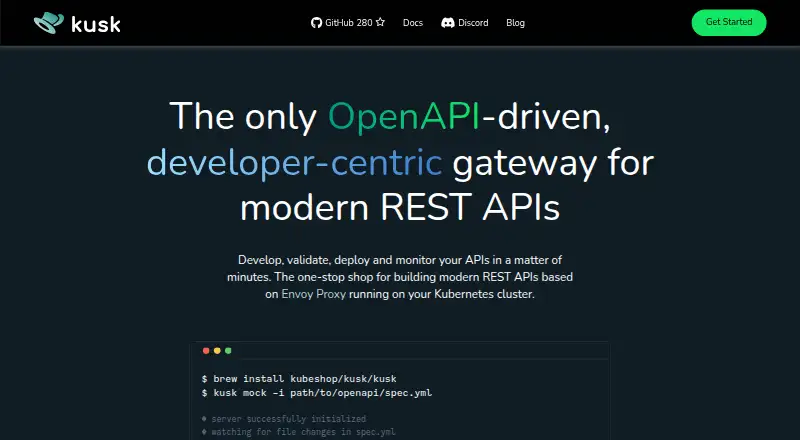
Kusk Gateway is a Kubernetes API gateway based on Envoy, with native OpenAPI support. It uses OpenAPI definitions to configure a Kubernetes cluster's Ingress Controller, making it relevant to teams using an OpenAPI-first API workflow. Kusk can mock API responses for prototyping and automatically validate requests and responses. Teams can set request timeouts and CORS without coding, and control headers, CORS, limits, and quality of service globally or for individual paths. The open-source dashboard supports central API management, including deploying APIs, editing and validating specifications, and testing APIs. The maker says an API can be published by adding an annotation to a service deployment, without extra configuration or DevOps support. Kusk Gateway is available for Mac, Linux, and Windows installations, and the project is licensed under MIT. The maker presents it for teams building REST APIs on Kubernetes. The project links to a Discord community and GitHub project. It is free and self-hosted.
Good
- Native OpenAPI support for Kubernetes ingress configuration.
- Can mock API responses before implementation.
- Automatic request and response validation.
- Dashboard supports API deployment, editing, validation, and testing.
- Free under the MIT License.
Watch out
- Designed for Kubernetes API gateway use.
- Self-hosted deployment model.
Who it suits
Kusk Gateway suits teams building REST APIs on Kubernetes that use OpenAPI-first practices. It may fit teams seeking an open-source gateway with API validation, policy controls, and a central dashboard.
Verdict
Kusk Gateway brings OpenAPI-based configuration, validation, and policy controls into a Kubernetes API workflow. Its stated audience is teams building REST APIs on Kubernetes.
Plans and prices
From Kusk Gateway's own pricing page, checked 15 Oct 2026.
| Plan | Price | What it gives you |
|---|---|---|
| Free | Free | MIT-licensed open-source gateway; self-hosted Kubernetes deployment |
| Kusk Gateway | Free | 100% open source · MIT License |
The facts
Each one read from Kusk Gateway's own pages, with the date it was checked.
What it does
- API management
- The Kusk site describes a dashboard for deploying and managing APIs, editing and validating specifications, and testing APIs.checked 5 Oct 2026
- API workflow
- Kusk uses OpenAPI definitions to configure the Ingress Controller of Kubernetes clusters.checked 5 Oct 2026
- Authentication
- Documented authentication modes include JWT, OAuth2/OIDC, custom authorization and Cloudentity.checked 15 Oct 2026
- CLI installation methods
- Installation options include Homebrew, a shell script, Debian/Ubuntu APT, Windows Chocolatey, release binaries and go install.checked 15 Oct 2026
- Community
- Kusk's documentation links to a Discord community and GitHub project.checked 5 Oct 2026
- Community support
- The project directs users to GitHub contribution workflows and a Discord community for feedback.checked 15 Oct 2026
- CORS and timeouts
- CORS, request timeouts, retries and idle timeouts can be configured through the x-kusk OpenAPI extension.checked 15 Oct 2026
- Dashboard
- The browser dashboard inspects APIs, Envoy Fleets and Static Routes and embeds Swagger UI for ad-hoc API requests.checked 15 Oct 2026
- Deployment
- Kusk says APIs can be published by adding an annotation to a service deployment, without additional configuration or DevOps support.checked 5 Oct 2026
- Development status
- The repository README says Kubeshop has paused active development and support, while still considering incoming pull requests.checked 15 Oct 2026
- Documentation depth
- Documentation includes getting-started tutorials, CLI reference, dashboard reference, Kubernetes resources, guides and a detailed OpenAPI extension reference.checked 15 Oct 2026
- Gateway components
- The installation can include Gateway Manager, Envoy Fleets, a REST API server and a dashboard.checked 15 Oct 2026
- Independent project feedback
- The GitHub issue tracker records an unassigned request for API logs and analytics, indicating a documented observability gap at that time.checked 15 Oct 2026
- Installation model
- Kusk installs into Kubernetes with Helm through the kusk cluster install command.checked 15 Oct 2026
- Intended users
- The maker presents Kusk for teams building modern REST APIs on Kubernetes and following an OpenAPI-first APIOps workflow.checked 5 Oct 2026
- Licence
- Kusk is presented as 100% open source under the MIT License.checked 15 Oct 2026
- License
- Kusk is 100% open source under the MIT License.checked 5 Oct 2026
- Limit: analytics
- A GitHub feature request asks for an API endpoint providing API logs and analytics; the issue remains open and marked for investigation.checked 15 Oct 2026
Where it runs
- CLI platforms
- The Kusk CLI is distributed for macOS, Linux and Windows.checked 15 Oct 2026
The company
- Company ownership event
- InfraCloud reported on July 7, 2022 that Kubeshop acquired a majority stake in BotKube and was backed by Insight Partners and Ratmir Timashev.checked 15 Oct 2026
- Company profile
- Crunchbase describes Kubeshop as a private Wilmington, Delaware company with 11–50 employees and Dmitry Fonarev as CEO and co-founder.checked 15 Oct 2026
- Maker headquarters
- The privacy policy gives the company address as 20 Brynwood Ln, Greenwich, Connecticut, United States.checked 15 Oct 2026
- Maker leadership
- Kubeshop lists Dmitry Fonarev as CEO, Ole Lensmar as CTO and Joon Park as CFO/CMO.checked 15 Oct 2026
- Maker legal identity
- Kubeshop operates as Kubernetes Innovation Labs LLC according to its privacy policy.checked 15 Oct 2026
The full review of Kusk Gateway
Overview
Kusk Gateway is an open-source API gateway for Kubernetes, built on Envoy and organized around OpenAPI definitions. It is aimed at teams that build REST APIs in Kubernetes and want API configuration to follow an OpenAPI-first workflow. The trade-off is a focused Kubernetes tool rather than a general-purpose gateway for teams working elsewhere.
Key features
Kusk uses OpenAPI definitions to configure a cluster’s Ingress Controller, while its dashboard supports editing and validating specifications and testing APIs. That ties API design more closely to deployment, which suits teams already using OpenAPI as the basis of their API workflow. Teams not working that way will get less from this central design choice.
Mock responses support prototyping before an API exists. Automatic request and response validation can help protect endpoints, and teams can set timeouts and CORS policies without coding them. Kusk can also change headers, CORS, limits and QoS for all traffic or individual paths; rate limiting and authentication policies are supported. This is a useful range of traffic controls, though it is presented as part of a Kubernetes ingress workflow.
The open-source dashboard provides a central place to manage APIs. Kusk says a service can be published by adding an annotation to its deployment, without further configuration or DevOps support. That could simplify the deployment path for teams already operating Kubernetes services, but the gateway’s self-hosted deployment model still makes it a poor fit for readers seeking a hosted service.
Pricing
Kusk Gateway is free: its plan costs nothing and is 100% open source under the MIT License. There is no paid tier to weigh against the free offering. Teams should choose it for its OpenAPI workflow and Kubernetes controls, not on the expectation of a managed deployment.
Platforms
Kusk is self-hosted and supports API, Linux, macOS, web and Windows platforms. The gateway’s deployment model is Kubernetes-based; the download page also says it can be installed for Mac, Linux or Windows. Its Envoy foundation is an open-source edge and service proxy for cloud-native applications.
Who it's for
Kusk is best suited to teams building REST APIs on Kubernetes and following an OpenAPI-first APIOps workflow. Those teams can use specifications to configure ingress, validate traffic, manage policies and prototype responses in one gateway. Teams that need a hosted gateway or do not build around Kubernetes should look elsewhere.
Pros and cons
- Pro: OpenAPI drives ingress configuration, with dashboard tools for editing, validating and testing specifications; this aligns gateway setup with an API-first process.
- Pro: Mocking, request and response validation, timeouts, CORS, rate limiting and authentication policies give teams several controls for protecting and shaping API traffic.
- Pro: The MIT-licensed open-source plan costs nothing.
- Con: Self-hosted Kubernetes deployment limits its appeal to teams prepared to operate that environment.
- Con: Its OpenAPI and REST focus makes it less suitable for teams seeking a broader, platform-neutral API gateway.
Alternatives
For a wider comparison of ingress options, see Kubernetes Ingress Controllers.
- ngrok is worth considering if you want a free plan with included usage, up to 3 online endpoints and up to 1GB data transfer, rather than Kusk’s Kubernetes-centered OpenAPI workflow.
- Traefik Proxy may suit teams looking for an open-source ingress controller with reverse proxy, load balancing and service auto-discovery.
- agentgateway is another free open-source gateway, deployable as a binary, Docker image or Kubernetes workload.
- HAProxy Ingress is a free alternative for Kubernetes clusters; its v0.16 release requires Kubernetes 1.21 or newer.
- Airlock Microgateway offers a free Community Edition for small environments or local development, with enforced throughput and a six-month license validity.
- Contour is a free open-source Kubernetes ingress controller with community support.
- Envoy Gateway is a free open-source project for teams considering another gateway option in the Envoy ecosystem.
- NGINX Gateway Fabric is a free open-source Kubernetes deployment with Gateway API support that varies by resource.
Verdict
Choose Kusk Gateway if your team builds REST APIs on Kubernetes and wants OpenAPI definitions to drive ingress configuration, validation and policy controls. Its strongest reason to stand out is the combination of that workflow with an MIT-licensed, free dashboard and gateway. Look elsewhere if you need a hosted service or a gateway not centered on Kubernetes.
Getting started
- Visit https://kusk.io/.
- Install Kusk Gateway for Mac, Linux, or Windows.
- Use OpenAPI definitions to configure the Kubernetes cluster's Ingress Controller.
- Use the dashboard to deploy and manage APIs, edit and validate specifications, or test APIs.
- Publish an API by adding an annotation to a service deployment.
Questions
Is Kusk Gateway free?
Yes. The Kusk Gateway plan is free.
Is Kusk Gateway open source?
Yes. It is 100% open source under the MIT License.
Which operating systems can run the installation?
Kusk Gateway can be installed for Mac, Linux, or Windows.
What does Kusk use OpenAPI for?
It uses OpenAPI definitions to configure the Ingress Controller of Kubernetes clusters.
Can Kusk mock or validate API traffic?
It can mock API responses for prototyping and automatically validate requests and responses.
Where is Kusk deployed?
Kusk Gateway is self-hosted and designed for Kubernetes API gateway use.
Alternatives to Kusk Gateway
- 1

ngrok
Free planWebAPILinuxmacOS7.8From $10 a month - 2

Higress
Free planOpen sourceWebAPILinuxmacOS7.7Free plan - 3

Traefik Proxy
Free planOpen sourceWebAPILinuxmacOS7.7Free plan - 4

agentgateway
Free planOpen sourceWebAPILinuxmacOS7.5Free plan - 5

BFE Ingress Controller
Free planOpen sourceAPILinuxmacOSSelf-hosted7.2Free plan - 6
LiteSpeed Ingress Controller
WebLinuxmacOSSelf-hosted6.6From $715 a year