Openport
Openport exposes a local TCP port to the internet through a tunnel, letting users reach a device remotely without opening firewall ports.
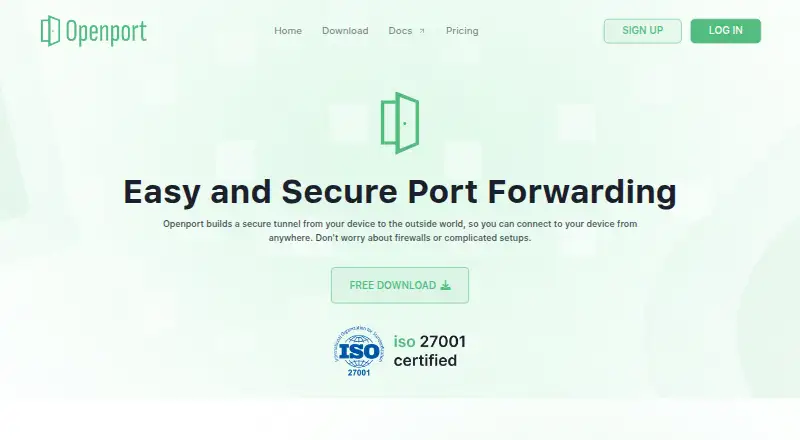
What Openport is
Openport exposes a local TCP port to the internet through a tunnel, letting users reach a device remotely without opening firewall ports. Its web service and API can show which IoT devices are online and manage a fleet, with access controlled by user groups. The service says its worldwide servers help provide lower-latency connections. For web access, the --http-forward option assigns a hostname that serves a local port over HTTP and HTTPS with a valid certificate. Custom-domain forwarding requires a CNAME record and works over HTTPS only. TLS passthrough keeps TLS termination on the user's machine, while forwarded ports use token-link protection by default; a clicked link stays valid for 24 hours. Openport also lists brute-force blocking and port-scan detection. It supports API, Linux, macOS, web, and Windows, and client 2.3.0 can forward UDP as well as TCP when the server supports it. The free plan allows one device, one connection, 10 MB transfer per month, a one-day connection timeout, and no API access.
Good
- Reach local ports without opening firewall ports.
- Manage online IoT devices through web or API.
- Supports group-based device access controls.
- Token links protect forwarded ports by default.
- Supports UDP forwarding when the server allows it.
Watch out
- Free plan allows one device and one connection.
- Free plan includes 10 MB transfer per month.
- Free plan has a one-day connection timeout.
- Custom-domain forwarding works over HTTPS only.
Who it suits
Openport suits people who need remote access to devices or want to manage IoT devices through a web service or API. Its plan options cover individual use as well as larger device fleets.
Verdict
Openport provides a tunnel-based way to reach devices remotely, with web forwarding and access controls. Check the plan limits and server support for UDP before choosing it.
Plans and prices
From Openport's own pricing page, checked 7 Oct 2026.
| Plan | Price | What it gives you |
|---|---|---|
| enterprise | $1 a month | Unlimited devices · 20 connections per device · 100000 MB transfer per month · No connection timeout · Full API access · 30 days free trial period · per month / device; a minimum of 30 devices are charged |
| home | $5 a month | 3 devices · 3 connections per device · 1000 MB transfer per month · No connection timeout · Full API access · 30 days free trial period · per month; price per year: $ 50 |
| educational | Priced on request | 100 devices · 5 connections per device · 10000 MB transfer per month · No connection timeout · Full API access · Contact Sales |
| free | — | 1 device · 1 connection per device · 10 MB transfer per month · 1 day connection timeout · No API access · per month |
The facts
Each one read from Openport's own pages, with the date it was checked.
What it does
- Access controls
- Users can manage access to devices based on user groups.checked 7 Oct 2026
- Custom domains
- A custom domain requires a CNAME record, and custom-domain forwarding is reachable over HTTPS only.checked 7 Oct 2026
- Default port protection
- Forwarded ports are protected by default by a feature that requires visitors to click a token link, and clicked links remain valid for 24 hours.checked 7 Oct 2026
- End-to-end encryption
- With TLS passthrough, TLS terminates on the user's machine so tunnelled traffic stays encrypted end-to-end.checked 7 Oct 2026
- Global servers
- Openport says it has servers around the world to let users connect with lower latency.checked 7 Oct 2026
- HTTP forwarding
- The --http-forward option gives a session a hostname serving a local port over HTTP and HTTPS with a valid certificate.checked 7 Oct 2026
- IoT management
- Openport says users can see which devices are online and manage an IoT fleet through the web or its API.checked 7 Oct 2026
- Other security measures
- Openport lists brute-force blocking and port-scanning detection among its safety measures.checked 7 Oct 2026
- Privacy
- Openport's privacy policy says it processes personal data under the GDPR and stores or transfers personal data only within the EEA.checked 7 Oct 2026
- Protocols
- Since client 2.3.0, a session can forward UDP as well as TCP on the same port when the server supports it.checked 7 Oct 2026
- Purpose
- Openport lets users expose a local TCP port to the internet without opening firewall ports.checked 7 Oct 2026
- Remote access
- The service builds a secure tunnel from a device to the outside world so it can be reached remotely.checked 7 Oct 2026
- Support
- Users can contact support through the website chat box or open a GitHub ticket.checked 7 Oct 2026
- Supported downloads
- The download page lists Windows 7/8/10/11, Mac OS X 10.8+, Debian/Ubuntu AMD64, ARM64, ARMHF, and Red Hat/Fedora/CentOS/Scientific Linux 64-bit packages.checked 7 Oct 2026
The company
- Founded
- 2014checked 28 Sep 2026
- Founded and audience
- Openport says it was founded in 2014, began as a tool for hobbyists, and is also used by large service providers to reach thousands of devices.checked 7 Oct 2026
The full review of Openport
Openport is a managed tunnelling service for reaching local devices and services remotely without opening firewall ports. It suits people who need controlled access to devices—particularly IoT fleets—through web and API tools. Its flexible access and security options are compelling, but the free plan’s 10 MB transfer allowance is too small for sustained use.
Overview
Openport creates a secure tunnel from a device to the outside world, making a local TCP port reachable remotely without changing firewall rules. That is useful for accessing devices behind restrictive networks. Fleet operators can see which devices are online and manage them through the web interface or API, and user groups let them control access. Servers around the world are intended to reduce latency, although that does not guarantee a particular connection speed.
HTTP forwarding can assign a session a hostname that serves a local port over HTTP and HTTPS with a valid certificate. Custom-domain forwarding requires a CNAME record and works over HTTPS only. TLS passthrough keeps TLS termination on the user’s machine, so tunnelled traffic remains encrypted end-to-end. Forwarded ports require visitors to click a token link by default; each clicked link remains valid for 24 hours. Brute-force blocking and port-scanning detection provide additional safeguards.
Openport forwards TCP and, since client 2.3.0, can forward UDP on the same port when the server supports it. WebSocket support adds another option for applications that use persistent web connections. The service’s privacy policy says personal data is processed under the GDPR and stored or transferred only within the EEA. Support is available through the website chat box or a GitHub ticket.
Key features
- Remote tunnels: Reach a local port over the internet without opening firewall ports, a practical advantage for devices on networks that are difficult to configure.
- Fleet visibility and access: Web and API management can show which devices are online, while user groups help limit who can reach them. API access depends on the plan.
- Web forwarding: HTTP forwarding supplies a hostname and valid certificate. Custom domains add a CNAME setup requirement and are HTTPS-only.
- Encryption and port protection: TLS passthrough keeps TLS termination at the user’s machine; token links, brute-force blocking and port-scanning detection provide further controls.
- Protocol flexibility: TCP is the core use case; UDP forwarding depends on both client version 2.3.0 or later and server support.
Pricing
Openport uses a freemium model, with a free plan, a 30-day trial on the Home and Enterprise plans, and paid plans from $1 a month. The limits on devices, connections and monthly transfer matter more than the entry price for anyone using it regularly.
| Plan | Price and terms | What it includes |
|---|---|---|
| Free | Custom pricing | 1 device, 1 connection, 10 MB transfer per month, a 1-day connection timeout and no API access. |
| Home | $5 a month, billed monthly; price per year: $ 50 | 3 devices, 3 connections per device, 1000 MB transfer per month, no connection timeout, full API access and a 30-day free trial. |
| Enterprise | $1 a month, billed per month / device; minimum charge of 30 devices | Unlimited devices, 20 connections per device, 100000 MB transfer per month, no connection timeout, full API access and a 30-day free trial. |
| Educational | Custom pricing | 100 devices, 5 connections per device, 10000 MB transfer per month, no connection timeout and full API access. |
The Free plan is suitable for a small, occasional connection, but 10 MB per month, one connection and no API access make it a poor fit for ongoing device management. Home is the more realistic option for an individual or small household: it raises the transfer allowance to 1000 MB and adds API access, though it still covers only three devices. Its listed annual price is $ 50. Enterprise’s per-device price looks low, but the minimum 30-device charge makes it a team-scale commitment rather than a cheap upgrade for one user. Educational provides more capacity for institutions, with custom pricing.
Platforms
Openport supports API, Linux, macOS, web and Windows. Downloads cover Windows 7/8/10/11, Mac OS X 10.8+, Debian/Ubuntu packages for AMD64, ARM64 and ARMHF, and 64-bit Red Hat, Fedora, CentOS and Scientific Linux. The managed deployment model avoids requiring users to host the service themselves; configuration supports both available methods.
Who it's for
Openport is a strong fit for people who need remote access to local services without opening firewall ports, and for operators who need visibility and group-based access across an IoT fleet. Home makes sense for a small setup that needs several devices and API access. The Enterprise minimum and larger quotas are aimed at deployments managing many devices. It is less suitable for sustained use on a free account or for a single device owner who would have to pay for the Enterprise minimum to get its per-device rate.
Pros and cons
- Pro: Secure tunnels expose local ports without opening firewall ports, reducing setup friction for remote access.
- Pro: Group-based access, online-device visibility and API management support organized fleet administration on eligible plans.
- Pro: TLS passthrough, token-link protection, brute-force blocking and port-scanning detection give operators several distinct security controls.
- Pro: Home and Enterprise remove connection timeouts and include full API access, with a 30-day trial on both.
- Con: The free plan’s 10 MB monthly transfer and 1-day timeout severely constrain regular use, and it has no API access.
- Con: UDP forwarding is conditional on server support, so it is not a dependable choice where UDP is essential unless that support is confirmed.
- Con: Enterprise requires charges for at least 30 devices, making its $1 a month per-device rate inaccessible as a small-scale option.
- Con: Custom-domain forwarding requires DNS configuration and is HTTPS-only.
Alternatives
Consider Reverse Proxy Software if you want to compare more tools in the category.
- ngrok is worth considering for a freemium tunnel option with a free allowance of up to three online endpoints and 1 GB of transfer, rather than Openport’s free plan’s single device and 10 MB cap.
- freenginx is a free option for readers seeking software whose sources and documentation are distributed under a 2-clause BSD-like license.
- frp is a free, open-source reverse proxy with self-hosted client and server binaries for readers who want to host both ends themselves.
- LocalXpose offers a free Starter plan with two active HTTP/HTTPS tunnels, SSL/TLS encryption and unique subdomains, with time limits and an interstitial warning page.
- Pomerium may suit readers comparing access controls: its free Personal plan includes 10 users, 10 routes, five policies and two service accounts.
- Fabio is a free, MIT-licensed option for users who need Consul for service discovery.
- NGINX is a free choice for readers seeking a web server with reverse proxy, content cache, load balancer, TCP/UDP proxy and mail proxy roles.
- Traefik Proxy is a free open-source option with ingress-controller, reverse-proxy, load-balancer and service auto-discovery roles.
Verdict
Choose Openport if you need secure remote reach to local devices without opening firewall ports, especially when fleet visibility, group controls or API management matter. Its strongest case is the combination of tunnelling and device administration, with meaningful security controls. Look elsewhere if you need substantial free transfer, guaranteed UDP support, or an Enterprise-scale rate without committing to at least 30 devices.
Getting started
- Visit https://openport.io/
- Choose the free plan or review the home, enterprise, and educational plans
- Use the client on Linux, macOS, or Windows, or access the web service or API
- For custom-domain forwarding, configure a CNAME record and use HTTPS
Limits worth knowing
The free plan includes one device, one connection, 10 MB transfer per month, a one-day connection timeout, and no API access. The home plan includes three devices, three connections per device, 1,000 MB transfer per month, and no connection timeout.
Questions
Is Openport free?
Yes. The free plan includes one device, one connection, 10 MB transfer per month, and a one-day connection timeout.
How much do the paid plans cost?
The home plan costs $5.00 per month, or $50 per year. Enterprise costs $1.00 per month per device, billed monthly, with a minimum charge for 30 devices.
What platforms does Openport support?
Openport supports API, Linux, macOS, web, and Windows. Its download page lists Windows 7/8/10/11, Mac OS X 10.8+, Debian/Ubuntu packages, and packages for Red Hat-based distributions.
Can Openport forward UDP?
Since client 2.3.0, a session can forward UDP as well as TCP on the same port when the server supports it.
Does Openport offer a free trial?
Yes. The listed paid plans include a 30-day free trial period.
Who makes Openport, and where is personal data handled?
Openport says it was founded in 2014. Its privacy policy says personal data is processed under the GDPR and stored or transferred only within the EEA.
Alternatives to Openport
- 1

Pomerium
Free planOpen sourceWebAPILinuxmacOS8.3From $7 a month - 2

ngrok
Free planWebAPILinuxmacOS7.8From $10 a month - 3

Traefik Proxy
Free planOpen sourceWebAPILinuxmacOS7.7Free plan - 4
HAProxy Community Edition
Free planOpen sourceAPILinuxmacOSSelf-hosted7.4Free plan - 5

Apache Traffic Server
Free planOpen sourceAPILinuxmacOSSelf-hosted7.2Free plan - 6
PageKite
AndroidWebAPILinux7.0From $3 a month