freenginx
freenginx is a free, open-development project for nginx server software used as an HTTP server and as an HTTP, mail, TCP, and UDP proxy.
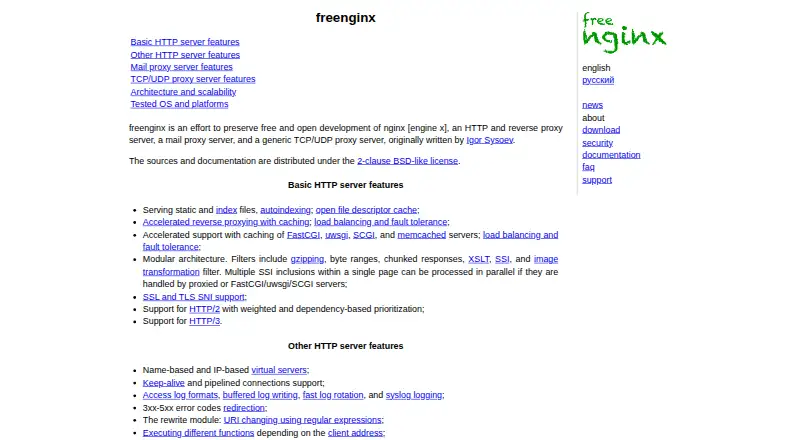
What freenginx is
freenginx is a free, open-development project for nginx server software used as an HTTP server and as an HTTP, mail, TCP, and UDP proxy. Its HTTP functions include serving static files, reverse proxying with caching, load balancing, and fault tolerance. It supports SSL/TLS SNI, HTTP/2, HTTP/3, and access controls based on client IP, HTTP Basic authentication, or a subrequest result. It can connect with caching and acceleration to FastCGI, uwsgi, SCGI, and memcached servers. Mail proxy support covers IMAP, POP3, and SMTP authentication, along with SSL and STARTTLS/STLS. Generic TCP and UDP proxying includes load balancing, fault tolerance, and client-address controls; TCP also supports SSL and TLS SNI. The process model pairs one master with several workers running as an unprivileged user. Configuration can be reloaded and the executable upgraded while client service continues. Source code and documentation use a 2-clause BSD-like license. It is self-hosted, with file-based configuration, TLS termination, response caching, WebSocket support, and rate limiting. The free plan is free.
Good
- Free plan: free.
- Supports HTTP/2 and HTTP/3.
- Offers HTTP caching and load balancing.
- Can reload configuration without interrupting service.
- Source and documentation use a 2-clause BSD-like license.
Watch out
- Self-hosted deployment is required.
- Mailing-list posting requires subscribing first.
- Windows builds are offered alongside Linux and macOS support.
Who it suits
It suits operators seeking self-hosted HTTP, mail, or TCP/UDP proxy software with a free plan. Its support is through mailing lists, and posting requires subscribing an email address first.
Verdict
freenginx combines HTTP serving and proxying with mail and generic TCP/UDP proxy functions. Its self-hosted deployment and mailing-list support are important considerations.
Plans and prices
From freenginx's own pricing page, checked 4 Oct 2026.
| Plan | Price | What it gives you |
|---|---|---|
| freenginx | Free | Sources and documentation distributed under a 2-clause BSD-like license |
The facts
Each one read from freenginx's own pages, with the date it was checked.
What it does
- Access control
- HTTP access control can be based on client IP address, password using HTTP Basic authentication, or the result of a subrequest.checked 4 Oct 2026
- Architecture
- It uses one master process and several worker processes, which run under an unprivileged user.checked 3 Oct 2026
- Backend integrations
- It supports cached and accelerated connections to FastCGI, uwsgi, SCGI, and memcached servers.checked 3 Oct 2026
- Current release
- The news page lists freenginx 1.31.4 as the mainline release announced on 2026-09-01.checked 3 Oct 2026
- Development
- The project uses Mercurial to store source code and directs proposed changes to the nginx development mailing list.checked 4 Oct 2026
- Downloads
- The download page lists mainline version 1.31.4 and stable version 1.30.1, with Windows builds and PGP links.checked 4 Oct 2026
- HTTP features
- It supports static files, cached reverse proxying, load balancing, and FastCGI, uwsgi, SCGI, and memcached servers.checked 4 Oct 2026
- License
- The source code and documentation are distributed under a 2-clause BSD-like license.checked 4 Oct 2026
- Mail proxy
- Its mail proxy supports IMAP, POP3, and SMTP authentication, plus SSL, STARTTLS, and STLS.checked 4 Oct 2026
- Operations
- It supports reconfiguration and executable upgrades without interrupting client servicing.checked 3 Oct 2026
- Performance
- The site says 10,000 inactive HTTP keep-alive connections use about 2.5M of memory and data copy operations are kept to a minimum.checked 4 Oct 2026
- Process model
- The architecture uses one master and several worker processes, with workers running under an unprivileged user.checked 4 Oct 2026
- Protocols
- The HTTP server supports SSL/TLS SNI, HTTP/2, and HTTP/3.checked 3 Oct 2026
- Purpose
- freenginx is an effort to preserve free and open development of nginx, an HTTP and reverse proxy server, mail proxy server, and generic TCP/UDP proxy server.checked 4 Oct 2026
- Resource use
- The site states that 10,000 inactive HTTP keep-alive connections take about 2.5M memory.checked 3 Oct 2026
- Security reporting
- The security page directs reports to [email protected] and says patches are signed using one of its PGP public keys.checked 4 Oct 2026
- Support
- Support is offered through English and Russian mailing lists; posting requires subscribing the email address used to post.checked 4 Oct 2026
- TCP and UDP
- It provides generic TCP and UDP proxying, including TCP SSL and TLS SNI support, load balancing, and fault tolerance.checked 4 Oct 2026
- TCP/UDP proxy
- The product provides generic TCP and UDP proxying, with load balancing, fault tolerance, and client-address access control.checked 3 Oct 2026
- Upgrades
- Configuration can be reloaded and an executable upgraded without interrupting client servicing.checked 4 Oct 2026
- Web protocols
- The HTTP server supports SSL and TLS SNI, HTTP/2, and HTTP/3.checked 4 Oct 2026
Where it runs
- Platforms
- The site lists tested Linux, macOS, and Windows platforms, along with FreeBSD, Solaris, AIX, and HP-UX.checked 3 Oct 2026
The full review of freenginx
Overview
freenginx is a free server and proxy for web traffic, mail, and general TCP/UDP connections. It suits administrators who want to run and configure infrastructure themselves. Its range of proxying and serving roles is a strong point; the trade-off is that deployment and support remain operator responsibilities.
Key features
For HTTP, freenginx serves static files and handles reverse proxying with caching, load balancing, and fault tolerance. HTTP/2, HTTP/3, SSL/TLS SNI, WebSockets, and TLS termination cover a broad set of web delivery needs. Access controls can use client IP addresses, HTTP Basic authentication, or a subrequest result, giving administrators more than one way to restrict requests.
It also caches and accelerates connections to FastCGI, uwsgi, SCGI, and memcached servers. That makes it a natural fit for deployments already using those backends, though its file-based configuration favors people comfortable managing server settings directly.
The mail proxy supports IMAP, POP3, and SMTP authentication methods, as well as SSL and STARTTLS/STLS. Generic TCP and UDP proxying adds load balancing, fault tolerance, and client-address access control; TCP also supports SSL and TLS SNI. This breadth can consolidate several proxying jobs in one tool, but users seeking a managed service should look elsewhere.
Its process model uses one master and multiple workers that run as an unprivileged user. Configuration reloads and executable upgrades can happen without interrupting client servicing, which is useful for maintaining a live service. The project says 10,000 inactive HTTP keep-alive connections use about 2.5M of memory and that data-copy operations are kept to a minimum.
The source code and documentation are distributed under a 2-clause BSD-like license. Downloads include mainline and stable versions, Windows builds, and source through Mercurial repositories and a GitHub mirror. Security issues can be reported by email, and patches are signed using one of the project's PGP public keys. Support is through mailing lists, where posting requires subscribing an email address first; that is a less direct route than support built into a hosted product.
Pricing
freenginx is free: the freenginx plan costs nothing and includes the sources and documentation under a 2-clause BSD-like license. There is no paid tier to add managed hosting or another support channel, so the value depends on having the skills and infrastructure to operate it yourself.
Platforms
freenginx supports Linux, macOS, Windows, and self-hosted deployment. The self-hosted model gives operators control over where it runs, but they are responsible for operating that environment.
Who it's for
Choose freenginx if you need a self-hosted component that can serve HTTP, proxy web and mail traffic, and handle generic TCP/UDP connections. It is especially well suited to administrators who value broad protocol support, file-based configuration, and uninterrupted reloads or upgrades. It is a poor fit for readers who want a hosted proxy or a support experience that does not depend on mailing lists.
Pros and cons
- Broad proxy coverage: HTTP, mail, and generic TCP/UDP functions can serve several infrastructure roles.
- Flexible HTTP delivery: Caching, load balancing, fault tolerance, access control, and support for HTTP/2 and HTTP/3 address varied serving needs.
- Maintenance without service interruption: Configuration reloads and executable upgrades do not interrupt client servicing.
- Self-management required: Users must deploy and configure the software themselves rather than rely on hosted operations.
- Mailing-list support: Posting requires email subscription, which may be inconvenient for users who prefer direct support.
Alternatives
Browse reverse proxy software for a wider comparison of tools in this category.
- NGINX is the closest alternative: its free open-source plan includes an HTTP web server, reverse proxy, content cache, load balancer, and TCP/UDP and mail proxying.
- Traefik Proxy is a free choice when an ingress controller and service auto-discovery are priorities alongside reverse proxying and load balancing.
- Envoy Proxy is another free open-source proxy, with installation options including Docker, macOS Homebrew, or a static binary.
- ngrok suits readers who prefer a free plan with online endpoint and data-transfer allowances rather than freenginx's self-hosted server model.
- LocalXpose offers a free starter plan for two active HTTP or HTTPS tunnels, with SSL/TLS encryption, unique subdomains, time limits, and an interstitial warning page.
- Pomerium is worth considering when a free plan with user, route, policy, and service-account quotas suits the deployment better.
- Caddy is another option.
Verdict
freenginx is a strong choice for operators who want a free, self-hosted tool spanning HTTP, mail, and TCP/UDP proxying, particularly when uninterrupted reloads and upgrades matter. Its main limitation is the operational burden: if you want hosted deployment or support beyond subscription-based mailing lists, choose another approach.
Alternatives to freenginx
- 1

Pomerium
Free planOpen sourceWebAPILinuxmacOS8.3From $7 a month - 2

ngrok
Free planWebAPILinuxmacOS7.8From $10 a month - 3

Traefik Proxy
Free planOpen sourceWebAPILinuxmacOS7.7Free plan - 4
HAProxy Community Edition
Free planOpen sourceAPILinuxmacOSSelf-hosted7.4Free plan - 5

Apache Traffic Server
Free planOpen sourceAPILinuxmacOSSelf-hosted7.2Free plan - 6
Openport
Free planWebAPILinuxmacOS7.1From $1 a month