TotalAR
TotalAR helps organizations link printed materials to augmented-reality content.
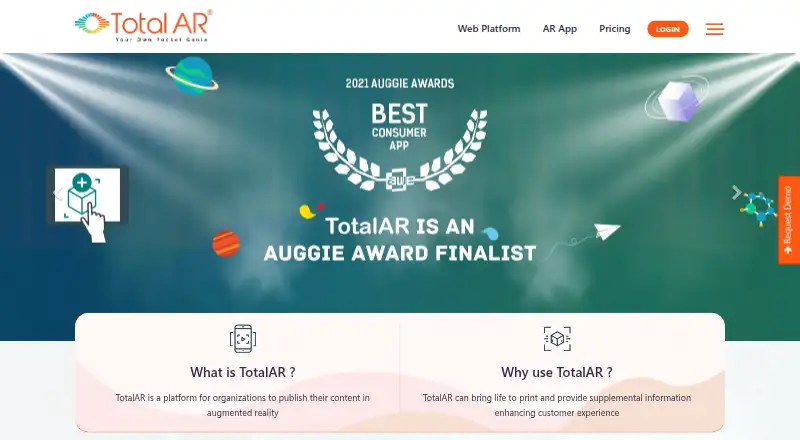
What TotalAR is
TotalAR helps organizations link printed materials to augmented-reality content. Users scan a printed image or TAR code with the app to display associated videos, website URLs, contact details, 2D or 3D animation, or feedback and survey forms. Experiences can use marker-based tracking or be based on location. The platform reports how many customers viewed or interacted with campaign content, accepts YouTube video links, and offers an API for integrating its AR Bot into an existing mobile app. It supports iOS and Android phones and tablets, and requires an internet connection over Wi-Fi or mobile data. The consumer app is described as a free download, though brands may charge users for content. Basic Free allows five TAR codes and 100 scans per month. Pro costs $90 a month, billed annually, and includes 100 TAR codes and 1,000 scans per month. TotalAR does not accept duplicate target images.
Good
- Scans printed images or TAR codes to show AR content
- Supports marker-based and location-based experiences
- Campaign analytics report views and interactions
- Free plan includes five TAR codes and 100 monthly scans
Watch out
- An internet connection is required
- Duplicate target images are not accepted
- Basic Free is limited to 100 scans per month
- Pro costs $90 a month, billed annually
Who it suits
TotalAR may suit publishers, educators, retailers, manufacturers, and other organizations connecting print materials with digital content. Its API option may interest teams integrating AR Bot into an existing mobile app.
Verdict
TotalAR is centered on turning print into mobile AR experiences, with campaign analytics and an API option. Check scan limits and duplicate-image restrictions against your campaign needs.
Plans and prices
From TotalAR's own pricing page, checked 2 Oct 2026.
| Plan | Price | What it gives you |
|---|---|---|
| Basic Free | Free | 5 TAR codes · 100 scans/month · 1 admin · 10 MB max 3D model · limited media library · business-hours support |
| Pro | $90 a month | 100 TAR codes · 1,000 scans/month · $0.05 per additional scan · 3 admins · 25 MB max 3D model · 5 GeoAR · 24/7 support · Billed Annually |
| Enterprise | $250 a month | Starting price · 1,000 TAR codes and 5,000 scans/month, subject to selected plan · $0.03 per additional scan · unlimited admins · 150 MB max 3D model · 25 GeoAR · 24/7 support · Billed Annually |
The facts
Each one read from TotalAR's own pages, with the date it was checked.
What it does
- API integration
- TotalAR says its AR Bot can be integrated into an existing mobile app through an API, with technical support from its team.checked 2 Oct 2026
- AR content
- The app can display videos, website URLs, contact details, 2D or 3D animation, and feedback or survey forms.checked 2 Oct 2026
- AR modes
- The app describes Geo AR experiences based on location and marker-based AR anchored to the real world.checked 2 Oct 2026
- Campaign analytics
- TotalAR says it provides granular analytics on how many customers viewed or interacted with campaign content.checked 2 Oct 2026
- Duplicate targets
- The platform does not accept duplicate target images.checked 2 Oct 2026
- Purpose
- TotalAR is a platform for organizations to publish content in augmented reality and connect print materials with digital content.checked 2 Oct 2026
- Scanning
- Users scan a printed image or TAR code with the app to view its associated content in AR.checked 2 Oct 2026
- Security
- The company describes its server service as secure and says content access is restricted by account credentials.checked 2 Oct 2026
- Support
- The pricing page lists business-hours support for Basic and 24/7 support for Pro and Enterprise; custom training is available on paid plans.checked 2 Oct 2026
- Supported audiences
- The site names publishers, educators, retailers, print media, advertising agencies, manufacturers, infrastructure, real estate, public sector, and construction as audiences.checked 2 Oct 2026
- YouTube
- The platform accepts YouTube video links as campaign content.checked 2 Oct 2026
Money
- Free app
- The consumer TotalAR app is described as a free download, though brands may charge users for content.checked 2 Oct 2026
The company
- Headquarters
- Dublin, Ohio, USAchecked 28 Sep 2026
Where it runs
- Platform limits
- The app supports iOS and Android smartphones and tablets, and requires an internet connection over Wi-Fi or mobile data.checked 2 Oct 2026
The full review of TotalAR
TotalAR is a print-to-mobile augmented-reality platform for organizations that want campaigns, publications, or information materials to launch digital experiences. It suits publishers, educators, retailers, agencies, and other teams already distributing printed material, particularly when location-based AR or campaign measurement matters. The free tier is a practical pilot, but recurring scan limits and annual billing make plan selection important for larger campaigns.
Overview
A reader scans a printed image or TAR code in the TotalAR app and is taken to associated augmented-reality content. Supported outputs include video, website URLs, contact details, 2D or 3D animation, and feedback or survey forms. YouTube links are accepted, so an organization can use existing hosted video rather than build a separate delivery system.
TotalAR offers marker-based AR anchored to the physical world and Geo AR experiences tied to location. That combination covers both image-triggered print campaigns and place-specific content. Campaign analytics report how many customers viewed or interacted with content, giving marketers and publishers an engagement signal rather than only a scan mechanism. Target images must be unique; duplicate images are not accepted, which can complicate campaigns that reuse the same artwork across editions or locations.
Key features
Print-triggered content
The scan workflow turns a poster, page, package, or other printed image into an entry point for mixed media. Video and web links work for promotion, contact details and forms suit lead collection or service information, and 2D or 3D animation can add a more visual layer. This breadth is useful when one campaign needs several content types, although every audience member needs the TotalAR app and an internet connection over Wi-Fi or mobile data.
Geo AR and marker tracking
Marker-based tracking keeps experiences tied to a recognizable printed target, while Geo AR supports experiences based on where the user is. The latter is relevant to property, infrastructure, retail, public-sector, and event-style deployments where place is part of the message. Geo AR allocations are plan-dependent, so teams with many locations should check the allowance before choosing a tier.
Analytics and API option
Granular campaign reporting on views and interactions is a meaningful advantage over a static QR-style handoff when a team must show engagement. TotalAR also offers an AR Bot API for integration into an existing mobile app, with technical support from its team. That option is better suited to organizations that need AR inside their own application than to a small campaign seeking the quickest standalone launch.
Access and security
TotalAR describes its server service as secure and restricts content access through account credentials. Paid plans include business-hours support on Basic and 24/7 support on Pro and Enterprise, with custom training available on paid plans.
Pricing
TotalAR uses a freemium model. The consumer app is a free download, although a brand may charge users for its content. For publishers and campaign owners, the Basic Free plan costs nothing and includes five TAR codes, 100 scans per month, one admin, a 10 MB maximum 3D model, a limited media library, and business-hours support. It is suitable for a small proof of concept or low-volume publication, but 100 monthly scans and one administrator leave little room for a broad public campaign.
Pro costs $90 a month, billed annually. It raises capacity to 100 TAR codes and 1,000 scans per month, charges $0.05 per additional scan, allows three admins, accepts 25 MB 3D models, and includes five GeoAR experiences plus 24/7 support. This is the sensible tier for a small or mid-sized campaign that needs predictable collaboration and location features, provided annual commitment is acceptable.
Enterprise starts at $250 a month, billed annually. It includes 1,000 TAR codes and 5,000 scans per month subject to the selected plan, $0.03 per additional scan, unlimited admins, 150 MB 3D models, 25 GeoAR experiences, and 24/7 support. It fits larger organizations with multiple teams, heavier media, or many locations. Extra-scan charges mean high-traffic campaigns should budget beyond the subscription.
Platforms
TotalAR publishes to iOS and Android and supports Android, iOS, web, and API components. It is not a WebAR publishing platform, so the experience depends on the mobile app rather than running directly in a browser. Smartphones and tablets require an internet connection over Wi-Fi or mobile data.
Who it's for
The platform is aimed at publishers, educators, retailers, print media, advertising agencies, manufacturers, infrastructure, real estate, public-sector organizations, and construction. It is a strong fit when printed material is central, engagement needs measurement, or Geo AR and app integration justify a dedicated platform. It is less suitable for campaigns that require browser-only access, duplicate target artwork, or uncapped low-cost reach.
Pros and cons
- Pros: supports video, links, contact details, animation, and forms from one print trigger.
- Pros: combines marker tracking with Geo AR and reports views and interactions.
- Pros: API integration can bring AR into an existing mobile app.
- Cons: users need the app and an internet connection; publishing is not WebAR.
- Cons: duplicate target images are prohibited.
- Cons: free capacity is narrow, while paid plans bill annually and charge for scans above quota.
Alternatives
MyWebAR is the better comparison for teams wanting a broader cross-platform footprint and a free Creator plan with 100 views per year, 100 MB storage, and five projects.
Choose MAKAR if a free plan with two projects, 10 MB cloud storage, 3,000 target scans, and watermarking is a closer match; its free tier has no analytics and no WebAR or WebVR.
8th Wall is an option for teams evaluating a free, web-oriented platform, though its hosted platform is retired and native export is coming.
BlippBuilder suits projects that can start free for creation and testing but can accept that publishing requires a paid plan.
WorldCAST is worth considering for unlimited monthly views, no expiry, QR generation, and basic analytics on its free Creator plan.
AR.js Studio is a free, open-source authoring platform for web projects.
Elysium is a free option centered on private and public spatial scenes, with one private world and 10 GB asset storage on its Personal plan.
WorkLink Create is an alternative for organizations seeking a wider multi-platform and self-hosted deployment range.
See the broader Augmented Reality Software category for more options.
Verdict
TotalAR is a good choice for organizations extending print campaigns into measured mobile AR, especially when marker tracking, Geo AR, or an API connection is important. Its free plan lowers the entry barrier, but app dependence, unique-image requirements, annual paid billing, and scan quotas are decisive drawbacks. Choose it when those constraints fit the campaign; look elsewhere when browser access or unrestricted, high-volume scanning is the priority.
Alternatives to TotalAR
- 1

MyWebAR
Free planAndroidiOSWebAPI8.1From $39 a month - 2
MAKAR
Free planAndroidiOSWebAPI8.0From $245 a month - 3
WorldCAST
Free planAndroidiOSWeb7.3From $10 a month - 4
Zapworks Studio
AndroidiOSmacOSWindows7.1From $64.99 a year - 5

Augment
AndroidiOSWebAPI7.0From $42 a month - 6
TeamViewer Frontline
AndroidiOSWebAPI7.0