Tidal LightMesh
Tidal LightMesh is cloud-first IP address management software for discovering, planning, and governing address data across cloud environments, DHCP, and impo…
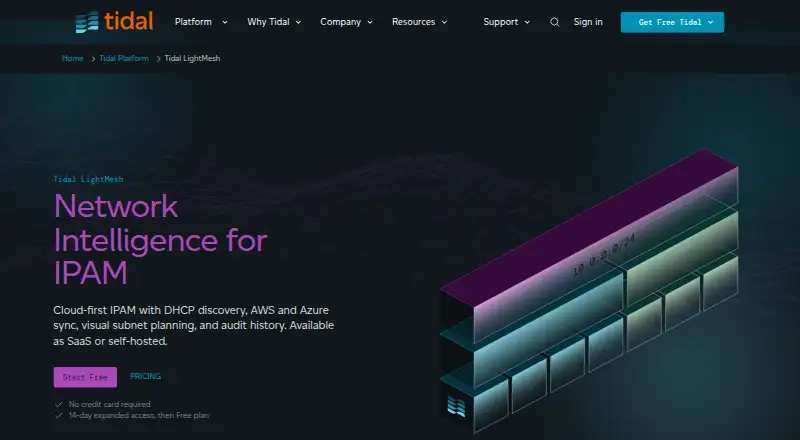
What Tidal LightMesh is
Tidal LightMesh is cloud-first IP address management software for discovering, planning, and governing address data across cloud environments, DHCP, and imports. Its read-only Windows Discovery Agent brings Microsoft DHCP scopes, leases, hostnames, and history into a searchable view. Agentless integrations find AWS VPCs and Azure VNets, subnets, and assignments. Inventory sync is on demand on Free, hourly on Pro and Team, and every five minutes on Enterprise. TreeView and Network Containers show planned and live networks together, support grouping, and help identify overlapping ranges. Subnet Builder visually divides a parent subnet into address sizes for cloud and data center plans. SaaS is available on every plan; Docker self-hosting on Ubuntu LTS, AWS, or Azure is limited to Enterprise. LightMesh supports API access, subnet planning, DNS and DHCP management, and IPv6. A 14-day trial is listed. Google Cloud support is not currently available.
Good
- Discovers Microsoft DHCP data in a searchable view.
- Finds AWS and Azure network assignments.
- Shows planned and live networks together.
- Includes subnet planning and API access.
Watch out
- Free allows one user and fewer than 1,000 IPs.
- Google Cloud support is not currently available.
- Docker self-hosting is limited to Enterprise.
Who it suits
LightMesh suits teams organizing IP address data across cloud, DHCP, and imported sources. Its Free plan is for a single user managing fewer than 1,000 IPs, while Enterprise lists unlimited users and IPs.
Verdict
LightMesh brings discovery and address planning into a single IPAM service, with SaaS across plans and self-hosting on Enterprise. Consider the user and IP limits, sync cadence, and deployment needs when selecting a plan.
Plans and prices
From Tidal LightMesh's own pricing page, checked 30 Sep 2026.
| Plan | Price | What it gives you |
|---|---|---|
| Free | Free | 1 user · <1,000 IPs · unlimited subnets · basic IPAM · DHCP discovery |
| Pro (monthly) | $35 a month | 1 user · <1,000 IPs · unlimited subnets · DHCP discovery · $35 USD /month |
| Team (monthly) | $249 a month | 5 users · <5,000 IPs · unlimited subnets · DHCP discovery · $249 USD /month |
| Pro (annual) | $385 a year | 1 user · <1,000 IPs · unlimited subnets · DHCP discovery · $385 USD /year |
| Team (annual) | $2,739 a year | 5 users · <5,000 IPs · unlimited subnets · DHCP discovery · $2,739 USD /year |
| Enterprise | Priced on request | Unlimited users and IPs · unlimited subnets · on-premise hosting · priority support · DHCP discovery · Custom |
The facts
Each one read from Tidal LightMesh's own pages, with the date it was checked.
What it does
- API
- The plan comparison lists API rates of 10 requests per second on Free and Pro, 25 on Team, and unlimited on Enterprise.checked 30 Sep 2026
- Audit history
- LightMesh traces changes per record and retains audit logs for 7 days on Free and Pro and 30 days on Team; Enterprise retention is listed as included.checked 30 Sep 2026
- Authentication
- LightMesh documentation lists Okta SSO, Google, Microsoft, and email-and-password sign-in methods.checked 30 Sep 2026
- Cloud integrations
- Read-only, agentless integrations discover AWS VPCs and Azure VNets, subnets, and assignments.checked 30 Sep 2026
- Cloud sync cadence
- AWS and Azure inventory syncs every five minutes on Enterprise and hourly on Pro and Team; Free sync is listed as on demand in the plan comparison.checked 30 Sep 2026
- Deployment
- LightMesh is offered as SaaS on any plan, while Docker self-hosting on Ubuntu LTS, AWS, or Azure is available for Enterprise.checked 30 Sep 2026
- DHCP discovery
- A read-only Windows Discovery Agent brings Microsoft DHCP scopes, leases, hostnames, and history into a searchable view.checked 30 Sep 2026
- Google Cloud
- Google Cloud support is on the future roadmap and is not currently available.checked 30 Sep 2026
- Intended users
- The Free plan allows one user and fewer than 1,000 IPs, while Enterprise lists unlimited users and IPs and includes RBAC and custom SAML.checked 30 Sep 2026
- Purpose
- LightMesh is cloud-first IP address management software for discovering, planning, and governing address data across cloud, DHCP, and imports.checked 30 Sep 2026
- Security
- Tidal says it completed a SOC 2 Type II audit and uses AES-256 encryption at rest and TLS v1.2 in transit.checked 30 Sep 2026
- Subnet Builder
- The Subnet Builder lets users visually divide a parent subnet into address sizes for cloud and data center plans.checked 30 Sep 2026
- Support
- Plan support ranges from best-effort email on Free and Pro to 8-hour email support on Team and email, phone, and Slack on Enterprise.checked 30 Sep 2026
The company
- Founded
- 2016checked 28 Sep 2026
- Headquarters
- Toronto, Ontario, Canadachecked 28 Sep 2026
Money
- Planning
- TreeView and Network Containers show planned and live networks together, help detect overlapping ranges, and group address space.checked 30 Sep 2026
The full review of Tidal LightMesh
Overview
Tidal LightMesh is IP address management software for teams that need to discover and plan address space across Microsoft DHCP, AWS, and Azure. Its strongest fit is an organization combining cloud inventory with network planning; its main drawback is that the affordable plans restrict both users and managed IPs.
LightMesh is cloud-first, with SaaS on every plan and Docker self-hosting reserved for Enterprise. It brings discovery, subnet planning, and address governance together, but organizations using Google Cloud will need another approach for that environment.
Key features
A read-only Windows Discovery Agent makes Microsoft DHCP scopes, leases, hostnames, and history searchable. AWS and Azure discovery is read-only and agentless, covering VPCs or VNets, subnets, and assignments. That combination suits teams that want visibility without making LightMesh the system that changes those environments.
Cloud inventory freshness depends on the plan: AWS and Azure sync every five minutes on Enterprise and hourly on Pro and Team, while Free syncs on demand. The Free cadence is a meaningful compromise for anyone relying on current cloud assignments. Google Cloud support is planned but not currently available.
TreeView and Network Containers bring planned and live networks together, helping teams identify overlapping ranges and group address space. The visual Subnet Builder divides a parent subnet into address sizes for cloud and data center plans. These tools make LightMesh useful before allocation as well as for tracking existing address data; they are less compelling if discovery alone is the priority.
LightMesh records changes per record. Audit history lasts 7 days on Free and Pro, 30 days on Team, and is included on Enterprise. Tidal says it completed a SOC 2 Type II audit and uses AES-256 encryption at rest and TLS v1.2 in transit. API rates are 10 requests per second on Free and Pro, 25 on Team, and unlimited on Enterprise, so integrations with heavier request needs point toward the top tier.
Authentication options include Okta SSO, Google, Microsoft, and email-and-password sign-in. Enterprise adds RBAC and custom SAML, while support rises from best-effort email on Free and Pro to 8-hour email support on Team and email, phone, and Slack on Enterprise.
Pricing
The Free plan costs nothing and allows one user, fewer than 1,000 IPs, unlimited subnets, basic IPAM, and DHCP discovery. Its on-demand cloud sync and 7-day audit retention make it a sensible solo evaluation tier, not a dependable shared inventory for teams that need regular updates.
Pro costs $35 a month (billed $35 USD /month) or $385 a year (billed $385 USD /year). Both versions allow one user, fewer than 1,000 IPs, unlimited subnets, and DHCP discovery. Pro raises the Free plan's basic IPAM positioning to a paid tier, but does not expand the seat or IP ceiling; hourly cloud sync and 7-day audit retention remain limiting for larger or more time-sensitive operations.
Team costs $249 a month (billed $249 USD /month) or $2,739 a year (billed $2,739 USD /year). It supports five users and fewer than 5,000 IPs, with unlimited subnets and DHCP discovery. For a small group, the added seats and capacity are more relevant than Pro's single-user structure, along with 30-day audit retention and hourly sync. API access is capped at 25 requests per second.
Enterprise has custom pricing and includes unlimited users and IPs, unlimited subnets, on-premise hosting, priority support, and DHCP discovery. It is the only stated route to self-hosting, five-minute cloud sync, unlimited API rates, and included audit retention. A 14-day trial is available; the Free plan is also an ongoing no-cost option.
Platforms
LightMesh supports web, API, Linux, macOS, and Windows, with self-hosting on Ubuntu LTS, AWS, or Azure available on Enterprise. SaaS is offered across all plans, so most buyers can avoid managing deployment; organizations requiring their own deployment must budget for Enterprise.
Who it's for
LightMesh is best for organizations that need to keep Microsoft DHCP and AWS or Azure address inventory alongside planned networks, and can match their workload to its user and IP limits. Free works for one user under 1,000 IPs; Pro has the same stated seat and IP ceiling, while Team suits up to five users and fewer than 5,000 IPs. Larger estates, self-hosting, or faster cloud sync make Enterprise the natural fit, subject to custom pricing.
It is a weaker choice for Google Cloud environments, teams requiring frequent cloud refresh on a lower tier, or groups whose shared usage exceeds the Free and Pro single-user limit.
Pros and cons
- Pro: DHCP and agentless AWS/Azure discovery share a service, reducing the split between cloud inventory and Microsoft DHCP visibility.
- Pro: TreeView, Network Containers, and Subnet Builder support overlap checking and address planning, not just inventory.
- Pro: SaaS is available on every plan, with Enterprise self-hosting for organizations that need deployment control.
- Con: Free and Pro are limited to one user and fewer than 1,000 IPs, making collaboration and growth difficult without moving up.
- Con: Free sync is on demand and Pro and Team sync hourly, less frequent than Enterprise's five-minute cadence.
- Con: Google Cloud is not currently supported, leaving a gap for teams managing that cloud's address space.
Alternatives
For a broader shortlist, see IP Address Management Software.
Subnetly is worth comparing if its free plan's stated 256 IPAM addresses, 10 subnets, and included DHCP pools and DNS zones fit a small deployment better than LightMesh's discovery and planning emphasis.
GestióIP offers free IPAM software and a paid configuration-management module for up to 50 devices; consider it when that configuration-management option is the priority.
teemIP is a free community option with 100% open-source code, free download and installation, and community support, making it a candidate for teams that prioritize an open-source self-hosted route.
phpIPAM is free, open-source IP address management software for self-hosted installation; choose it when that deployment model is the main requirement.
SpatiumDDI is another free option.
Danbyte is free and open source, with all features included, no seat license, and self-hosted deployment; it may suit teams seeking those licensing and deployment terms.
Obelinf offers a Personal plan for one user and one organization; consider it if those stated personal-use limits match the intended scope.
Infoblox Cloud Network Automation uses token-based licensing; consider it if that licensing approach better fits the purchasing model.
Verdict
Choose Tidal LightMesh if you need DHCP and AWS/Azure discovery in the same IPAM service as subnet planning, and can work within the plan's user and IP limits. Its key advantage is that combination of inventory and planning, with SaaS available throughout and self-hosting at Enterprise. Look elsewhere if you need Google Cloud support, more frequent sync without Enterprise, or broad multi-user access at a lower tier.
Getting started
- Open the LightMesh website
- Choose the Free plan or a paid plan
- Use the 14-day trial when selecting a paid option
- Sign in with Okta, Google, Microsoft, or email and password
- Use LightMesh as SaaS, or deploy Docker on Ubuntu LTS, AWS, or Azure with Enterprise
Limits worth knowing
Free permits one user and fewer than 1,000 IPs, with on-demand cloud inventory sync and seven-day audit retention. Pro keeps the same user and IP limits and seven-day audit retention; Team allows five users and fewer than 5,000 IPs with 30-day audit retention.
Questions
Is there a free plan?
Yes. Free costs nothing and allows one user, fewer than 1,000 IPs, unlimited subnets, basic IPAM, and DHCP discovery.
How much do paid plans cost?
Pro monthly is $35 a month, Pro annual is $385 a year, Team monthly is $249 a month, and Team annual is $2,739 a year. Enterprise pricing is custom.
Which cloud platforms are supported?
Read-only integrations discover AWS VPCs and Azure VNets, subnets, and assignments. Google Cloud support is on the future roadmap and is not currently available.
Can LightMesh be self-hosted?
SaaS is available on every plan. Enterprise also includes Docker self-hosting on Ubuntu LTS, AWS, or Azure.
What sign-in methods are available?
Documentation lists Okta SSO, Google, Microsoft, and email-and-password sign-in.
Does LightMesh provide an API?
Yes. API limits are 10 requests per second on Free and Pro, 25 on Team, and unlimited on Enterprise.
Alternatives to Tidal LightMesh
- 1
GestióIP
Free planOpen sourceWebAPILinuxSelf-hosted8.2From $400 a year - 2
ManageEngine OpUtils
Free planAndroidiOSWebAPI8.2From $138 a year - 3
Subnetly
Free planiOSWebAPILinux7.9From $49 a month - 4

NetBox
Free planOpen sourceWebAPILinuxSelf-hosted7.6Free plan - 5

Danbyte
Free planOpen sourceWebAPILinuxSelf-hosted7.4Free plan - 6

Obelinf
Free planWebAPI7.4From $99 a month