SpatiumDDI
SpatiumDDI is a free, self-hosted control plane for DNS, DHCP, and IP address management.
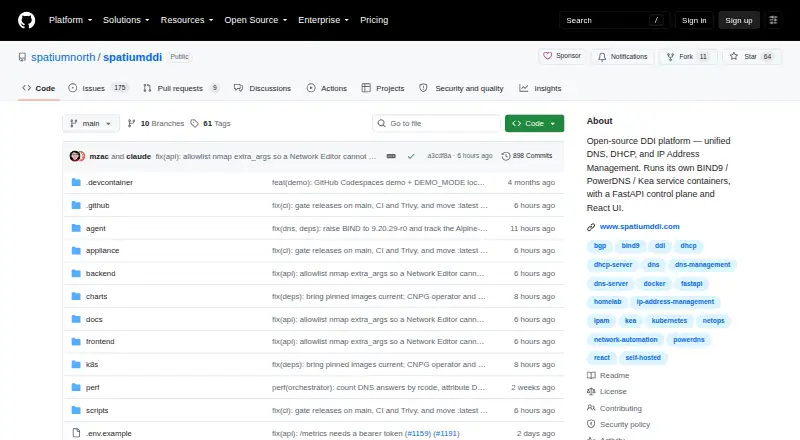
What SpatiumDDI is
SpatiumDDI is a free, self-hosted control plane for DNS, DHCP, and IP address management. Its IPAM organizes hierarchical spaces, blocks, and subnets for both IPv4 and IPv6. It can manage DNS configurations for BIND9, PowerDNS, or Technitium, as well as Kea DHCP. Listed cloud DNS drivers include Cloudflare, Route 53, Azure DNS, Google Cloud DNS, DigitalOcean, Hetzner, Linode, and Vultr. It can also connect to existing Windows DNS and DHCP servers through RFC 2136 and WinRM, without installing software on domain controllers. Every interface action is available through a REST API, with Terraform and Ansible named as automation clients. Group-based access controls and LDAP, OIDC, SAML, RADIUS, and TACACS+ are supported. Data is stored in PostgreSQL on the user's infrastructure; the project says it does not collect telemetry, usage analytics, crash reports, or account data. Docker Compose and Kubernetes with Helm are listed deployment methods. SpatiumDDI is beta software, described as suitable for labs, homelabs, and pilots with non-critical client populations. It is free under Apache 2.0 wherever it runs.
Good
- Manages IPv4 and IPv6 spaces, blocks, and subnets.
- Supports several DNS servers and Kea DHCP.
- REST API exposes every UI action.
- Data stays in PostgreSQL on user infrastructure.
Watch out
- The project labels the software beta.
- Positioned for non-critical client populations.
- OS appliance deployment is marked beta.
Who it suits
It suits teams that want to manage DNS, DHCP, and IP addresses on infrastructure they operate. The project positions its beta software for labs, homelabs, and pilots with non-critical client populations.
Verdict
SpatiumDDI brings DNS, DHCP, and IPAM management into a self-hosted control plane, with API access and multiple integrations. Its beta status makes the stated lab, homelab, and pilot use cases important to consider.
Plans and prices
From SpatiumDDI's own pricing page, checked 30 Sep 2026.
| Plan | Price | What it gives you |
|---|---|---|
| SpatiumDDI | Free | Apache 2.0 · every feature free wherever you run it |
The facts
Each one read from SpatiumDDI's own pages, with the date it was checked.
What it does
- Access controls
- The project describes group-based RBAC and support for LDAP, OIDC, SAML, RADIUS, and TACACS+.checked 30 Sep 2026
- Automation
- Every UI action is available through a REST API, and the project names Terraform and Ansible as automation clients.checked 30 Sep 2026
- Data and privacy
- The project says data is stored in PostgreSQL on the user's infrastructure and that it collects no telemetry, usage analytics, crash reports, or account data.checked 30 Sep 2026
- Deployment
- Supported deployment methods listed are Docker Compose and Kubernetes with Helm; the OS appliance is marked beta.checked 30 Sep 2026
- DNS and DHCP
- It can run BIND9, PowerDNS, or Technitium for DNS and Kea for DHCP, with the control plane managing their configuration.checked 30 Sep 2026
- Integrations
- The project lists agentless cloud DNS drivers for Cloudflare, Route 53, Azure DNS, Google Cloud DNS, DigitalOcean, Hetzner, Linode, and Vultr.checked 30 Sep 2026
- IPAM
- IPAM supports hierarchical spaces, blocks, and subnets with IPv4 and IPv6 address management.checked 30 Sep 2026
- License
- The product ships under Apache 2.0, with every feature free wherever it runs.checked 30 Sep 2026
- Maturity
- The project labels SpatiumDDI beta software and says it is suitable for labs, homelabs, and pilots with non-critical client populations.checked 30 Sep 2026
- Outbound connections
- A daily anonymous GitHub release check is enabled by default and can be disabled; the project says all features work air-gapped.checked 30 Sep 2026
- Purpose
- SpatiumDDI is a self-hosted control plane for DNS, DHCP, and IP address management.checked 30 Sep 2026
- Security reporting
- The security policy asks users to report vulnerabilities through a GitHub Security Advisory and aims to acknowledge reports within 48 hours.checked 30 Sep 2026
- Support
- SpatiumNorth sells support, deployment, and migration services from the people who wrote the code.checked 30 Sep 2026
The company
- Maker
- SpatiumNorth is described as a Montréal-based software company that builds infrastructure software in the open.checked 30 Sep 2026
Where it runs
- Windows support
- SpatiumDDI can connect to existing Windows DNS and DHCP servers using RFC 2136 and WinRM without installing software on the domain controller.checked 30 Sep 2026
The full review of SpatiumDDI
Overview
SpatiumDDI brings DNS, DHCP, and IP address management together in a self-hosted control plane. Its broad protocol and automation support is appealing, but beta status makes it a better fit for non-critical environments than production networks where maturity is paramount.
Apache 2.0 licensing keeps every feature free wherever you run it, while PostgreSQL data storage stays on your infrastructure. The trade-off is that you take responsibility for deployment and operations.
Key features
IPAM organizes IPv4 and IPv6 addresses into hierarchical spaces, blocks, and subnets, with subnet planning, DNS data management, DHCP management, and audit history. That combination suits teams seeking one place to coordinate address allocation and core DDI services rather than separate tools for each task.
For DNS and DHCP, SpatiumDDI manages configuration for BIND9, PowerDNS, or Technitium, and Kea. Agentless cloud DNS drivers cover Cloudflare, Route 53, Azure DNS, Google Cloud DNS, DigitalOcean, Hetzner, Linode, and Vultr, while RFC 2136 and WinRM let it connect to existing Windows DNS and DHCP servers without installing software on domain controllers. The range is useful in mixed environments, though the control plane's beta maturity remains a consideration for critical infrastructure.
Every UI action is exposed through a REST API, and Terraform and Ansible are named as automation clients. Group-based RBAC and support for LDAP, OIDC, SAML, RADIUS, and TACACS+ make it more relevant to organizations that need integration with existing identity and access systems.
PostgreSQL stores data on the user's infrastructure. The project says it collects no telemetry, usage analytics, crash reports, or account data. A daily anonymous GitHub release check is enabled by default but can be disabled; all features are said to work air-gapped. That gives privacy-conscious and disconnected environments a workable path, with the release check worth switching off where outbound traffic is restricted.
Pricing
SpatiumDDI costs free. The Apache 2.0 plan includes every feature wherever the software runs, with no feature tier to unlock for API access, audit history, IPv6, subnet planning, DNS, or DHCP. There is no free trial because the product is free.
The price does not remove the operational burden: SpatiumDDI is self-hosted, and deployment methods are Docker Compose and Kubernetes with Helm. SpatiumNorth also sells support, deployment, and migration services for teams that want help from the code's authors; no service prices are given.
Platforms
SpatiumDDI is available as API, Linux, self-hosted, and web software. Docker Compose and Kubernetes with Helm are the supported deployment methods. Its OS appliance is marked beta, so teams choosing that route should account for the additional maturity caveat.
Who it's for
SpatiumDDI is best suited to infrastructure teams evaluating unified DNS, DHCP, and IPAM in a lab, homelab, or pilot with non-critical client populations. Its API, named automation clients, identity integrations, and cloud DNS drivers are useful for teams that want to connect DDI management to existing workflows.
It is a weaker choice for organizations that need a mature platform for critical client networks today, or do not want to operate self-hosted software. SpatiumNorth describes itself as a Montréal-based company building infrastructure software in the open and sells support, deployment, and migration services. Its security policy asks for vulnerability reports through a GitHub Security Advisory and aims to acknowledge them within 48 hours.
Pros and cons
- Pros: Apache 2.0 licensing includes every feature at no charge, avoiding feature-based plan limits.
- Pros: IPv4 and IPv6 IPAM, DNS, and DHCP management are combined with API access and audit history.
- Pros: Cloud DNS drivers and agentless connections to Windows servers make it relevant to mixed environments.
- Pros: On-infrastructure PostgreSQL storage, no reported telemetry collection, and air-gapped operation support privacy-sensitive deployments.
- Cons: Beta status makes it unsuitable as an unqualified choice for critical client populations.
- Cons: Self-hosting means teams must manage deployment and operation themselves unless they buy services.
- Cons: The default daily GitHub release check creates an outbound connection, though it can be disabled.
Alternatives
Tidal LightMesh is worth considering for teams that want a freemium option with a Windows platform and a free tier capped at one user and fewer than 1,000 IPs; its free plan includes unlimited subnets, basic IPAM, and DHCP discovery.
GestióIP offers free IPAM software and a separate Configuration Management Module priced at $400 per ye, making it an alternative for teams comparing a free standard package with a paid configuration module.
Subnetly has a free monthly plan with defined caps—256 IPAM addresses, 10 subnets, 2 DHCP pools, and 1 private and 1 public DNS zone—so it may fit smaller deployments that can work within those quotas.
EfficientIP SOLIDserver DDI is a paid alternative with hardware and virtual appliances, for teams considering an appliance-based DDI product.
teemIP has a forever-free Community plan with open-source code, free installation, and community support, making it another option for teams prioritizing a free community edition.
Cygna DDI is another paid web-based option.
NetBox is an alternative for teams considering hosted NetBox, with a Starter plan described as fully managed and including email support and certified plugins.
Danbyte offers free, self-hosted software with all features included and no seat license or enterprise tier, making it a straightforward alternative for teams seeking those terms.
Compare more options in IP Address Management Software and DHCP Management Software.
Verdict
Choose SpatiumDDI if you want a free, self-hosted control plane that unifies IPAM, DNS, and DHCP, especially when API automation, identity integrations, and cloud DNS support matter. Its strongest reason to choose it is the breadth of capability under Apache 2.0 without feature charges; its strongest reason to look elsewhere is beta status. Keep it to labs, homelabs, and non-critical pilots until its maturity suits your operational risk.
Alternatives to SpatiumDDI
- 1
Subnetly
Free planiOSWebAPILinux7.9From $49 a month - 2

ISC Stork
Free planOpen sourceWebAPILinuxmacOS7.5Free plan - 3

Danbyte
Free planOpen sourceWebAPILinuxSelf-hosted7.4Free plan - 4
OpenIPAM
Free planOpen sourceWebAPILinuxSelf-hosted7.4Free plan - 5
Jen Kea DHCP Management Console
Free planOpen sourceWebAPILinuxSelf-hosted7.1Free plan - 6
teemIP
Free planWebAPILinuxSelf-hosted7.1From €6,000 a year