ThinkReview
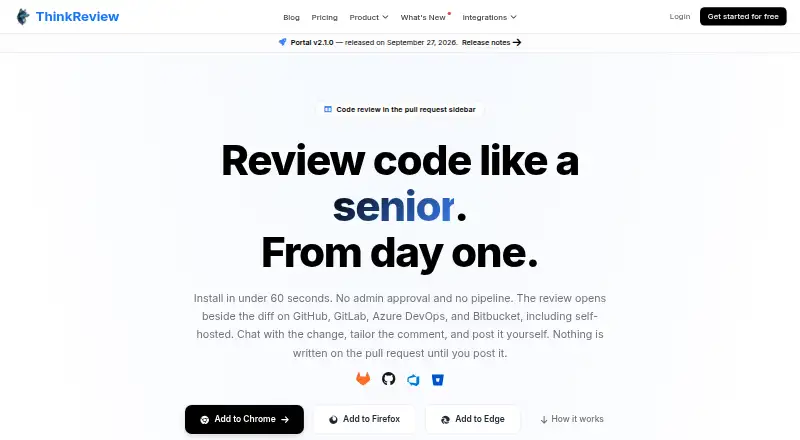
ThinkReview provides AI-assisted code reviews in a browser sidebar on pull and merge request pages.
What ThinkReview is
ThinkReview provides AI-assisted code reviews in a browser sidebar on pull and merge request pages. It supports GitHub, GitLab, Azure DevOps, and Bitbucket, including several self-hosted editions. Reviews can offer code-quality suggestions, security analysis, best-practice recommendations, quality scores, and follow-up answers. Developers can define review standards and create agents tailored to a project's technology stack. They can discuss a change, edit a review comment, and post it themselves; nothing is written to the pull request until they post. ThinkReview MCP supports live pull-request reviews from Cursor, Claude Code, and Copilot, returning structured feedback. With Ollama, reviews can use local models without sending patches to the cloud, including on air-gapped machines. The Free plan is for individual developers and lists two review credits per day for small pull requests up to 1,000 lines of code changes. Lite costs $10 a month and Professional costs $16 a month. The maker says cloud review diffs are processed in memory and discarded without storage or AI training; cloud conversation data may be retained for up to 90 days. Trial duration is inconsistent across the pricing information: the FAQ says seven days monthly or 14 days annually, while the homepage section says five days.
Good
- Supports four major code-hosting platforms
- Users control when review comments are posted
- Custom rules and project-specific review agents
- Local Ollama reviews can avoid cloud patch transfer
- Free plan includes two daily review credits
Watch out
- Free reviews are limited to small PRs up to 1,000 lines
- Cloud conversation data may be retained up to 90 days
- Listed trial durations differ between pricing pages
- Enterprise Gateway requires Teams and enterprise provisioning
Who it suits
It suits developers and teams seeking AI feedback within pull and merge request workflows. Local-model reviews may suit users who need patches to stay off the cloud.
Verdict
ThinkReview offers review suggestions alongside manual control over what reaches a pull request, plus local-model options. Check the free-plan limits and trial terms, which are described inconsistently.
Plans and prices
From ThinkReview's own pricing page, checked 4 Oct 2026.
| Plan | Price | What it gives you |
|---|---|---|
| Lite | $10 a month | 15 review credits/day · PRs up to 40,000 lines · up to 3 custom review agents per PR · GitLab custom domains & Bitbucket Cloud |
| Professional | $16 a month | 25 review credits/day · up to 5 custom review agents per PR · GitHub Enterprise Server · Azure DevOps Cloud & Server · priority support |
| Free | — | For individual developers · GitLab.com & GitHub.com · 2 review credits/day · small PRs up to 1,000 lines of code changes |
The facts
Each one read from ThinkReview's own pages, with the date it was checked.
What it does
- Code retention
- The maker says cloud review diffs are processed in memory and discarded without being stored or used for AI training.checked 4 Oct 2026
- Conversation data
- The privacy policy says cloud-based conversation data may be retained for up to 90 days for operational purposes.checked 4 Oct 2026
- Custom rules and agents
- Users can define review standards and create review agents tailored to their projects and technology stack.checked 4 Oct 2026
- Enterprise deployment
- The Enterprise Gateway routes diffs, Git tool results, and model traffic through the customer's network and is available on the Teams plan after enterprise provisioning.checked 4 Oct 2026
- Git integrations
- The extension supports GitHub, GitLab, Azure DevOps, and Bitbucket, including several self-hosted editions.checked 4 Oct 2026
- Intended users
- The maker describes ThinkReview as built for developers and teams who want to improve code quality and speed up reviews.checked 4 Oct 2026
- Local AI
- With Ollama, reviews can run on local models without sending patches to the cloud, including on air-gapped machines.checked 4 Oct 2026
- MCP integrations
- ThinkReview MCP supports live PR reviews from Cursor, Claude Code, and Copilot and returns structured feedback.checked 4 Oct 2026
- Product
- ThinkReview provides AI code reviews in a browser sidebar on pull and merge request pages.checked 4 Oct 2026
- Review features
- The product offers code quality suggestions, security analysis, best-practice recommendations, quality scoring, and follow-up questions.checked 4 Oct 2026
- Review workflow
- Users can chat about a change, edit the review comment, and post it themselves; nothing is written to the pull request until they post.checked 4 Oct 2026
- Support
- The contact page offers live chat and email support and says the team typically responds within 24 hours.checked 4 Oct 2026
Money
- Trial
- The pricing FAQ states Lite and Professional plans include a 7-day trial on monthly billing or a 14-day trial on annual billing.checked 4 Oct 2026
- Trial duration discrepancy
- The pricing section shown on the homepage labels Lite and Professional trials as free 5-day trials.checked 4 Oct 2026
The full review of ThinkReview
ThinkReview is an AI code-review tool for pull and merge requests, with browser-extension and coding-assistant workflows. It suits developers and teams that want project-specific feedback but prefer to approve every comment before it reaches a pull request. Its strongest case is that control, paired with local-model support; daily review caps and uncertainty over trial length are the main cautions.
Overview
Reviews are manually triggered in a browser sidebar on pull and merge request pages. You can discuss a change, revise the review comment and post it yourself; nothing is written to the pull request until you decide to publish it. That makes ThinkReview a better fit for teams seeking review assistance than for those wanting an automated reviewer to comment without intervention.
Feedback can cover code quality, security and best practices, with quality scoring, follow-up questions and fix suggestions. Custom rules and project-specific review agents let teams align feedback with their standards and technology stack. The trade-off is that daily credits and agent caps constrain how broadly those tailored reviews can be used.
Key features
Review workflow and integrations
The extension supports GitHub, GitLab, Azure DevOps and Bitbucket, including several self-hosted editions. ThinkReview MCP also supports live PR reviews from Cursor, Claude Code and Copilot, returning structured feedback. That offers a route into coding-assistant workflows, while the manual trigger and posting step preserve developer oversight.
Local models and privacy
With Ollama, reviews can run on local models without sending patches to the cloud, including on air-gapped machines. For cloud reviews, the maker says diffs are processed in memory, discarded rather than stored, and not used for AI training. Cloud conversation data may be retained for up to 90 days for operational purposes, so local review is the clearer option for teams that need to avoid sending patches to the cloud.
The Enterprise Gateway routes diffs, Git tool results and model traffic through the customer's network. It is available on the Teams plan after enterprise provisioning, giving organizations a network-routed deployment option without implying that every plan has it.
Pricing
ThinkReview has a free plan and two monthly paid plans. Lite costs $10 a month and includes 15 review credits per day, PRs up to 40,000 lines, up to three custom review agents per PR, GitLab custom domains and Bitbucket Cloud. It suits developers who need larger PR coverage and more than the free daily allowance, but its lower credit quota and agent cap make it less suited to heavier team use.
Professional costs $16 a month and raises the allowance to 25 review credits per day and up to five custom review agents per PR. It adds GitHub Enterprise Server, Azure DevOps Cloud and Server, and priority support. Those additions make it the stronger fit for teams using those hosts or needing more review capacity; it does not remove the daily quota.
The Free plan is aimed at individual developers and supports GitLab.com and GitHub.com, with two review credits per day and small PRs up to 1,000 lines of code changes. Its price is custom pricing. The low cap and host restrictions make it a limited way to assess the workflow, not a practical choice for sustained review volume or larger changes.
Lite and Professional include a free trial, but the trial terms conflict: the pricing section calls it five days, while the FAQ says seven days on monthly billing or 14 days on annual billing. Confirm the applicable length before relying on a trial period.
Platforms
ThinkReview is available through an API, browser extension, Linux, macOS, web and Windows. Its hybrid deployment model combines cloud use with local-model reviews, while the review trigger remains manual.
Who it's for
ThinkReview is best suited to developers and teams that want security and quality feedback shaped by their own rules, with a human deciding what gets posted. It is particularly compelling where local-model review or network-routed enterprise deployment matters. Developers who need a generous free allowance, automatic posting or fewer capacity constraints should compare other tools.
Pros and cons
- Manual control over comments: chat and editing happen before publication, so unapproved feedback does not reach a pull request.
- Flexible review setup: custom rules, tailored agents and support for four major code hosts accommodate project-specific practices.
- Local review option: Ollama support enables reviews without sending patches to the cloud, including on air-gapped machines.
- Daily caps: the free plan allows two credits per day, while Lite and Professional cap use at 15 and 25 credits per day respectively.
- Cloud conversation retention: conversation data may remain for up to 90 days even though review diffs are described as discarded after processing.
- Unclear trial length: the homepage section and FAQ give different durations, complicating decisions about when a trial ends.
Alternatives
AI Code Review Tools is the broader category to browse if you want to compare options across the field.
Consider CodeRabbit for its free reviews of public repositories. Gitar has a free open-source option for qualifying public GitHub or GitLab repositories. PR Quorum offers a free plan with 50 reviews a month across two repositories, but limits its panel to three reviewers and inline comments to three. Sourcery offers free AI reviews for public repositories, with summaries, diagrams, one-click fixes and custom rules.
AI Code Reviewer is a free Linux and self-hosted option where users pay only their model provider's usage. Bito may suit teams comparing an annual per-seat plan: its AI Code Reviews Team plan is $12 a year, billed at $12 monthly per seat, billed annually, with 5K lines per seat per month included. Codacy offers a free Developer plan with an IDE plugin, 38 programming languages and VSCode, JetBrains and Cursor integration. CodeAnt AI offers a 14-day free trial with no credit card required.
Verdict
Choose ThinkReview if you want tailored code-review feedback, local-model flexibility and final control over every posted comment. Its combination is well suited to developers and teams that treat AI as an assistant rather than an autonomous reviewer. Look elsewhere if the daily credit limits are too tight, or if you need consistent trial terms before committing.
Alternatives to ThinkReview
- 1

DeepSource
Free planWebAPILinuxmacOS8.0From $30 a month - 2

Cubic
Free planWebAPILinuxmacOS7.9From $30 a month - 3

Sourcery
Free planWebAPIExtensionLinux7.9From $12 a month - 4

Ellipsis
Free planWebAPILinuxmacOS7.8Free plan - 5

Greptile
Free planWebAPIExtensionLinux7.7From $30 a month - 6

CodeAnt AI
Free planWebAPIExtensionSelf-hosted7.5From $20 a month