Terminalz
Terminalz is a free, open-source terminal multiplexer that streams terminals from multiple machines to one web browser.
What Terminalz is
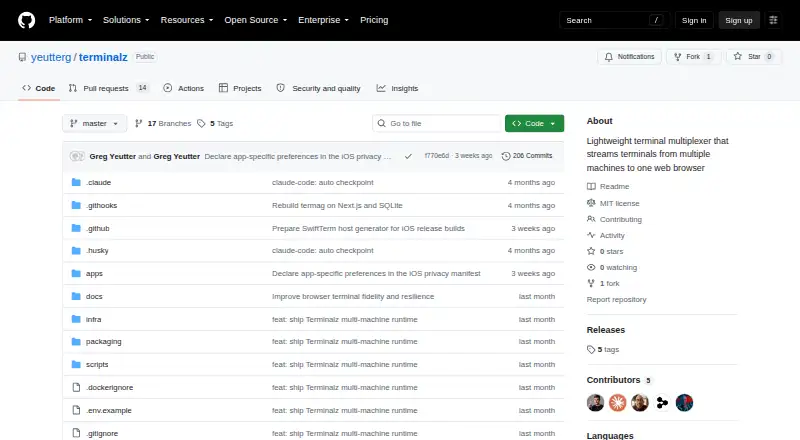
Terminalz is a free, open-source terminal multiplexer that streams terminals from multiple machines to one web browser. Users can connect any number of uniquely named machines to one web account and switch between them in a sidebar. When Herdr is running, Terminalz mirrors its sessions, spaces, tabs, panes, layout, ordering, statuses, and icons; without Herdr, local tmux sessions remain available, and users can create sessions inside allowlisted directories. Terminal input and output flow both ways, with the latest focus, click, or keystroke taking control of writing and resizing. The web control plane runs through Docker Compose and must be self-hosted; the native machine agent is installed through Homebrew or a GitHub release script. Machines connect over outbound authenticated WSS, so they do not need an inbound port. A SwiftUI client for iPhone and iPad offers native navigation and settings with the existing terminal renderer, and requires building with Xcode. Terminal output and replay checkpoints stay in bounded memory rather than being persisted or sent to observability services. The project has an MIT license and no GitHub releases listed.
Good
- Connects any number of uniquely named machines.
- Mirrors Herdr sessions and local tmux sessions.
- Agents connect without requiring an inbound port.
- Terminal output is not persisted.
Watch out
- The web control plane must be self-hosted.
- The iPhone and iPad client requires building with Xcode.
- Phone scrollback is capped at 500 lines.
- The GitHub releases page lists no releases.
Who it suits
Terminalz suits people who want to access terminals from multiple machines through a browser and work with Herdr or tmux sessions. It requires self-hosting the web control plane, and its mobile client requires an Xcode build.
Verdict
Terminalz provides a self-hosted browser interface for terminals across machines, with Herdr and tmux support. Its setup involves a Docker Compose control plane and a separately installed machine agent.
The facts
Each one read from Terminalz's own pages, with the date it was checked.
What it does
- Access modes
- For public hostnames, the README instructs users to configure Google OAuth and an allowed email; trusted-network mode is described for private networks.checked 4 Oct 2001
- Connections
- A lightweight Rust agent connects to the web service over an outbound encrypted connection, so machines need no inbound port.checked 11 Oct 2001
- Data handling
- Terminal output is not persisted or sent to observability services; output and replay checkpoints remain memory-only and bounded.checked 4 Oct 2001
- Herdr integration
- When Herdr is running, Terminalz mirrors its sessions, spaces, tabs, panes, split layout, ordering, statuses, and icons.checked 4 Oct 2001
- Installation
- The web control plane is distributed as a Docker Compose image, and the native agent is offered through Homebrew or GitHub Releases.checked 11 Oct 2001
- Integrations
- The project documents integration with Herdr, tmux, Docker, Google OAuth, and Tailscale or WireGuard networks.checked 11 Oct 2001
- License
- The repository provides the software under the MIT License, whose text grants use without charge.checked 11 Oct 2001
- Limits
- Phone terminal scrollback is capped at 500 lines and desktop scrollback at 2,000 lines.checked 11 Oct 2001
- Mobile
- A SwiftUI iPhone and iPad client provides native navigation and settings and requires building with Xcode.checked 11 Oct 2001
- Mobile client
- A SwiftUI iPhone and iPad client provides native dark navigation and settings with the existing terminal renderer, and requires building with Xcode.checked 4 Oct 2001
- Product
- Terminalz is a lightweight terminal multiplexer that streams terminals from multiple machines to one web browser.checked 4 Oct 2001
- Purpose
- Terminalz streams terminals from multiple machines to one web browser.checked 11 Oct 2001
- Release status
- The GitHub releases page states that there are no releases.checked 11 Oct 2001
- Security
- Machine tokens are shown once and stored hashed in SQLite, and terminal output is not persisted or sent to observability services.checked 11 Oct 2001
- Security configuration
- The project recommends OAuth for public hostnames and says trusted-network mode is only as private as the network in front of it.checked 11 Oct 2001
- Self-hosting
- The README instructs users to run the web control plane themselves using Docker Compose.checked 4 Oct 2001
- Session support
- Terminalz mirrors Herdr sessions and can show local tmux sessions when Herdr is not running.checked 11 Oct 2001
- Support and releases
- The repository has no GitHub releases listed.checked 4 Oct 2001
- Supported setup
- The web control plane runs as a Docker Compose image, while the native machine agent is installed through Homebrew or a GitHub release script.checked 4 Oct 2001
- Terminal control
- Users can create, rename, and close runtime objects through typed Herdr or tmux operations; the project says it does not provide an arbitrary remote shell-command channel.checked 11 Oct 2001
- Terminal streaming
- Terminalz streams terminal bytes bidirectionally, with the latest terminal focus, click, or keystroke taking the writer and resize lease.checked 4 Oct 2001
- tmux support
- Without Herdr, local tmux sessions still appear and users can create sessions inside allowlisted directories.checked 4 Oct 2001
Where it runs
- Machine connections
- Users can connect any number of uniquely named machines to one web account and switch between them in a sidebar.checked 4 Oct 2001