
Terminal49
Terminal49 brings container tracking, shipment documents, and workflow automation together for logistics teams.
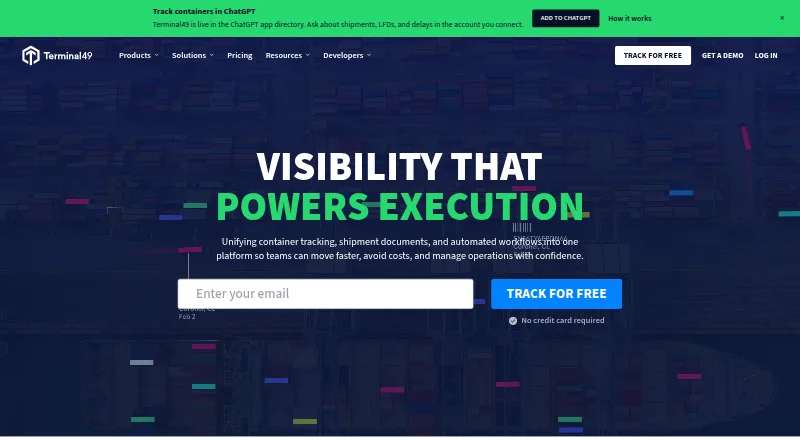
What Terminal49 is
Terminal49 brings container tracking, shipment documents, and workflow automation together for logistics teams. Its visibility covers carriers, terminals, vessel/AIS activity, and intermodal rail, with data described as updated hourly. The API provides milestones such as vessel events, container moves, holds, fees, and Last Free Day information. Users can receive milestone and exception alerts, while the Complete plan adds automated workflows and custom reports. The platform can classify documents and link them to the relevant container. Its API uses webhooks for status changes and returns standardized JSON, with developer documentation and code samples. Listed integrations include systems such as Snowflake, Google BigQuery, Microsoft SQL Server, Google Sheets, Excel, NetSuite, SAP, CargoWise, Power BI, and Azure. Terminal49 offers a free plan for up to 10 active containers and three users. Lite, Complete, and Essential use annual contracts or pay-as-you-go terms, with prices available by request or demo; the API page also offers a 7-day trial with full API access. The listed platforms are web and API.
Good
- Tracks across carriers, terminals, vessel/AIS, and intermodal rail.
- API milestones include holds, fees, and Last Free Day.
- Can classify documents and link them to containers.
- Supports exception alerts and webhook status updates.
- Free plan includes tracking for up to 10 active containers.
Watch out
- Free plan is limited to 10 active containers.
- Free plan is limited to three users.
- Lite, Complete, and Essential prices require a request or demo.
Who it suits
Terminal49 suits cargo owners, importers, exporters, freight forwarders, customs brokers, 3PLs, and logistics technology companies that need container visibility or shipment milestones. Its free plan may suit teams tracking no more than 10 active containers with up to three users.
Verdict
Terminal49 combines shipment visibility, documents, milestones, and integrations in one logistics platform. Its free plan has clear container and user caps, while prices for other plans are available only by request or demo.
Plans and prices
From Terminal49's own pricing page, checked 14 Oct 2026.
| Plan | Price | What it gives you |
|---|---|---|
| Free | Free | 50 shipments per month · unlimited users · core milestones · dashboard, CSV, email and limited API tracking · no webhooks |
| Complete | — | Predictive ETAs and port congestion insights · Automated workflows and custom reports · Advanced integration add-ons · Dedicated CSM and shared Slack channel · SLA-backed uptime and data guarantees · Annual contract; price by demo |
| Enterprise | Priced on request | Committed container volumes · unlimited users and shipments · full API and webhooks · dedicated customer success · onboarding · enterprise add-ons |
| Essential | Priced on request | API access and webhooks · Intermodal rail tracking · Container assignments and team collaboration · Document processing credits included · Annual contract or Pay-as-you-go; price by demo |
| Lite | — | Unlimited users · Full shipment and container dashboards · Document processing (50 credits included, buy more as needed) · Planning and performance reporting · Annual contract; price by request |
| Pay As You Go | Priced on request | Unlimited users and shipments · full API and webhooks · alerts · container dashboard · exports · optional add-ons |
The facts
Each one read from Terminal49's own pages, with the date it was checked.
What it does
- Alerts
- Milestone, exception and daily email alerts are available on paid plans.checked 14 Oct 2026
- Alerts and workflows
- The platform supports milestone and exception alerts, and Complete includes automated workflows and custom reports.checked 29 Sep 2026
- API
- The API uses webhooks for status changes and provides standardized JSON data and developer documentation with code samples.checked 29 Sep 2026
- API capabilities
- The API supports shipment, container, shipping-line, tracking-request, webhook and webhook-notification resources.checked 14 Oct 2026
- CargoWise integration
- A CargoWise integration supplies automated container updates including gate, load, discharge, departure, arrival and delivery milestones.checked 14 Oct 2026
- Chain.io integration
- Chain.io can register tracking requests through the Terminal49 API and pass milestone updates into connected TMS, ERP, WMS and other logistics systems.checked 14 Oct 2026
- Collaboration
- Custom container views can be shared as read-only links without requiring recipients to have Terminal49 accounts.checked 14 Oct 2026
- Containers at risk
- A Containers at Risk view is designed to prioritize containers needing attention.checked 14 Oct 2026
- Current status
- On October 14, 2026 the status page showed the API, dashboard, homepage and webhooks operational, while some shipping-line feeds had materially lower uptime such as Gold Star Line at 34.928% and Maersk at 87.559%.checked 14 Oct 2026
- Dashboards
- Shipment and container dashboards provide unified monitoring, custom views and issue management.checked 14 Oct 2026
- Data coverage
- The company says it connects directly to more than 150 data sources, including ocean carriers, terminals and Class 1 rail carriers.checked 14 Oct 2026
- DataSync
- DataSync writes shipment, container and tracking-request tables into databases, warehouses, object stores or Google Sheets, with hourly or 15-minute synchronization options.checked 14 Oct 2026
- Developer extensibility
- Terminal49's GitHub organization lists a public TypeScript API repository and a public agent-plugins repository for Cursor, Claude Code, Codex and GitHub Copilot.checked 14 Oct 2026
- Documentation and support
- Customers receive a self-service knowledge base plus email and chat support; Enterprise adds onboarding and a dedicated customer-success manager.checked 14 Oct 2026
- Document management
- It can classify documents from different sources and link them to the appropriate container.checked 14 Oct 2026
- Documents
- Terminal49 can automatically classify documents and link them to the relevant container.checked 29 Sep 2026
- ETA and LFD tracking
- The platform tracks estimated arrivals, holds, Last Free Day and related milestones to help reduce detention and demurrage costs.checked 14 Oct 2026
- Funding
- Terminal49's own about page reports more than $8 million raised from Silicon Valley investors.checked 14 Oct 2026
- Funding round
- Crunchbase lists two funding rounds, including a Series A led by Grand Ventures and Stage 2 Capital, with 11–50 employees shown on its profile.checked 14 Oct 2026
- Integrations
- The cargo-owner page lists SAP, Descartes, CargoWise, Power BI, Azure and Snowflake as supported workflow integrations.checked 14 Oct 2026
Money
- API limits on Free
- The Free tier API can create tracking requests but cannot retrieve shipment data or receive webhook events.checked 14 Oct 2026
- Free plan limit
- The Free plan allows tracking up to 10 active containers at a time and up to 3 users.checked 29 Sep 2026
The company
- Company history
- The company says its founders began building Terminal49 in 2015 after learning about container drayage operations.checked 29 Sep 2026
- Company profile
- LinkedIn describes Terminal49 as a privately held software-development company founded in 2017, headquartered in San Francisco, with 51–200 employees.checked 14 Oct 2026
The full review of Terminal49
Terminal49 is a shipment operations platform for teams tracking containers and coordinating documents across ocean, rail, and road. It best suits cargo owners and logistics providers that want shipment events connected to their other systems. The free plan is a practical starting point, but its container cap and custom pricing on paid plans make it a poor fit for teams that need predictable costs at scale.
Overview
Terminal49 brings container visibility, shipment documents, and workflow automation together. It draws tracking data from carriers, terminals, vessel/AIS sources, and intermodal rail, with updates described as hourly. That breadth helps teams follow shipments across handoffs, though hourly updates may not suit operations that depend on more frequent location refreshes.
The API returns standardized JSON milestones, including vessel events, container moves, holds, fees, and Last Free Day information. Webhooks can send status changes into connected systems, and automatic document classification links files to the relevant container. Together, these capabilities make Terminal49 useful as an operational data source, not just a tracking screen.
Key features
- Tracking and milestones: Coverage across carriers, terminals, vessels/AIS, and intermodal rail supports visibility across multiple handoffs. Milestones include both movement and exception or cost-related events, helping teams monitor more than location alone.
- Documents: Automatic classification and container linking can reduce the work of matching shipment paperwork to the right movement. The Free plan includes 50 document credits; Lite includes 50 and allows more to be purchased, while Essential includes document processing credits.
- Alerts and workflows: Basic notifications are part of Free, and exception alerts are supported. Complete adds automated workflows and custom reports, making it the stronger fit for teams seeking to move beyond status monitoring into more tailored operations.
- Integrations and API: Webhooks, developer documentation, and code samples support integration work. Named data flows include Snowflake, Google BigQuery, Microsoft SQL Server, Google Sheets, Excel, NetSuite, SAP, Descartes, CargoWise, Power BI, and Azure. The integrations page states that transfers are encrypted and the service is SOC 2 compliant.
Pricing
Terminal49 uses a freemium model. Free costs free and is billed free forever; it allows up to 10 active containers at a time and up to 3 users, with shipment tracking and details, basic notifications, and 50 document credits. Those caps make it suitable for a small operation or an initial evaluation, but teams with more concurrent containers or users will need another plan.
Lite has custom pricing under an annual contract. It removes the user limit and adds full shipment and container dashboards, planning and performance reporting, and document processing with 50 included credits plus the option to buy more. It suits teams needing broader operational reporting, but annual terms and custom pricing offer less flexibility and cost certainty than Free.
Essential is custom-priced by demo, with either an annual contract or pay-as-you-go terms. It includes API access and webhooks, intermodal rail tracking, container assignments, team collaboration, and document processing credits. This is the plan to consider when integration and collaborative container work matter more than Complete's predictive and workflow features.
Complete is custom-priced by demo under an annual contract. It adds predictive ETAs, port congestion insights, automated workflows, custom reports, advanced integration add-ons, a dedicated customer success manager, a shared Slack channel, and SLA-backed uptime and data guarantees. It is aimed at operations that need higher-touch support and stronger service commitments, though its annual commitment and demo-based pricing make it less suited to buyers seeking a self-serve, budget-clear upgrade.
The API page also offers a 7-day free trial with full API access for building and testing an integration. That is a focused way for technical teams to validate API fit before committing to an integration effort.
Platforms
Terminal49 is available on web and through its API. Its stated transport modes are ocean, rail, and road; API access and webhooks support teams connecting shipment events to other systems.
Who it's for
Terminal49 names cargo owners, importers, exporters, freight forwarders, customs brokers, 3PLs, and logistics technology companies as its audience. It is particularly well matched to teams that need container events and documents to feed into business or analytics software. Smaller users can start with Free, while organizations needing API access, intermodal rail tracking, or dedicated support should assess the corresponding paid plans. Teams whose workflows require continuously refreshed location data should weigh the stated hourly update cadence carefully.
Pros and cons
Pros
- Broad shipment visibility: Carrier, terminal, vessel/AIS, and intermodal rail data cover several important handoffs in one platform.
- Useful operational milestones: Holds, fees, and Last Free Day information sit alongside vessel and container movement events.
- Integration-oriented design: Standardized JSON, webhooks, documentation, and code samples give technical teams clear building blocks for connecting shipment changes to other systems.
- Accessible entry point: Free forever includes tracking, basic notifications, and document credits, albeit with strict container and user caps.
Cons
- Hourly tracking updates: The stated cadence may be too slow for teams that need very frequent location refreshes.
- Limited free capacity: A maximum of 10 active containers and 3 users constrains larger or growing teams.
- Paid-plan cost opacity: Lite, Essential, and Complete use custom pricing, making direct budget comparison harder; Lite and Complete also require annual contracts.
Alternatives
For broader comparisons, browse Transportation Visibility Software or Container Tracking Software.
- GoComet is another paid option with a free plan, available on Android, API, and web.
- Tive Platform is a paid alternative with a free trial and Android, API, iOS, and web support; its Plus plan includes CSV shipment creation, multi-tracker shipments, branded public sharing links, ETAs with alerts, and geofence alerts.
- Flexport Control Tower is a paid option available on API and web.
- Descartes Customs and Regulatory Compliance is a paid API and web option without a free plan, with separate base-platform and additional-user plans.
- Intugine offers a Cruise plan at from ₹8 (priced on request), billed per call-minute, with final pricing dependent on client needs.
- ShipsGo has a free plan and trial, plus a pay-as-you-track option at $1,000, paid once for 500 credits valid for 1 year, with one credit per new shipment tracking.
- Gnosis Freight is a paid API and web alternative without a free plan; its Essentials plan includes unlimited users, dedicated support, premium container milestones, and demurrage and detention alarms.
- project44 Intelligent TMS is a paid API and web alternative priced according to modes, volumes, and deployment scope.
Verdict
Choose Terminal49 if your logistics team needs container visibility, document handling, and structured milestone data connected through an API. Its strongest case is the combination of cross-handoff tracking, useful shipment events, and integration tools; its clearest drawbacks are hourly updates, a tightly capped free tier, and custom-priced paid plans. Look elsewhere if frequent location refreshes or clear upfront pricing matter more than consolidating these workflows.
Getting started
- Open the Terminal49 website in a web browser.
- Start with the Free plan, which allows up to 10 active containers and three users.
- Use the API page’s seven-day trial for full API access to build and test an integration.
- For paid plans, request pricing or a demo.
- Connect using the API’s webhooks and standardized JSON, or review listed system integrations.
Limits worth knowing
The Free plan allows up to 10 active containers at a time and up to three users. It includes shipment tracking and details, basic notifications, and 50 document credits.
Questions
Does Terminal49 have a free plan?
Yes. Free is listed as free, with up to 10 active containers at a time, up to three users, and 50 document credits.
How long is the API trial?
The API page offers a seven-day free trial with full API access to build and test an integration.
What platforms are available?
Terminal49 is listed for web and API.
What integrations are listed?
Listed systems include Snowflake, Google BigQuery, Microsoft SQL Server, Google Sheets, Excel, NetSuite, SAP, Descartes, CargoWise, Power BI, and Azure.
What do paid plans cost?
Lite pricing is available by request, while Complete and Essential pricing is available by demo. Lite and Complete use annual contracts; Essential is listed with annual contract or pay-as-you-go terms.
What does the Complete plan add?
Complete includes predictive ETAs and port congestion insights, automated workflows and custom reports, advanced integration add-ons, a dedicated customer success manager and shared Slack channel, and SLA-backed uptime and data guarantees.
Alternatives to Terminal49
- 1
GEGO Tracking Solutions
AndroidiOSWebAPI7.1$99 one-time - 2

Portcast
WebAPI6.7From $45,000 a year - 3
Trucker Tools
Free planAndroidiOSWebAPI6.7Free plan - 4

Shippeo
AndroidiOSWebAPI6.5 - 5

Tive Platform
AndroidiOSWebAPI6.5 - 6
SeaVantage Cargo Insight
WebAPI6.4From $100 a month