Tencent Cloud GooseFS
Tencent Cloud GooseFS is a distributed caching and data acceleration service for storage access in data analysis, machine learning, and AI workloads.
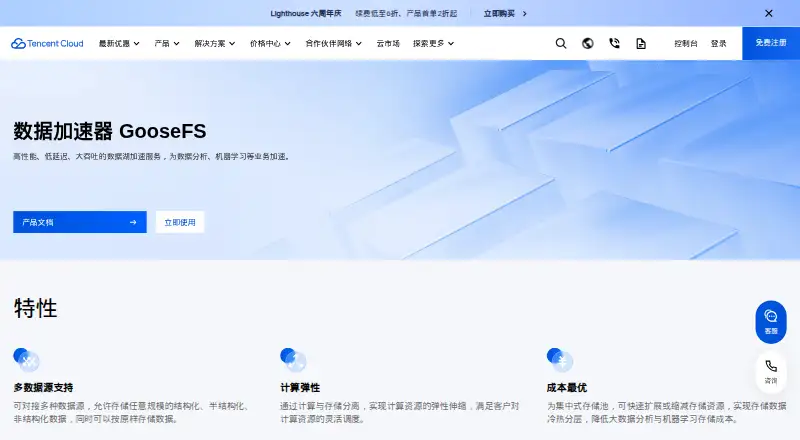
What Tencent Cloud GooseFS is
Tencent Cloud GooseFS is a distributed caching and data acceleration service for storage access in data analysis, machine learning, and AI workloads. Deployed alongside compute nodes, it can improve data locality and cache performance and increase write bandwidth to COS. It supports HDFS and POSIX protocols and connects local file systems, COS, and Tencent Cloud HDFS through a unified namespace and access APIs. The documented namespace options are COS, CHDFS, and local HDFS. Cache configurations can use one or multiple levels, with memory, SSD, or HDD media and LRU or LRFU replacement policies. GooseFS Catalog can identify metadata tables in big data scenarios and preheat caches at the table level. Tencent describes public-cloud clusters that use local compute-node disks as cache nodes, and directs customers to COS for persistent storage. Clusters can report monitoring data to Tencent Cloud Observability Platform or Cloud Log Service. GooseFS is available through API, Linux, self-hosted, and web platforms. It is paid, with postpaid pay-as-you-go billing settled hourly; usage under one hour is charged as one hour.
Good
- Supports HDFS and POSIX protocols.
- Cache media include memory, SSD, and HDD.
- Offers single-level and multi-level cache configurations.
- Catalog supports table-level cache preheating.
- Monitoring data can go to Tencent Cloud services.
Watch out
- No free plan is listed.
- Billing is postpaid and settled hourly.
- Usage under one hour is billed as one hour.
- Persistent storage is directed to COS.
Who it suits
GooseFS suits teams handling data analysis, machine learning, or AI storage access that need caching alongside compute nodes. It is designed for use with Tencent Cloud COS, Cloud HDFS, and local file systems.
Verdict
GooseFS provides configurable caching and a unified namespace for supported storage systems. Teams should account for its hourly postpaid billing and use COS for persistent data storage.
Plans and prices
From Tencent Cloud GooseFS's own pricing page, checked 4 Oct 2001.
| Plan | Price | What it gives you |
|---|---|---|
| GooseFS management capacity fee | — | Beijing, Guangzhou, Shanghai, Nanjing, and Virginia · Postpaid, settled hourly; usage under one hour is billed as one hour. |
| Managed Master LARGE fee | — | High-performance instance type, suitable for scenarios with around 1 billion files · Beijing, Shanghai, Guangzhou, Nanjing, and Virginia · Postpaid; hourly settlement. |
| GooseFS storage capacity fee | — | Shanghai Autonomous Driving Cloud · Postpaid; hourly settlement. |
| Managed Master MEDIUM fee | — | Standard instance, suitable for scenarios with around 100 million files · Beijing, Shanghai, Guangzhou, and Nanjing · Postpaid; hourly settlement. |
| Managed Master XLARGE fee | — | Flagship instance type, suitable for scenarios with around 10 billion files · Beijing, Shanghai, Guangzhou, Nanjing, and Virginia · Postpaid; hourly settlement. |
The facts
Each one read from Tencent Cloud GooseFS's own pages, with the date it was checked.
Money
- Billing
- Tencent says GooseFS supports only postpaid pay-as-you-go billing, settled hourly, with usage under one hour charged as one hour.checked 4 Oct 2001
What it does
- Cache acceleration
- It can be deployed with compute nodes to improve data locality and cache performance, and to increase write bandwidth to COS.checked 4 Oct 2001
- Caching
- Cache configurations include single-level or multi-level storage and LRU or LRFU replacement policies; documented cache media include memory, SSD, and HDD.checked 4 Oct 2001
- Deployment
- Tencent describes GooseFS cluster deployment on the public cloud and says clusters use local disks on compute nodes as cache nodes.checked 4 Oct 2001
- Monitoring integrations
- GooseFS clusters can report monitoring data to Tencent Cloud Observability Platform or Cloud Log Service.checked 4 Oct 2001
- Namespace limitation
- The documented namespace creation guide lists COS, CHDFS, and local HDFS as supported underlying storage systems.checked 4 Oct 2001
- Persistent storage
- GooseFS provides data caching, and Tencent directs customers to COS for persistent data storage.checked 4 Oct 2001
- Protocols
- GooseFS supports HDFS and POSIX protocols.checked 4 Oct 2001
- Purpose
- GooseFS is a distributed data acceleration and caching service for storage access in data analysis, machine learning, and AI workloads.checked 4 Oct 2001
- Storage integrations
- The product overview names Tencent Cloud COS and Cloud HDFS as compatible storage services.checked 4 Oct 2001
- Support
- The product overview offers contact sales and ticket submission for help.checked 4 Oct 2001
- Table metadata
- GooseFS Catalog can perceive metadata tables in big data scenarios and provide table-level cache preheating.checked 4 Oct 2001
- Unified namespace
- GooseFS can connect local file systems, COS, and Tencent Cloud HDFS (CHDFS) through a unified namespace and access APIs.checked 4 Oct 2001
- Use cases
- Tencent lists massive data analysis, machine learning, and AI-related storage access among GooseFS use cases.checked 4 Oct 2001
Alternatives to Tencent Cloud GooseFS
- 1

HPCC Systems
Free planOpen sourceWebAPIExtensionLinux7.5Free plan - 2
Tencent Cloud Application Performance Management
WebAPILinuxSelf-hosted7.2 - 3

Apache Hadoop HDFS
Free planOpen sourceAPILinuxSelf-hostedWindows7.1Free plan - 4

Parseable
Free planWebAPILinuxSelf-hosted6.9From $0.39 a month - 5

Oracle Big Data Service
WebAPILinux6.2 - 6

Qubole
WebAPI6.2