
TAO
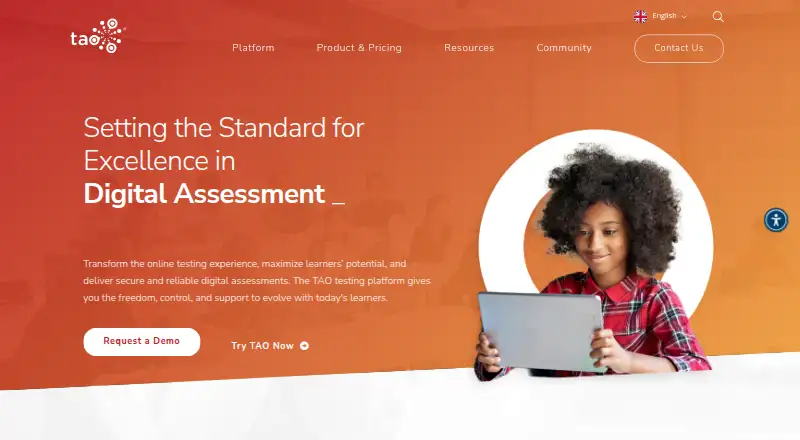
TAO is an online assessment platform for creating, delivering, and managing digital assessments.
What TAO is
TAO is an online assessment platform for creating, delivering, and managing digital assessments. Authors can build assessments manually, convert existing exam files, draft with AI assistance, or import QTI packages. Its question formats include Choice, Extended Text, File Upload, Hotspot, and Text Entry, among others. Scoring options include automatic or manual scoring, partial credit, weighted responses, and cut scores; branching logic is also available. For reviewing results, TAO provides session and test-taker reports, custom reports, CSV results, Data Explorer, and TAO Insights. It supports QTI 2.2 and QTI 3.0 and promotes QTI and LTI interoperability. Assessments can be delivered online, through an LMS via LTI, at test centers, with local proctoring, or through cloud-hosted and self-hosted setups. TAO Cloud offers shared or private hosting. Community Edition support comes through its forum and user guide, while paid plans include additional support options. TAO was founded in 2013 and is based in Capellen, Luxembourg.
Good
- Imports QTI packages and converts existing exam files
- Offers automatic and manual scoring options
- Provides reports, CSV results, and Data Explorer
- Supports cloud-hosted and self-hosted delivery
Watch out
- Starter is not designed for team programs at scale
- Starter allows one author seat
- Community Edition support is limited to forum and user guide
Who it suits
TAO suits solo authors, educators, and organizations that need to create and deliver digital assessments. Starter is intended for solo authors, small-scale classroom assessment, or piloting, rather than large team-based programs.
Verdict
TAO combines assessment authoring, delivery, scoring, and reporting, with options for both cloud and self-hosted use. Check the limits of the plan you need, especially if you expect a larger team or assessment program.
Plans and prices
From TAO's own pricing page, checked 7 Oct 2026.
| Plan | Price | What it gives you |
|---|---|---|
| TAO Community Edition | Free | Self-hosted · access to and extension of source code · community forum and user guide support · Free open-source edition |
| TAO Starter | Free | 1 author seat · 3,000 monthly AI credits · 50 monthly learner test attempts · QTI tools · AI-assisted conversion and generation · Free Forever; per month |
| TAO Author | $149 a month | 1 included author seat, up to 5 authors · 10,000 monthly AI credits · 50 monthly learner test attempts · shared item bank · helpdesk support · Starting at; per month |
| TAO Ignite | $990 a month | 5 included author seats, up to 25 authors · 10,000 monthly AI credits · 1,250 monthly learner attempts · branded URL · dedicated account management · Data API and AI proctoring available as add-ons · Starting at; per month |
| TAO Elevate | Priced on request | 10 included author seats, up to 50 authors · 10,000 monthly AI credits · 5,000 monthly learner attempts · AI API and Data API · custom quality rules and rubrics · AI remote proctoring · Custom; contact us |
| TAO Enterprise | Priced on request | Custom author capacity · custom AI credits and learner volume · custom connectors and platform configuration · enterprise support and account management · private TAO Cloud hosting available · Custom; contact us |
The facts
Each one read from TAO's own pages, with the date it was checked.
What it does
- AI features
- The free Starter plan includes AI-assisted item generation, AI tagging, semantic search, summaries and AI quality or audit tools.checked 15 Oct 2026
- Analytics
- TAO Insights offers customizable reports, dashboards, data export and APIs for third-party analytics integration.checked 15 Oct 2026
- API and extensibility
- TAO exposes APIs, LTI 1.3 connectivity and an extensible architecture for learning platforms, identity systems and other tools.checked 15 Oct 2026
- Assessment lifecycle
- The platform combines authoring, content management, secure delivery, scoring, grading and reporting in one environment.checked 15 Oct 2026
- Authoring
- TAO provides a WYSIWYG editor, drag-and-drop multimedia authoring and more than 20 built-in question types.checked 15 Oct 2026
- Cloud hosting
- TAO Cloud uses providers including AWS, Google Cloud and Linode and offers shared or private cloud hosting.checked 7 Oct 2026
- Delivery
- TAO supports online scheduling, session management, monitoring, automated scoring and learner result reporting.checked 15 Oct 2026
- Delivery and scoring
- The platform supports online assessment delivery, test-session management, scoring and results reporting.checked 7 Oct 2026
- Developer SDK
- The public GitHub organization provides a TAO Frontend Core SDK installable with npm as @oat-sa/tao-core-sdk.checked 15 Oct 2026
- Documentation
- The online user guide covers administration, importing and exporting, session security, monitoring, scoring, delivery, reporting and experimental features.checked 15 Oct 2026
- Human grading
- TAO Grader supports rubrics, multi-trait scoring and asynchronous team scoring for manually scored responses.checked 15 Oct 2026
- Integrations
- Listed integrations include Moodle, Canvas, Blackboard, GeoGebra, Proctorio, MathType, Wiris and Texthelp.checked 15 Oct 2026
- Item banks
- Shared item banks let teams organize and reuse assessment content across authors.checked 15 Oct 2026
- Licence
- TAO Community Edition core components are released under the GNU Affero General Public License version 3 (AGPLv3).checked 15 Oct 2026
- Limit: SourceForge reviewer feature concern
- A reviewer complained that the open-source edition lacked result analysis and had seen little feature development, while TAO replied that annual releases continued and paid support was available.checked 15 Oct 2026
- Limit: SourceForge reviewer scalability concern
- A reviewer said the open-source edition appeared practical mainly for small groups and lacked clear information for deployments above 100 simultaneous users.checked 15 Oct 2026
- Limit: SourceForge reviewer support concern
- A reviewer said enterprise-level support requires payment and that the open-source edition does not include hosting or live support.checked 15 Oct 2026
The company
- Company founding
- The company was created in 2013 when TAO spun off into Open Assessment Technologies S.A.checked 15 Oct 2026
- Company legal name
- Crunchbase identifies the maker as Open Assessment Technologies S.A., a private for-profit company founded by Marc Oswald and Patrick Plichart.checked 15 Oct 2026
- Company size
- LinkedIn lists Open Assessment Technologies as having 51–200 employees and headquarters in Capellen, Luxembourg.checked 15 Oct 2026
- Founded
- 2013checked 23 Sep 2026
- Headquarters
- Capellen, Luxembourgchecked 23 Sep 2026
Money
- Free-plan limit
- TAO Starter is intended for solo authors, small-scale classroom assessment, or piloting and is not designed for team-based programs at scale.checked 7 Oct 2026
Where it runs
- Lockdown Browser
- TAO Lockdown Browser blocks unauthorized applications and websites and supports Windows, macOS, iPadOS and Chromebooks.checked 15 Oct 2026
The full review of TAO
TAO is assessment software for schools, assessment providers and organizations that need to build and run digital exams. It is best suited to teams that value portable standards-based content and flexible hosting; solo authors can start free, but larger programs need to budget around firm author-seat and learner-attempt limits.
Overview
TAO brings assessment authoring, online delivery, session management, scoring and reporting together. Authors can create tests manually, convert existing exam files, draft with AI assistance or import QTI packages, making it useful both for new programs and for digitizing existing exams.
Its support for QTI 2.2 and 3.0, plus LTI interoperability, is a practical advantage for organizations that need to move assessment content between systems or deliver through an LMS. Moodle, 2E Estudios & Evaluaciones, Wiris, Proctorio, Texthelp, Cito and GeoGebra are among its partners. TAO Cloud offers shared or private hosting, while self-hosting is also an option. TAO says customer content is encrypted in cloud and on-premise systems and that it periodically schedules external penetration tests.
Key features
TAO supports a broad range of question formats: choice, order, association, matching, hottext, gap match, sliders, extended text, file uploads, inline choice, text entry, hotspots, and graphic order, association, gap and point items. Branching logic and scoring options—including automatic and manual scoring, partial credit, weighted responses and cut scores—make it suitable for assessments more structured than a basic quiz.
Reporting ranges from session and test-taker reports to custom reports, CSV results, Data Explorer and TAO Insights. Assessments can be delivered online, through an LMS via LTI, at test centers, with local proctoring, or through cloud-hosted and self-hosted deployments. That range serves varied delivery models, though some higher-scale needs, such as remote proctoring and Data API access, are optional add-ons on Ignite.
Pricing
TAO has two free routes with different trade-offs. TAO Starter costs nothing, billed Per Month, and is free forever. It includes one author seat, 3,000 AI credits per month and 50 learner test attempts per month. Those caps make it a reasonable solo-author or pilot tier, not a foundation for a team program with regular volume. TAO Community Edition costs nothing as a free open-source edition; it is self-hosted, provides access to and extension of the source code, and relies on the community forum and user guide for support. It suits organizations prepared to manage their own hosting and work within community support.
TAO Author costs $149 a month, billed Per Month. It allows up to five authors and includes 10,000 AI credits and 50 learner test attempts per month, plus a shared item bank. The author capacity and collaboration feature suit small teams, but the same 50-attempt cap makes it a poor fit for a larger active assessment program.
TAO Ignite costs $990 a month, billed Per Month. It includes five author seats, expandable to 25, 10,000 AI credits per month and 1,250 learner test attempts per month. The higher attempt allowance is a more credible fit for regular delivery; Data API and remote proctoring are optional add-ons, so buyers needing either should account for that separately.
TAO Elevate has custom pricing and includes 10 author seats, expandable to 50. TAO Enterprise also has custom pricing, with custom capacity, integrations, configuration and support, plus private TAO Cloud or custom third-party hosting. These tiers are aimed at larger or more tailored deployments rather than teams seeking a fixed-cost plan. TAO offers a trial, but no duration is stated. The pricing note also gives paid plans as starting from €499/mo (annual), so buyers should confirm which plan and terms that entry price covers.
Platforms
TAO supports API, Linux, macOS, self-hosted, web and Windows. That mix, alongside cloud and on-premise options, makes it more adaptable to organizations with hosting requirements than a web-only assessment service.
Who it's for
TAO is a strong candidate for education and assessment teams that need QTI or LTI interoperability, varied item types, detailed scoring options or control over hosting. Starter works for solo authors and pilots; Community Edition fits technically prepared users who want open-source access. Teams expecting more than 50 monthly attempts should look beyond Starter and Author, while programs needing still higher throughput or bespoke configuration should consider Ignite, Elevate or Enterprise.
Pros and cons
- Pro: QTI 2.2 and 3.0 support and LTI interoperability make content portability and LMS delivery central strengths.
- Pro: Manual creation, exam-file conversion, AI drafting and QTI import give teams several ways to build or migrate assessments.
- Pro: Shared, private-cloud and self-hosted options accommodate different hosting preferences.
- Con: Starter and Author both cap delivery at 50 learner attempts per month, limiting their usefulness for ongoing programs.
- Con: Ignite's Data API and remote proctoring are add-ons, and the upper tiers use custom pricing, complicating budget comparisons.
- Con: Community Edition support is forum- and guide-based, which may not suit teams needing more direct assistance.
Alternatives
For a simpler quiz-focused option, FlexiQuiz offers a free plan with unlimited quizzes but caps each quiz at 10 questions and allows 20 responses per month. Testportal is another free-plan option, with advanced test configuration, reporting and storage for 100 results in its Free EDU plan. If a modest monthly exam quota is enough, SpeedExam offers 25 exam attempts per month on its free tier and a Professional plan at $37 a month.
Crowdpurr is a web-based alternative with a free Basic plan capped at 20 participants, 15 questions and three simultaneous experiences. TriviaMaker offers a free tier with limited game styles and disabled customization and team features. QuizFaber is freeware for Linux, Windows and web use, though commercial use requires the author's prior authorization.
ProProfs Quiz Maker has a free plan capped at 12 questions and 90-day report history. Classtime may suit classroom use where up to 40 simultaneous students, unlimited questions and sessions, and a library of 50,000+ free questions are the priority. For category browsing, see Assessment Software, Online Exam Software, Quiz Maker Software, Automated Grading Software and Lockdown Browser Software.
Verdict
Choose TAO if your assessment program depends on standards-based content, flexible delivery and hosting, and scoring beyond basic quizzes. Its authoring breadth and deployment choices are compelling, but the low attempt allowances on entry plans and add-on costs on Ignite make it a less convincing fit for higher-volume programs seeking predictable all-in pricing.
Getting started
- Open the TAO website
- Choose TAO Starter, Community Edition or another plan
- Start the available trial if you want to evaluate it
- Use the web platform or deploy Community Edition in a self-hosted environment
- Create or import assessment content
- Publish through online delivery, LTI, test centers or another supported channel
Limits worth knowing
TAO Starter includes one author seat, 3,000 AI credits per month and 50 learner test attempts per month, and is intended for solo authors, small classroom assessment or piloting. Community Edition is self-hosted and supported through the community forum and user guide.
Questions
Is TAO free?
TAO has a free Starter plan and a free, open-source Community Edition.
Which platforms does TAO support?
TAO supports API, Linux, macOS, self-hosted, web and Windows environments.
Is TAO open source?
TAO Community Edition is a free open-source edition with access to and extension of its source code.
How many learners can Starter handle?
TAO Starter includes 50 learner test attempts per month and one author seat.
Can TAO connect to an LMS?
Yes. TAO supports LMS delivery through LTI and promotes QTI and LTI interoperability; Moodle is among its listed partners.
Alternatives to TAO
- 1
Wayground (formerly Quizizz)
Free planAndroidiOSWebExtension8.3From $18 a month - 2

ClassMarker
Free planAndroidiOSWebAPI8.2From $19.95 a month - 3
Socrative
Free planAndroidiOSWeb7.8From $10 a month - 4

Gradescope
Free planAndroidiOSWeb7.6Free plan - 5

HackerRank
WebAPImacOSWindows7.4From $165 a month - 6

Questionmark
AndroidiOSWebAPI7.4$4,000 one-time