
Gradescope
Gradescope helps instructors administer and grade assessments given online or in class.
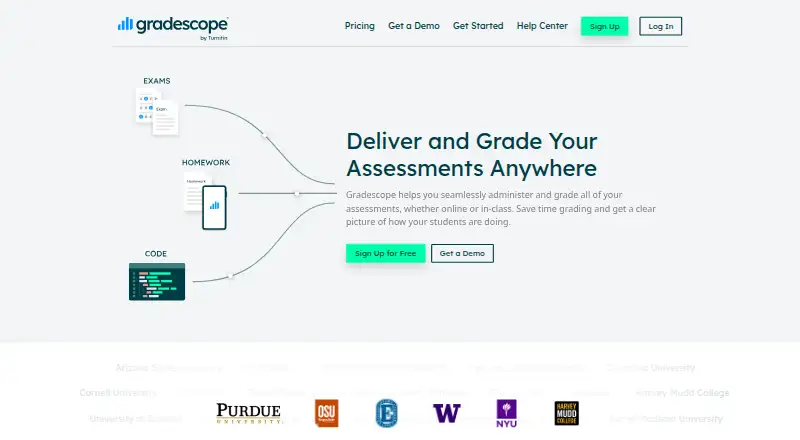
What Gradescope is
Gradescope helps instructors administer and grade assessments given online or in class. It supports variable-length work such as problem sets and projects, alongside fixed-template worksheets, quizzes, bubble sheets, and exams. Instructors can use flexible rubrics for detailed feedback and apply rubric changes to work already graded. For code assignments, students can submit through GitHub or Bitbucket; instructors can use autograders or grade manually with inline comments. Gradescope provides question-level and rubric-level statistics, and grades and data can be exported. For some question types, Gradescope AI groups similar answers for instructor review, but Answer Groups and AI-assisted grading require an Institutional license. That license also enables integrations with Blackboard, Brightspace, Canvas, Moodle, and Sakai. Without a supported LMS or institutional access, rosters can be imported by CSV and grades downloaded as spreadsheets for LMS upload. The Android and iOS app is for students to submit assignments and view grades, not for instructor workflows. It requires iOS 13 or later or Android 15 or later. A free Basic plan is listed, and institutional pricing is not listed.
Good
- Supports variable-length and fixed-template assignments
- Rubric changes can apply to previously graded work
- Code can be autograded or graded with inline comments
- Free Basic plan is listed
Watch out
- AI-assisted grading and Answer Groups require an Institutional license
- LMS integrations require an institutional license
- Mobile app does not support instructor workflows
- Mobile app requires iOS 13 or Android 15 or later
Who it suits
Gradescope suits instructors who grade varied assessment formats and want rubrics, code-assignment workflows, or grading statistics. Students can use its mobile app to submit assignments and view grades.
Verdict
Gradescope covers a range of assessment formats and offers flexible grading tools, with additional AI and LMS features tied to institutional access. The mobile app is student-only, so instructors need another workflow for managing assessments.
Plans and prices
From Gradescope's own pricing page, checked 14 Oct 2026.
| Plan | Price | What it gives you |
|---|---|---|
| Gradescope Basic | Free | paper-based PDF assignments · core rubrics · question-by-question grading · statistics · exports |
| Institutional Trial | Free | full feature set during trial; Basic remains free afterward · one academic term |
| Gradescope Institutional | Priced on request | programming, online and bubble-sheet assignments · AI grading · LMS integration · SSO · administrator dashboard · collaborative grading |
The facts
Each one read from Gradescope's own pages, with the date it was checked.
What it does
- Acquisition news
- Turnitin announced its acquisition of Gradescope on October 3, 2018.checked 14 Oct 2026
- AI grading
- Gradescope AI can automatically form groups of similar answers for instructors to review for some question types; Answer Groups and AI-assisted grading are part of the Institutional license.checked 29 Sep 2026
- Analytics
- Question-level and rubric-level statistics provide item analysis and help identify learning gaps.checked 14 Oct 2026
- Answer grouping
- Answer Groups lets graders score multiple similar responses together, while institutional AI suggests groups for review.checked 14 Oct 2026
- Assessment coverage
- The product supports variable-length work such as problem sets and projects plus fixed-template worksheets, quizzes, bubble sheets and exams.checked 14 Oct 2026
- Assignment formats
- It supports variable-length assignments such as problem sets and projects, and fixed-template assignments such as worksheets, quizzes, bubble sheets, and exams.checked 29 Sep 2026
- Autograder documentation
- The project publishes autograder specifications, language examples and best-practice guidance, with Ubuntu 22.04 used as the default base system.checked 14 Oct 2026
- Bubble sheets
- Bubble-sheet submissions are automatically scored against an answer key and can handle multiple exam versions.checked 14 Oct 2026
- Code assignments
- Students can submit code from GitHub and Bitbucket, and instructors can use autograders or manually grade code with inline comments.checked 29 Sep 2026
- Current operational status
- The status page currently reports core functionality, regional sites, LMS integrations, LTI/API integration, code autograding, code similarity and SSO as operational.checked 14 Oct 2026
- Documentation and support
- The help center provides workflow, assignment, student, administrator, FAQ, release-note and known-issue sections, with email support available.checked 14 Oct 2026
- Founders and size
- Crunchbase names Arjun Singh, Ibrahim Awwal, Pieter Abbeel and Sergey Karayev as founders and lists company size as 1–10 employees.checked 14 Oct 2026
- Grading
- Instructors can use flexible rubrics to give detailed feedback and can apply rubric changes to work already graded.checked 29 Sep 2026
- License
- Terms grant limited, revocable use and state that Turnitin exclusively owns the service and its materials, indicating proprietary software rather than an open-source product.checked 14 Oct 2026
- Limit: institutional paywalls
- A G2 reviewer says the most useful automation features are restricted to expensive institutional tiers.checked 14 Oct 2026
- Limit: learning curve
- Capterra reviewers say initial setup can overwhelm new users and that the product may not fit every subject.checked 14 Oct 2026
- Limit: setup and scanning
- G2 reviewers report substantial template and rubric setup, blurry scans requiring remapping and handwriting recognition errors.checked 14 Oct 2026
- LMS integrations
- Institutional accounts integrate with Canvas, Blackboard, Brightspace, Moodle and Sakai through LTI workflows.checked 14 Oct 2026
- Manual code grading
- Code can also be graded manually with rubrics and inline comments, alongside automated tests.checked 14 Oct 2026
- Manual LMS workflow
- Without a supported LMS or an institutional license, course rosters can be imported by CSV and grades downloaded as spreadsheets for upload to the LMS.checked 29 Sep 2026
Where it runs
- Browser requirements
- Supported browsers are current and previous versions of Chrome, Firefox, Safari and Edge; recommended desktop systems include Windows 8.1/10, macOS 10.11 or later and ChromeOS.checked 14 Oct 2026
The company
- Company founding and headquarters
- Crunchbase states that Gradescope was founded in 2014 and headquartered in Berkeley, California.checked 14 Oct 2026
- Company legal identity
- Crunchbase lists the legal name as Gradescope, Inc., an active for-profit company acquired by Turnitin.checked 14 Oct 2026
Money
- Institutional trial
- The pricing page offers an Institutional Trial for one term, after which users can continue with the Basic plan for free.checked 29 Sep 2026
The full review of Gradescope
Overview
Gradescope is an assessment and grading platform for instructors handling online or in-class work. It suits courses that mix problem sets, exams and programming assignments, especially when consistent rubric-based marking matters. Its free Basic plan covers core grading work, but advanced formats and institutional integrations require a paid institutional arrangement; the mobile app is for students, not instructors.
Key features
Flexible assignment and rubric grading
Gradescope accommodates variable-length work such as projects and problem sets alongside fixed-template worksheets, quizzes, bubble sheets and exams. Flexible rubrics support detailed feedback, and instructors can apply rubric changes to work already graded. That revision ability is useful when a grading standard needs clarification midstream, though it does not remove the need for instructors to review grading decisions.
Programming, analytics and AI
Students can submit code from GitHub or Bitbucket; instructors can grade it manually with inline comments or use autograders. The platform also provides math autograding and written-work OCR. Per-question and per-rubric statistics, plus grade and data exports, help instructors review results and move information into other workflows.
Gradescope AI can group similar answers for instructor review on some question types. Answer Groups and AI-assisted grading require the Institutional license, so this is not a capability to count on in a free-plan course.
LMS and roster workflows
The Institutional license connects Gradescope with Blackboard, Brightspace, Canvas, Moodle and Sakai. Without an institutional license or supported LMS, instructors can import course rosters by CSV and download grades as spreadsheets for LMS upload. That fallback is workable, but adds manual steps compared with an integrated workflow.
Pricing
Gradescope Basic — free
Basic includes basic assignment types, dynamic rubrics, question-by-question grading, assignment statistics, regrade requests, data export and the student mobile app. It is a sensible starting point for courses that can use those formats and do not need institutional integrations or the advanced features below.
Gradescope Institutional — custom pricing
Institutional adds collaborative grading, AI-powered grading and roster matching, programming, online and bubble-sheet assignments, LMS integration, SSO, an administrator dashboard, and dedicated onboarding and training. It is the relevant plan for institutions needing those workflows; its cost is custom rather than a published per-seat price. An Institutional Trial lasts one term, after which users can continue on Basic for free.
Gradescope also offers a free trial. The stated trial terms apply to the Institutional Trial; no separate duration is given for another trial.
Platforms
Gradescope is available on the web, iOS and Android. The mobile app lets students submit assignments and view grades; instructors need a different workflow to manage assessments. The app requires iOS 13 or later or Android 15 or later.
Who it's for
Gradescope is strongest for instructors and institutions managing varied assessment formats, rubric-driven feedback, code submissions or large grading workflows. Basic can suit an individual course using its included assignment types. Institutions that want collaborative grading, AI-assisted review, SSO or direct LMS connections need Institutional. It is a weaker fit for instructors who expect to manage assessments from a phone, or who want integrated LMS handling without the institutional license.
Gradescope says it uses safeguards including SSL encryption, redundant servers, firewalls, multiple data centers, and privacy and security audits. It says it claims no rights to assignments or rubrics beyond what is needed to display them, and student records can be deleted upon request. Questions or concerns can be sent to [email protected].
Pros and cons
- Pros: Supports both variable-length and fixed-template work, giving courses with mixed assessment styles one grading workflow.
- Pros: Rubric changes can be applied to already graded submissions, which helps instructors correct or refine scoring consistently.
- Pros: Code autograding, manual inline comments, statistics and exports cover more than basic rubric marking.
- Cons: AI-assisted review, LMS integration and several advanced assignment types are reserved for Institutional, limiting what Basic can do.
- Cons: The mobile app is student-only, so instructors cannot use it to administer assessments.
- Cons: Without Institutional LMS integration, roster and grade exchange relies on CSV and spreadsheet transfers.
Alternatives
For a wider comparison, see Rubric Software and Automated Grading Software.
- UniRubric is worth considering for a lecturer who wants a free, one-lifetime-marking-job plan with rubric-anchored output, approval before release and PDF export.
- ComPAIR is a free, self-hosted web alternative.
- iRubric is a freemium web alternative.
- OpenRubric is a self-hosted alternative with a free first-event option in exchange for sponsor recognition and permission for an anonymized case study.
- Rubrical is a web alternative with custom pricing.
- GradeBoard is a freemium web alternative.
- Pawtograder is a free web alternative.
- Quick Rubric is a free web alternative.
Verdict
Choose Gradescope if your course or institution needs flexible rubric grading across varied assignments, with code grading and useful assessment statistics in the same platform. Basic makes the core workflow accessible for free, but the main reason to look elsewhere is instructor mobile management or a need for integrated LMS and AI workflows without moving to custom-priced Institutional access.
Getting started
- Visit https://www.gradescope.com/.
- Choose the free Basic plan or review the Institutional Trial for one term.
- Use the web platform to administer and grade assessments.
- For student mobile submissions and grade viewing, use the iOS or Android app that meets the stated operating system requirements.
- Without a supported LMS or institutional license, import course rosters by CSV and download grades as spreadsheets for LMS upload.
Limits worth knowing
Basic includes basic assignment types, dynamic rubrics, question-by-question grading, assignment statistics, regrade requests, data export, and the student mobile app. Answer Groups, AI-assisted grading, and LMS integrations are institutional features; the Institutional Trial lasts one term before users can continue on Basic.
Questions
Is Gradescope free?
Yes. Gradescope Basic is listed as free. An Institutional Trial is offered for one term, after which users can continue with Basic.
Which platforms are supported?
Gradescope lists Android, iOS, and web. The student apps require iOS 13 or later or Android 15 or later.
Can instructors use the mobile app?
No. The iOS and Android app is for students to submit assignments and view grades, not for instructor workflows.
Which learning management systems does it integrate with?
With an institutional license, it integrates with Blackboard, Brightspace (D2L), Canvas, Moodle, and Sakai. Without supported LMS access or an institutional license, rosters can be imported by CSV and grades downloaded as spreadsheets.
Does it support code grading?
Yes. Students can submit code from GitHub and Bitbucket. Instructors can use autograders or grade manually with inline comments.
What does the Institutional license add?
It includes collaborative grading, AI-powered grading and roster matching, online and bubble-sheet assignments, LMS integration, SSO, an administrator dashboard, and dedicated onboarding and training.
Alternatives to Gradescope
- 1
UniRubric
Free planWebAPI7.3From $9 a year - 2
OpenRubric
Free planWebAPISelf-hosted7.2$50 one-time - 3

Classwise AI
Web6.9From $17 a month - 4

Teachfloor
WebAPI6.7From $89 a month - 5

GradeBoard
Free planWeb6.6From £24.99 a month - 6
RubriqFlow
Free planWeb6.6From $5 a month