Stedi
Stedi is a cloud-based healthcare clearinghouse and revenue cycle management platform whose functionality is available through APIs.
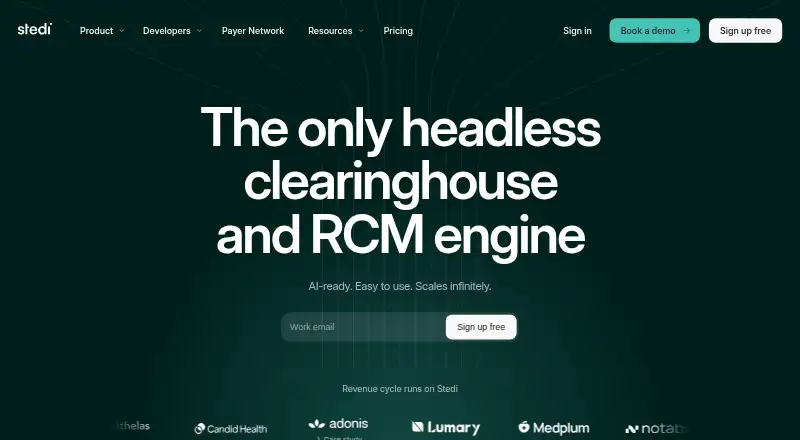
What Stedi is
Stedi is a cloud-based healthcare clearinghouse and revenue cycle management platform whose functionality is available through APIs. It handles real-time and batch eligibility checks through its portal or API, plus professional, institutional, and dental claims, claim status checks, acknowledgments, and electronic remittance advice. Its EDI platform can generate and deliver transactions through a single API request, with transforms, webhooks, retries, rate limiting, and separate environments. Stedi Apps provide prebuilt integrations for revenue cycle management, practice management, and EHR systems. Stedi says it connects to more than 3,500 U.S. healthcare payers, including Medicare and Medicaid. It lists HIPAA compliance, HITRUST certification, SOC 2 compliance, role-based access, and built-in multi-factor authentication. Free Sandbox accounts include mock eligibility checks and test API keys, but cannot submit test claims through API or SFTP. Pay-as-you-go has no monthly minimum, setup fee, per-provider fee, or per-payer fee; transaction charges vary by transaction type and monthly volume. Production transactions require production API keys.
Good
- Supports real-time and batch eligibility checks
- Handles professional, institutional, and dental claims
- Connects to more than 3,500 U.S. healthcare payers
- Lists HIPAA, HITRUST, and SOC 2 credentials
- Pay-as-you-go has no monthly minimum
Watch out
- Sandbox cannot submit test claims through API or SFTP
- Transaction charges vary by type and monthly volume
- Production transactions require production API keys
Who it suits
Stedi is aimed at healthcare technology businesses and established organizations that exchange healthcare transactions. It may suit teams seeking API-based eligibility, claims, and EDI workflows.
Verdict
Stedi covers a broad set of healthcare transaction workflows through APIs, a portal, and prebuilt integrations. Its free Sandbox supports mock eligibility work, but testing claims through API or SFTP is not supported there.
Plans and prices
From Stedi's own pricing page, checked 14 Oct 2026.
| Plan | Price | What it gives you |
|---|---|---|
| Sandbox | Free | Mock eligibility checks · Stedi portal access · Test API keys · Unlimited users · Free |
| ERA | $0.20 a month | 835 electronic remittance advice · Per adjudicated claim; $0.20 for 1–500 monthly, down to $0.08 at 10,001+ |
| Claim submission | $0.30 a month | 837P professional · 837I institutional · 837D dental · Per claim; $0.30 for 1–500 monthly, down to $0.10 at 10,001+ |
| Eligibility checks | $0.30 a month | 270/271 real-time and batch checks · Per check; $0.30 for 1–250 monthly, down to $0.08 at 10,001+ |
| Custom | Priced on request | Publish Stedi apps · SSO and SCIM · Consolidated billing · Dedicated technical account manager · Custom pricing with volume discounts |
| Pay as you go | — | Production portal/API/SFTP/webhooks/MCP · Unlimited providers and enrollments · Stedi apps · Treasury/EFT · Dedicated support · Signed BAA · No monthly minimum; usage-based |
The facts
Each one read from Stedi's own pages, with the date it was checked.
What it does
- API access
- Stedi APIs require an API key; test keys can return mock healthcare API responses, while production keys can send transactions to trading partners and payers.checked 30 Sep 2026
- API authentication
- Every API request requires a Stedi API key in the Authorization header, with separate test and production keys.checked 14 Oct 2026
- API design
- Stedi describes its APIs as JSON-native and provides APIs for eligibility, claims, transaction enrollment, and payer lists.checked 14 Oct 2026
- Availability architecture
- The company says its infrastructure is cloud-native, multi-region, AWS-powered, with redundant payer connections and automatic failover.checked 14 Oct 2026
- Claim attachments
- Users can submit 275 claim attachments through APIs, SFTP, or the portal.checked 14 Oct 2026
- Claims
- Stedi supports 837P professional, 837I institutional, and 837D dental claims in JSON and X12 EDI.checked 14 Oct 2026
- Claim status and remittance
- The platform returns 277CA acknowledgments, supports 276/277 claim-status checks, and processes 835 ERAs.checked 14 Oct 2026
- Coordination of benefits
- Its APIs identify coverage overlap and payer responsibility for claims.checked 14 Oct 2026
- Current status
- Stedi's official status page currently reports all listed systems operational and no notices in the previous seven days.checked 14 Oct 2026
- Documentation depth
- Developer documentation covers eligibility, claims, SFTP, attachments, edits, status, ERAs, Treasury, events, OAuth apps, and API references.checked 14 Oct 2026
- Eligibility
- The service supports real-time and batch 270/271 eligibility checks through its portal or API in JSON or X12 EDI.checked 14 Oct 2026
- Extensibility
- Event destinations can deliver Stedi events to customer endpoints, and OAuth apps can connect external systems to customer accounts.checked 14 Oct 2026
- Funding
- Healthcare Industry Reviews reports a $70 million Series B in August 2025 led by Stripe and Addition, bringing reported total funding to $142 million.checked 14 Oct 2026
- Independent pricing observation
- The independent review describes published usage pricing with no monthly minimum and says costs depend on transaction volume and support level.checked 14 Oct 2026
- Independent score
- Healthcare Industry Reviews scores Stedi 8.3 overall and labels it highly recommend.checked 14 Oct 2026
- Insurance discovery
- Stedi offers insurance-discovery checks that find active health plans from patient information.checked 14 Oct 2026
- Integrations
- Stedi Apps are prebuilt integrations for third-party revenue cycle management, practice management, and EHR systems; providers can browse and install them from their Stedi account settings.checked 30 Sep 2026
- Intended users
- Stedi presents its APIs and clearinghouse services for healthcare technology businesses and established organizations that exchange healthcare transactions.checked 30 Sep 2026
- License and hosting
- Stedi's service terms restrict copying, modification, distribution, sublicensing, and reverse engineering of licensed materials, indicating a proprietary hosted service rather than open-source software.checked 14 Oct 2026
- Limit: broader revenue-cycle scope
- The independent review says Stedi is a weak fit for buyers seeking denial management and patient payments from one vendor.checked 14 Oct 2026
- Limit: technical staffing
- The independent review says Stedi is a weak fit for practices without technical staff that want a ready-made billing screen.checked 14 Oct 2026
The company
- Company facts
- LinkedIn lists Stedi as privately held, founded in 2017, headquartered in New York, and employing 51–200 people.checked 14 Oct 2026
- Company identity
- The website identifies the maker as Stedi, Inc.checked 14 Oct 2026
Where it runs
- EDI platform
- Stedi’s EDI platform can generate and deliver EDI transactions with one API request and includes transforms, webhooks, retries, rate limiting, and separate environments.checked 30 Sep 2026
The full review of Stedi
Stedi is a healthcare transaction platform for organizations that need to connect their systems with payers. It is best suited to healthcare technology businesses and established organizations building or running those workflows; its free Sandbox helps with mock eligibility work, but production transactions require a paid plan.
Overview
Stedi combines clearinghouse and revenue cycle workflows in a cloud platform accessible through APIs and a portal. Eligibility checks, claims, claim status, acknowledgments, and electronic remittance advice are covered alongside broader EDI exchange. That breadth can reduce the need to assemble separate transaction connections, but the API-led approach is a better match for organizations integrating workflows than for individual clinicians seeking a standalone practice tool.
Stedi says it connects to more than 3,500 U.S. healthcare payers, including Medicare, Medicaid, medical, and dental payers. That reach is compelling for organizations exchanging varied payer transactions, though coverage alone does not remove the integration work required to build workflows around the service.
Key features
Eligibility checks can run in real time or in batches through the portal or API. Claims support includes professional, institutional, and dental claims, as well as status checks, acknowledgments, and electronic remittance advice. Teams handling multiple stages of revenue cycle exchange can work across those transaction types in one platform rather than relying on a narrow eligibility-only service.
The EDI platform generates and delivers transactions with one API request. Transforms, webhooks, retries, rate limiting, and separate environments support automated integrations and operational control. Stedi supports X12 and EDIFACT, with document types spanning benefit enrollment, eligibility, claims, claim status, attachments, remittance, and purchase orders. REST API, webhooks, SFTP, FTPS, FTP, and AS2 provide multiple ways to exchange transactions, a practical advantage for organizations integrating with different systems.
Stedi Apps are prebuilt connections for third-party revenue cycle management, practice management, and EHR systems, which users can browse and install from account settings. That can shorten integration work where a suitable app exists. The service also lists HIPAA compliance, HITRUST certification, SOC 2 compliance, role-based access, and built-in multi-factor authentication. Each customer gets a dedicated Slack or Microsoft Teams channel, as well as email support; Stedi reports an average response time under 10 minutes.
Pricing
Sandbox — free (billed Free) includes mock eligibility checks, portal access, test API keys, and unlimited users. It is useful for development and mock eligibility workflows, but it does not support submitting test claims through the API or SFTP. It is therefore not a complete test path for teams whose integration work depends on claims exchange.
Pay as you go — custom pricing has no monthly minimum, setup fee, per-provider fee, or per-payer fee. Charges are per transaction, with rates varying by transaction type and monthly volume. The plan includes a production portal, API, SFTP, webhooks, and MCP server; unlimited providers and transaction enrollments; dedicated support; and a signed BAA. This is the practical route for organizations moving real transactions into production, but costs depend on usage rather than a fixed published rate.
Custom — custom pricing adds volume discounts, the ability to publish Stedi Apps, SSO and SCIM, consolidated billing, and a dedicated technical account manager. It is aimed at organizations needing those enterprise-oriented controls or higher-volume commercial terms; teams that do not need them can start with pay as you go.
API use requires an API key. Test keys return mock healthcare API responses, while production keys send transactions to trading partners and payers, making the Sandbox’s limits particularly relevant before planning a production rollout.
Platforms
Stedi is available through web and API access and is deployed in the cloud. Its supported exchange methods include REST API, webhooks, SFTP, FTPS, FTP, and AS2. Partner onboarding is supported, which helps organizations setting up payer and trading-partner connections.
Who it's for
Stedi is strongest for healthcare technology businesses and established organizations exchanging healthcare transactions with payers. It suits teams that need broad transaction coverage, API-based automation, and multiple integration methods. It is less suitable for an individual clinician looking for a simple standalone application, or for a team that needs to test claim submissions through the free Sandbox before committing to production.
Pros and cons
- Pros: Broad coverage across eligibility, claims, status, acknowledgments, and remittance can consolidate several payer workflows.
- Pros: More than 3,500 payer connections and support for several EDI formats and exchange methods give integration teams flexibility.
- Pros: The free Sandbox has unlimited users and mock eligibility checks, with no seat cap to constrain a development team.
- Cons: The Sandbox cannot submit test claims through API or SFTP, leaving an important production workflow outside free testing.
- Cons: Production pricing is transaction-based and varies by transaction type and monthly volume, so spend is not a fixed monthly amount.
- Cons: The product is oriented toward organizations building transaction workflows, not individual practitioners seeking a standalone tool.
Alternatives
Electronic Data Interchange Software is the category directory for comparing EDI tools.
- EdiFabric is worth considering if a non-production EDI environment with a stated daily operation cap and leased-seat limit fits better; its Community plan is free forever.
- Rocket EDX is another option for teams comparing usage-based or fixed-price subscription models.
- SPS Analytics may suit readers looking for a supplier-focused platform.
- Babelway is an alternative for teams wanting published monthly tiers, including a Lite plan at $99 a month with 200 messages/month, 50 MB incoming volume, one environment, and one user.
- Commport Cloud EDI is positioned for businesses of all sizes and low-volume data exchange.
- EDI2XML is an option for teams seeking an on-premises plan, with its On-Premises EDI2XML plan starting at $450 a month and mapping and translation charged by volume.
- Jitterbit EDI is another subscription-based EDI add-on to compare for organizations evaluating transaction-volume allowances.
- Boomi is an alternative for teams comparing a 30-day free trial and a Pay-As-You-Go plan at $99 a month plus usage.
Verdict
Choose Stedi if your organization needs API-centered healthcare transaction infrastructure with broad payer reach and support across eligibility, claims, and EDI exchange. Its strongest case is bringing varied payer workflows into one service with flexible integration methods and dedicated support. Look elsewhere if you need a standalone clinician tool or must validate claim submissions in a free test environment before moving toward production.
Getting started
- Open https://www.stedi.com/.
- Create a free Sandbox account for portal access, mock eligibility checks, and test API keys.
- Use a test API key to receive mock healthcare API responses.
- For production transactions, use a production API key and the pay-as-you-go plan.
- Browse and install Stedi Apps from account settings if you need a prebuilt integration.
- Contact Stedi about Custom pricing if you need its listed custom-plan features.
Limits worth knowing
The free Sandbox supports mock eligibility checks and test API keys, but not test claims submitted through the API or SFTP. Pay-as-you-go has no monthly minimum, setup fee, per-provider fee, or per-payer fee, but transaction charges vary by transaction type and monthly volume.
Questions
Is Stedi free?
Stedi offers a free Sandbox with mock eligibility checks, portal access, test API keys, and unlimited users.
What does the Sandbox not support?
It does not support submitting test claims through the API or SFTP.
How is pay-as-you-go priced?
There is no monthly minimum, setup fee, per-provider fee, or per-payer fee. Transaction charges vary by transaction type and monthly volume.
What can Stedi process?
It supports eligibility checks; professional, institutional, and dental claims; claim status checks; acknowledgments; and electronic remittance advice.
Which integrations and connection methods are supported?
Stedi Apps are prebuilt integrations for revenue cycle management, practice management, and EHR systems. Listed integration methods include REST API, webhooks, SFTP, FTPS, FTP, and AS2.
What security credentials does Stedi list?
It lists HIPAA compliance, HITRUST certification, SOC 2 compliance, role-based access, and built-in multi-factor authentication.