EdiFabric
EdiFabric provides developer tools for translating EDI data to structured JSON and back.
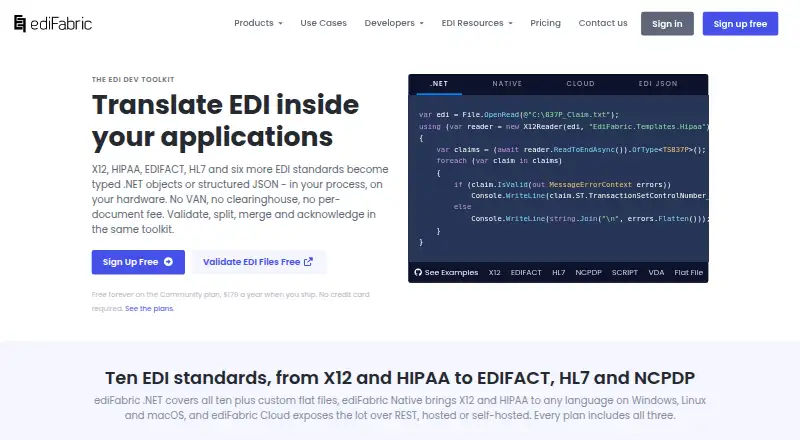
What EdiFabric is
EdiFabric provides developer tools for translating EDI data to structured JSON and back. The tools can parse, validate, generate, acknowledge, split, and map EDI, with support for custom models or templates. Its .NET and Cloud products cover EDIFACT, EANCOM, X12, HIPAA, IAIABC, NCPDP, HL7, VDA, EDIGAS, and IATA; .NET also supports custom flat files.
The Cloud product is a REST API callable from any language that can make REST requests and needs no installation. It can also be self-hosted; the vendor-hosted service processes EDI on its servers and is stated not to be HIPAA or SOC compliant. Native currently supports X12 and HIPAA, and Cloud requests have a 3 MB cap. Integration options include a .NET library, native C ABI, REST API, and self-hosted API. The free Community plan is for non-production use. Developer is listed at $179 a year, and Enterprise at $799 a year.
Good
- Translates EDI to and from structured JSON.
- Supports validation and custom EDI models or templates.
- Cloud API can be self-hosted.
- .NET includes Entity Framework database contexts.
- Community plan is free.
Watch out
- Native currently supports only X12 and HIPAA.
- Cloud requests are capped at 3 MB.
- Vendor-hosted Cloud is stated not to be HIPAA or SOC compliant.
- Community is restricted to non-production use.
Who it suits
Community is described for evaluation, learning, and prototyping; Developer is aimed at individual developers and small teams. Enterprise is positioned for company-wide use at scale.
Verdict
EdiFabric offers multiple integration approaches and broad standards coverage across its .NET and Cloud products. Check the Native and Cloud restrictions, and the hosted service compliance statement, against your requirements.
Plans and prices
From EdiFabric's own pricing page, checked 14 Oct 2026.
| Plan | Price | What it gives you |
|---|---|---|
| Community | Free | 250 operations/day shared across .NET, Native and Cloud · 3 leased seats · non-production only · public Cloud EDI models · forum support · forever |
| Cloud only | $0.01 a month | Hosted REST API only · no annual subscription or platform fee · private custom models · nothing installed locally · first 1,000 operations/month free, then $0.01 per operation |
| Developer | $179 a year | Unlimited local operations · 3,000 Cloud operations/month, then $0.01 each · 3 leased seats · 1 production environment · private Cloud models · standard support · annually |
| Enterprise | $799 a year | Unlimited local operations · 25,000 Cloud operations/month, then $0.008 each · unlimited seats and environments · offline mode · private Cloud models · standard support · annually |
| Perpetual | $2,950, paid once | Enterprise rights excluding hosted Cloud · perpetual serial key · legal entities only · one-time; $600/year after first year for updates and support |
| OEM | $4,500 a year | Requires Enterprise · redistribution rights · derived serial key per end customer · standard support · from $4,500 annually, quoted by customer count |
The facts
Each one read from EdiFabric's own pages, with the date it was checked.
What it does
- API authentication
- Cloud calls use HTTPS and require the serial key in the Ocp-Apim-Subscription-Key header.checked 14 Oct 2026
- Changelog news
- On 14 October 2026, the project announced Native bindings for Node.js, Go and Rust, with Windows, Linux and macOS packages.checked 14 Oct 2026
- Cloud API
- ediFabric Cloud is a REST API callable from any language that can make REST requests and requires no software installation.checked 30 Sep 2026
- Compliance limitation
- The hosted Cloud service is stated to be unsuitable for HIPAA or SOC 2 data, while .NET, Native and self-hosted deployments keep data inside the customer environment.checked 14 Oct 2026
- Documentation depth
- The help center lists standards references, error codes, FAQs, .NET features, .NET tutorials, Native guides, Cloud API references and Cloud tutorials.checked 14 Oct 2026
- EDI standards
- The .NET product covers X12, HIPAA, EDIFACT, HL7, NCPDP, IATA PADIS, VDA, EDIGAS and flat files; Cloud supports X12, HIPAA, EDIFACT, HL7, NCPDP and VDA.checked 14 Oct 2026
- Feature: acknowledgments
- The software can produce X12 997, 999 and TA1 acknowledgments plus EDIFACT CONTRL responses.checked 14 Oct 2026
- Feature: customization
- EDI templates can be customized for partner-specific usage, repetitions, lengths and code values through OpenEDI and the Spec Builder.checked 14 Oct 2026
- Feature: generation
- The tools write EDI from typed objects or JSON through .NET, Native and Cloud interfaces.checked 14 Oct 2026
- Feature: parsing
- The .NET SDK reads EDI into typed C# template objects, while Native and Cloud convert EDI to JSON.checked 14 Oct 2026
- Feature: validation
- Validation uses transaction templates and can include HIPAA SNIP checks.checked 14 Oct 2026
- Independent limitation: communications
- An independent GitHub ecosystem listing states that EdiFabric does not provide AS2 or SFTP communication components, a dashboard or a complete end-to-end EDI solution.checked 14 Oct 2026
- Integrations
- The .NET library includes Entity Framework database contexts for EDI data, and code examples are available on GitHub.checked 30 Sep 2026
- Integrations and deployment
- Official materials describe deployment on Windows, Linux, macOS, containers, AWS, Azure, Google Cloud, Docker, Visual Studio and Visual Studio Code.checked 14 Oct 2026
- Intended users
- The company describes Community as suitable for evaluation, learning, and prototyping, Developer for individual developers and small teams, and Enterprise for company-wide use at scale.checked 30 Sep 2026
- Languages and runtimes
- The Native library can be called from C, C++, Rust, Go, Python, Node.js, Java, and .NET through a C library interface.checked 30 Sep 2026
- Legal entity
- The About page identifies the maker as EDI Fabric Limited, incorporated in England and Wales under company number 8248816.checked 14 Oct 2026
- Licence
- EdiFabric is distributed under a proprietary commercial EULA with serial-key authentication and paid production rights; it is not presented as open-source software.checked 14 Oct 2026
- Limit: support
- A Capterra reviewer reported needing extensive digging for answers and rated customer service 1 out of 5.checked 14 Oct 2026
The company
- Company founding
- LinkedIn and the company About page identify 2016 as the founding year.checked 14 Oct 2026
- Company history
- EDI Fabric Limited was founded in 2016 by Kamen Nikolov while he was consulting for the NHS in London.checked 30 Sep 2026
- Company size and location
- LinkedIn lists EdiFabric as a privately held IT services company with 2–10 employees headquartered in Old Basing, England.checked 14 Oct 2026
- Founded
- 2016checked 28 Sep 2026
Money
- Limit: price
- A Capterra reviewer said the product was more expensive than alternatives they tried, despite working better for their use case.checked 14 Oct 2026
The full review of EdiFabric
Overview
EdiFabric is a set of developer tools for adding EDI processing to software, rather than a ready-made workflow app. It best suits developers and companies building integrations around EDI documents. Its range of libraries and APIs is a strength, but the right product depends on your runtime and standards: Native supports only X12 and HIPAA, and hosted Cloud requests are limited to 3 MB.
The .NET and Cloud products cover standards including EDIFACT, EANCOM, X12, HIPAA, IAIABC, NCPDP, HL7, VDA, EDIGAS, and IATA. .NET also supports custom flat files. The tools translate between EDI and structured JSON, with options to parse, validate, generate, acknowledge, split, and map data, as well as use custom EDI models or templates. For a wider category comparison, see Electronic Data Interchange Software.
Key features
- Multiple integration paths: A .NET library, Native library, and REST API let teams choose how to integrate EDI handling. The Cloud API can be called from any language able to make REST requests and needs no software installation; Native can be called through a C library interface from C, C++, Rust, Go, Python, Node.js, Java, and .NET.
- Database support in .NET: Entity Framework database contexts for EDI data give .NET developers a direct integration option. Code examples are available on GitHub.
- Cloud hosting choices: Cloud can run on customer infrastructure or on the vendor's servers. The vendor-hosted service processes EDI data on its servers and is stated not to be HIPAA or SOC compliant, so organizations with those compliance requirements should consider self-hosting instead.
- Defined operating limits: Cloud requests are capped at 3 MB each. The Developer plan includes 3,000 Cloud operations per month, matching the stated monthly transaction limit; extra operations cost $0.01 each.
Pricing
The free Community plan is suited to evaluation, learning, and prototyping, not production: it allows 250 operations per day, three leased seats, public Cloud EDI models, and forum support. Its non-production restriction is a material limit for anyone planning to run live integrations.
Cloud only costs $0.01 per contact, billed $ 0.01 /op. The first 1,000 operations each month are free, with no platform or subscription fee. It provides the hosted REST API and private custom EDI models, but no .NET or Native license. It is a focused way to pay for API use without buying a library license.
Developer costs $179 a year, billed $ 179 /year. It includes 3,000 Cloud operations per month, then charges $0.01 each, plus unlimited local operations, three leased seats, private Cloud models, and standard support. Standard support is three incidents a year for Developer. This is the most direct fit for an individual developer or small team that needs both local processing and a modest Cloud allowance.
Enterprise costs $799 a year, billed $ 799 /year. It raises the Cloud allowance to 25,000 operations per month, then charges $0.008 each, and adds unlimited local operations, seats, and owned environments, offline mode, and standard support. That makes it more suitable for company-wide use at scale; the higher annual cost buys capacity and deployment flexibility rather than unlimited Cloud usage.
Perpetual costs $2,950, paid once, billed $ 2,950 once. It provides Enterprise rights excluding Cloud, with a serial key that never expires; updates and support last one year, then cost $600 per year to stay current. It is restricted to legal entities, so it is not an individual-developer alternative to Developer.
OEM costs $4,500 a year, billed $ 4,500 /year, is quoted on customer count, and requires an Enterprise plan. It adds commercial redistribution rights and one derived serial key per end customer, with standard support to the main licensee. This is for vendors redistributing EDI software, not ordinary internal use. A 14-day trial is also offered.
Platforms
EdiFabric supports API, Linux, macOS, self-hosted, and Windows environments. The product choices matter more than the platform list: .NET offers the broadest standards coverage, Native is limited to X12 and HIPAA, and Cloud offers language-independent REST integration but imposes the 3 MB request cap. Self-hosting is available for Cloud where control of the processing environment matters.
Who it's for
EdiFabric is a strong fit for software developers embedding EDI translation and validation in their own systems, particularly teams that need custom models or support for multiple EDI standards. Community gives learners and prototypes room to explore without a charge, while Developer targets individual developers and small teams. Enterprise is aimed at broader company use, and OEM at commercial redistribution. It is a poor fit for buyers seeking a general-purpose EDI application rather than developer components, or for Native users who need standards beyond X12 and HIPAA.
Pros and cons
- Pro: Broad standards coverage in .NET and Cloud, with custom flat-file support in .NET, serves teams handling varied EDI formats.
- Pro: .NET, Native, Cloud, and customer-hosted Cloud options accommodate different integration and deployment needs.
- Pro: Developer includes unlimited local operations, and Enterprise adds unlimited seats and owned environments.
- Con: Community is non-production only and limits users to 250 daily operations and three leased seats.
- Con: Native currently handles only X12 and HIPAA, making it unsuitable when a project depends on another listed standard.
- Con: Vendor-hosted Cloud processes data on vendor servers and is stated not to be HIPAA or SOC compliant; requests also cannot exceed 3 MB.
- Con: Cloud usage is metered above each paid plan's monthly allowance, so high-volume API use adds variable costs.
Alternatives
Stedi is worth considering for teams that want a free sandbox with mock eligibility checks, test API keys, portal access, and unlimited users; its paid option has no monthly minimum.
Rocket EDX is an alternative for teams looking at a paid EDI product across API, Linux, web, and Windows.
SPS Analytics may suit buyers seeking a supplier-focused platform, though its Decision Intelligence pricing is by sales contact.
Babelway is a paid option with a free trial; its Lite plan costs $99 a month for 200 messages, 50 MB incoming volume, one environment, and one user.
EDI2XML is an alternative for teams seeking an on-premises service, with a mandatory fixed license subscription starting at $450 a month and mapping and translation charged by volume.
Boomi offers a 30-day free trial and a Pay-As-You-Go plan at $99 a month plus usage, for buyers comparing a broader integration platform.
Orderful may fit teams focused on labels API access, with its Labels Only plan at $99 a month and ERP/WMS integration.
TrueCommerce is another paid option, with plans organized by trading-partner count.
Verdict
Choose EdiFabric if you are building EDI processing into software and want a choice of .NET, Native, or REST integration, with broad standards support in .NET and Cloud. Its main advantage is that flexibility, backed by custom models and local processing; look elsewhere if you need a turnkey EDI application, broader Native standards, or vendor-hosted Cloud that meets HIPAA or SOC compliance requirements.
Getting started
- Visit the EdiFabric website.
- Choose Community, Cloud only, Developer, Enterprise, Perpetual, or OEM based on the listed plan terms.
- Select a .NET library, Native C ABI, REST API, or self-hosted API integration route.
- Check that the product covers the EDI standards and file types your workflow needs.
- For Cloud use, decide between the vendor-hosted service and self-hosting on customer infrastructure.
Limits worth knowing
Community is limited to 250 operations per day, three leased seats, public Cloud EDI models, and non-production use. Cloud only includes 1,000 free operations per month, then costs $0.01 per operation; Developer includes 3,000 Cloud operations per month, then $0.01 each. Cloud requests are capped at 3 MB.
Questions
Is EdiFabric free?
Yes. Community is free forever and includes 250 operations per day, three leased seats, public Cloud EDI models, and non-production use. Cloud only also provides the first 1,000 operations each month free.
What does a paid plan cost?
Developer costs $179 a year, and Enterprise costs $799 a year. Other listed plans include Cloud only at $0.01 per contact, Perpetual at 2950.00 USD once, and OEM at $4,500 a year.
Which platforms and integration methods does it support?
Listed platforms are API, Linux, macOS, self-hosted, and Windows. Integration methods include REST API, .NET library, native C ABI, and self-hosted API.
Which EDI standards does EdiFabric support?
.NET and Cloud cover EDIFACT, EANCOM, X12, HIPAA, IAIABC, NCPDP, HL7, VDA, EDIGAS, and IATA. .NET also supports custom flat files; Native currently supports X12 and HIPAA.
Can EdiFabric be self-hosted?
Yes. The Cloud API can run on customer infrastructure. The vendor-hosted Cloud service processes EDI data on its servers and is stated not to be HIPAA or SOC compliant.
Is there a free trial, and what support is included?
A 14-day trial is listed. Community includes EDI forum support; paid plans include standard support, described as three incidents a year for Developer.