Spleenlab Video Stabilization
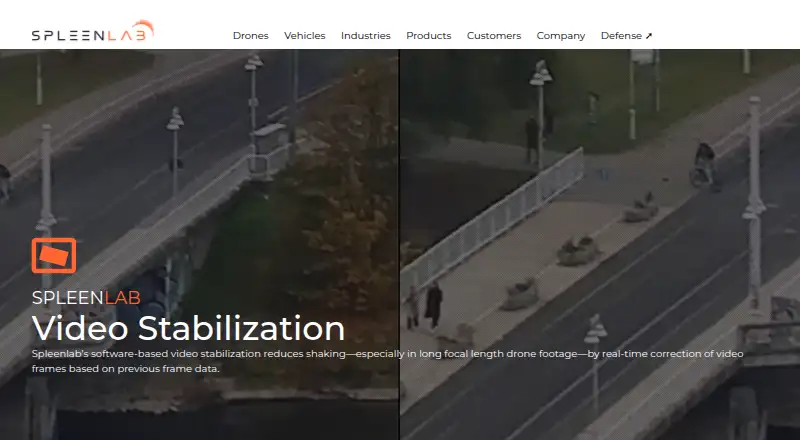
Spleenlab Video Stabilization corrects shaking video in real time by using information from earlier frames.
What Spleenlab Video Stabilization is
Spleenlab Video Stabilization corrects shaking video in real time by using information from earlier frames. It accepts RGB or thermal infrared camera streams and outputs stabilized frames plus a stabilization vector. The software is especially suited to long focal length drone footage and is intended to support perception functions such as object detection and tracking. Optional IMU integration combines inertial data with video to improve accuracy during fast motion or when GPS is unavailable. The listed interface is ROS2, allowing combination with perception pipelines. Spleenlab lists an update rate of up to 60 Hz and initialization under one second, while noting that results vary by configuration. Processing runs locally on Linux with Docker required. Companion hardware includes Nvidia Jetson, ModalAI Voxl2 or Mini, Qualcomm RB5, IMX7, IMX8, and Raspberry PI. Minimum resources are 2 GB RAM and 20 GB storage; recommended resources are 4 GB RAM and 50 GB storage. The product is presented for drone operations, ADAS and AD, industrial, agriculture, cargo and logistics, and defense. Pricing is available on request.
Good
- Processes video locally on Linux
- Supports RGB and thermal streams
- Optional IMU improves stabilization accuracy
- ROS2 interface for perception pipelines
- Outputs stabilized frames and a vector
Watch out
- Pricing is available on request
- Docker is required
- Actual requirements vary by configuration
- Animation or other unrelated workflows are not provided
Who it suits
The software suits drone and autonomous-mobility teams that need local video stabilization for perception pipelines, including operations using long focal lengths, thermal cameras, or GPS-denied motion.
Verdict
Spleenlab Video Stabilization targets real-time camera correction for drones and related autonomous systems. Its Linux, Docker, hardware, and configuration requirements should be confirmed with Spleenlab before deployment.
The facts
Each one read from Spleenlab Video Stabilization's own pages, with the date it was checked.
What it does
- AI output
- The product provides stabilized video streams intended to improve perception modules such as object detection and tracking.checked 11 Oct 2001
- Camera support
- The product supports visual RGB cameras and thermal infrared video streams.checked 11 Oct 2001
- Getting started
- The product page directs prospective customers to contact Spleenlab to learn more.checked 11 Oct 2001
- Hardware
- Listed supported companion hardware includes Nvidia Jetson, ModalAI Voxl2 / Mini, Qualcomm RB5, IMX7, IMX8, and Raspberry PI.checked 11 Oct 2001
- IMU
- Optional IMU integration fuses inertial data to improve stabilization accuracy, especially in GPS-denied or fast-motion scenarios.checked 11 Oct 2001
- Inputs and outputs
- Inputs are camera video frames from any camera type; outputs are stabilized video frames and a stabilization vector.checked 11 Oct 2001
- Integration
- The listed interface is ROS2, and the product page says the software combines with perception pipelines.checked 11 Oct 2001
- Intended users
- The product is presented for drone operations and related industries including ADAS & AD, industrial, agriculture, cargo & logistics, and defense.checked 11 Oct 2001
- Interface
- The product page lists ROS2 as its interface.checked 11 Oct 2001
- Limits
- The listed hardware specifications are recommendations based on customer projects and integrations; the maker says actual requirements may vary by configuration.checked 11 Oct 2001
- Long focal lengths
- Spleenlab says the software is especially suited to long focal length drone footage.checked 11 Oct 2001
- Performance
- The product page lists an update rate of up to 60 Hz and an initialization time under one second.checked 11 Oct 2001
- Performance caveat
- Spleenlab says the listed performance metrics are demonstrative, based on configurations with proven results, and may vary by setup.checked 11 Oct 2001
- Privacy
- Spleenlab's website privacy policy says it is governed by GDPR, BDSG, and TTDSG and describes technical and organizational measures to protect website data.checked 11 Oct 2001
- Purpose
- The software stabilizes shaking video by correcting frames in real time using data from previous frames.checked 11 Oct 2001
- Resource guidance
- The page recommends 4 GB RAM and 50 GB storage, with minimum figures of 2 GB RAM and 20 GB storage.checked 11 Oct 2001
- Resource recommendations
- The page lists minimum and recommended RAM of 2 GB and 4 GB, storage of 20 GB and 50 GB, and camera resolutions and frame rates of 640 × 480 at 10 FPS and 1920 × 1080 at 30 FPS.checked 11 Oct 2001
- Runtime requirements
- The listed basis software and operating system are Linux with Docker required.checked 11 Oct 2001
- Software requirements
- The page lists Linux as the basis software/OS and says Docker is required.checked 11 Oct 2001
- Support
- The maker invites prospective customers to contact its team to discuss the product and its configuration.checked 11 Oct 2001
The company
- Company security
- Spleenlab's website privacy policy says it implements technical and organizational measures to protect personal data.checked 11 Oct 2001
- Company security context
- Spleenlab describes itself as developing reliable, safety-driven software for complex autonomous mobility environments.checked 11 Oct 2001
- Founded
- 2018checked 28 Sep 2001
- Headquarters
- Saalburg-Ebersdorf, Thuringia, Germanychecked 28 Sep 2001
Alternatives to Spleenlab Video Stabilization
- 1
Cutout.Pro
Free planAndroidiOSWebAPI8.2From $4.99 a month - 2
TensorPix
Free planAndroidiOSWebAPI8.2From $5.50 a month - 3
HitPaw VikPea
AndroidiOSWebAPI7.8From $8.33 a month - 4
Wink AI Video Generator
Free planAndroidiOSWebmacOS7.8From $9.99 a month - 5
Wondershare Filmora
Free planAndroidiOSWebmacOS7.8$79.99, paid once - 6

PhotoDirector
Free planmacOSWindows7.7$119.99, paid once