
Skeema
Skeema is a declarative SQL-based schema management utility for applying repository changes to MySQL and MariaDB tables and routines.
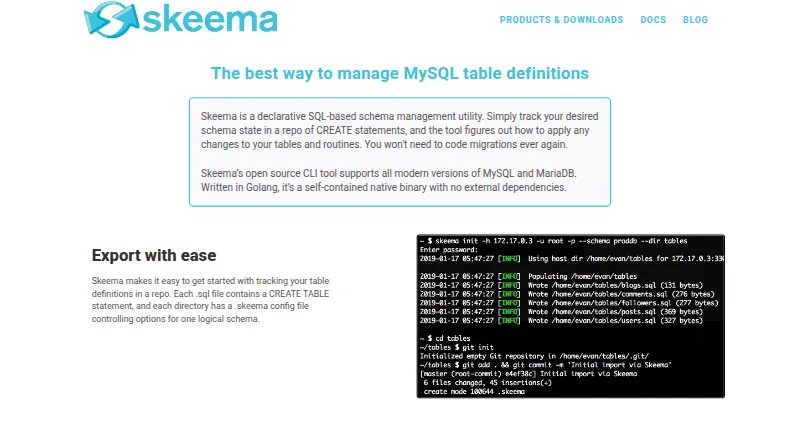
What Skeema is
Skeema is a declarative SQL-based schema management utility for applying repository changes to MySQL and MariaDB tables and routines. It generates SQL DDL from schema files and provides diff, lint, push, and pull commands. Configurable linter rules flag unsafe changes, and Skeema checks generated ALTER TABLE statements in a workspace before proceeding. For online schema changes, it supports native database alterations and external tools including pt-online-schema-change and gh-ost, with execution configured by environment and table size. Schema directories can map to multiple database servers or schemas, and the utility can detect drift across shards. The site lists support for MySQL 5.5–9.7, MariaDB 10.1–12.3, and Percona Server; AWS Aurora MySQL 5.7–8.4 is listed for Premium. Skeema Cloud Linter can automatically produce diff and lint output for related GitHub commits. All editions can use SSL/TLS; Premium adds client certificates, CA verification options, and SSH tunnels. Community lists Linux and macOS, while paid Plus and Max list Linux, macOS, and Windows.
Good
- Provides diff, lint, push, and pull commands.
- Checks generated ALTER statements in a workspace.
- Supports native and external online schema changes.
- Can detect schema drift across shards.
- Free Community edition is available.
Watch out
- Does not manage users, grants, roles, or global variables.
- MariaDB sequences are not yet supported.
- Community lists Linux and macOS, not Windows.
Who it suits
Skeema suits teams managing MySQL or MariaDB schema changes through SQL files and repository workflows. Its sharding and drift features may be useful where schemas span multiple servers or databases.
Verdict
Skeema provides a repository-based SQL workflow with safety checks and options for online changes. Check its listed database scope and exclusions, and note that Windows is listed for paid plans rather than Community.
Plans and prices
From Skeema's own pricing page, checked 29 Sep 2026.
| Plan | Price | What it gives you |
|---|---|---|
| Community | Free | Tables · stored procedures and functions · 18 linter checks · Linux and macOS · Apache 2.0 |
| Plus | $124 a month | Tables, routines, views, triggers, events, seed data · Linux, macOS, Windows · sharding up to 10 shards per directory · public support · $124/month or $1238/year |
| Max | $499 a month | Tables, routines, views, triggers, events, seed data · Linux, macOS, Windows · unlimited sharding · private email technical support · $499/month or $4988/year |
| Skeema Cloud Linter | $649 a year | Optional SaaS add-on · covers an entire GitHub organization · automatic diff and lint for Skeema commits in GitHub repositories · $649 USD per year |
| Plus | $1,238 a year | Tables, routines, views, triggers, events, seed data · Linux, macOS, Windows · sharding up to 10 shards per directory · public support · $124/month or $1238/year |
| Max | $4,988 a year | Tables, routines, views, triggers, events, seed data · Linux, macOS, Windows · unlimited sharding · private email technical support · $499/month or $4988/year |
The facts
Each one read from Skeema's own pages, with the date it was checked.
What it does
- Database compatibility
- The site lists support for MySQL 5.5–9.7, MariaDB 10.1–12.3, Percona Server, and—on Premium—AWS Aurora MySQL 5.7–8.4.checked 29 Sep 2026
- GitHub integration
- Skeema Cloud Linter provides automatic diff and lint output for Skeema-related commits in GitHub repositories and supports a pull-request workflow through cloud-based CI.checked 29 Sep 2026
- Intended users
- Skeema Community is described as free open-source software, while Premium Plus is positioned for startups and smaller teams and Max for larger organizations.checked 29 Sep 2026
- Notable limits
- Skeema does not manage database users, privilege grants, roles, or global variables, and MariaDB sequences are not yet supported.checked 29 Sep 2026
- Online schema changes
- Skeema supports database-native online alterations and external tools such as pt-online-schema-change and gh-ost, with configurable execution based on environment and table size.checked 29 Sep 2026
- Purpose
- Skeema is a declarative SQL-based schema management utility that applies changes expressed as CREATE statements in a repository to MySQL and MariaDB tables and routines.checked 29 Sep 2026
- Safety
- Skeema uses configurable linter rules, detects unsafe changes, and verifies generated ALTER TABLE statements in a workspace before proceeding.checked 29 Sep 2026
- Schema workflow
- Skeema generates SQL DDL from schema files and provides diff, lint, push, and pull commands.checked 29 Sep 2026
- Security
- All editions can use SSL/TLS connections; Premium adds client certificates, CA verification options, and SSH tunnels.checked 29 Sep 2026
- Sharding
- Skeema can map a schema directory to multiple database servers or schemas and can detect schema drift across shards.checked 29 Sep 2026
- Support
- Public technical support is available to all CLI users through GitHub issues, while private technical support is included with Max.checked 29 Sep 2026
The company
- Founded
- 2016checked 28 Sep 2026
- Headquarters
- Northern New Jersey, United Stateschecked 28 Sep 2026
- Maker history
- The Skeema CLI was initially released in 2016, and its creator Evan Elias independently created the tool to bring declarative schema management to MySQL and MariaDB.checked 29 Sep 2026
The full review of Skeema
Skeema is a SQL schema-management utility for teams that keep MySQL and MariaDB structure in a repository. It best suits developers who want reviewable, repeatable schema changes and safeguards before deployment. Its strengths are deployment controls and shard awareness; its narrower scope and lack of rollback support matter when choosing a plan or tool.
Overview
Skeema turns repository schema files into database DDL, with commands to diff, lint, push, and pull changes. That makes it a practical fit for teams who want database structure managed alongside application code rather than through a separate, ad hoc workflow. Schema diffs, CI/CD automation, drift detection, and a self-hosted option support that approach.
Configurable lint rules flag unsafe changes, and Skeema verifies generated ALTER TABLE statements in a workspace before proceeding. For online changes, teams can choose native database alterations or external tools such as pt-online-schema-change and gh-ost, with execution tuned by environment and table size. These checks and options are useful deployment controls, but they do not provide rollback support.
Key features
Repository workflow and safeguards
Diff and lint commands help teams review proposed schema changes before pushing them. Workspace verification adds another check on generated ALTER statements, which is valuable when a change could affect production tables. The tool's declarative SQL approach will appeal most to teams comfortable expressing desired structure as CREATE statements.
Online changes and sharding
Online alteration options let teams use database-native behavior or integrate established external tools, with execution configurable by environment and table size. Skeema can also map a schema directory to multiple servers or schemas and detect drift across shards. Plus caps sharding at 10 shards per directory; Max removes that cap, making the higher tier more relevant for larger distributed deployments.
Compatibility and boundaries
Skeema supports MySQL 5.5–9.7, MariaDB 10.1–12.3, and Percona Server; AWS Aurora MySQL 5.7–8.4 is supported on Max. SSL/TLS connections are available in all editions, while Max adds client certificates, CA verification options, and SSH tunnels. Skeema does not manage database users, grants, roles, or global variables, and MariaDB sequences are not supported, so teams needing those objects must handle them elsewhere.
Skeema Cloud Linter adds automatic diff and lint output for Skeema-related commits in GitHub repositories through cloud-based CI and supports pull-request workflows. Public technical support is available to CLI users; private email technical support comes with Max.
Pricing
Community is free open-source software under Apache 2.0. It covers tables, stored procedures, and functions, with 18 linter checks, and runs on Linux and macOS. It is the sensible starting point for open-source use or teams whose schema objects and operating systems fit those limits, but it excludes views, triggers, events, seed data, and Windows.
Plus costs $124 a month, billed at $124/month or $1238/year. It adds views, triggers, events, and seed data alongside tables and routines, supports Linux, macOS, and Windows, and includes public support and sharding up to 10 shards per directory. This is the fit for smaller teams that need the expanded object coverage or Windows support without unlimited sharding or private support.
Max costs $499 a month, billed at $499/month or $4988/year. It includes the same schema-object coverage and platforms as Plus, with unlimited sharding, private email technical support, and the additional connection-security options. Larger organizations with extensive shard fleets or a need for private support have the clearest reason to pay the premium.
Skeema Cloud Linter is an optional SaaS add-on at $649 a year. It covers an entire GitHub organization and automates diff and lint output for Skeema commits; teams seeking this cloud review workflow should account for it separately from the CLI plan.
Platforms
Community runs on Linux and macOS. Plus and Max add Windows support. The listed database scope spans MySQL, MariaDB, and Percona Server, with AWS Aurora MySQL support reserved for Max. That makes the edition choice consequential for Windows users and Aurora deployments, not merely a question of team size.
Who it's for
Skeema is strongest for MySQL- and MariaDB-focused teams that want SQL schemas in version control, pre-deployment checks, and configurable online changes. Its sharding features make it particularly relevant to multi-server environments. It is a weaker fit for teams that need schema rollback, database user and privilege management, or MariaDB sequences within the same tool.
Pros and cons
Pros
- Repository-based diff, lint, push, and pull workflow gives teams a repeatable path for schema changes.
- Unsafe-change checks and workspace verification provide safeguards before generated ALTER statements proceed.
- Native and external online-change options, plus shard drift detection, suit varied deployment setups.
- Community is free, while paid tiers add broader object coverage and Windows support.
Cons
- No rollback support, so teams should not treat Skeema as a recovery mechanism for a bad deployment.
- Community is limited to Linux and macOS and covers fewer schema objects than Plus or Max.
- Users, grants, roles, global variables, and MariaDB sequences fall outside its management scope.
- Aurora MySQL support and private support require Max, a substantial step up from Plus.
Alternatives
Database Migration Tools and Database Schema Comparison Tools are useful starting points for comparing the broader categories.
- Atlas is worth considering if its open-core model, free plan, free trial, or API and self-hosted platform options better match your setup.
- FluentMigrator is a free Apache-2.0 framework distributed through NuGet, a relevant alternative for teams choosing provider packages separately.
- Bytebase Enterprise offers a free Community plan for up to 20 users and 10 database instances, with a paid Pro option; consider it if those stated limits and its API, self-hosted, or web platforms suit your needs.
- SchemaHero is a free alternative with Linux, macOS, self-hosted, web, and Windows platforms.
- sqldef is a free alternative available for Linux, macOS, self-hosted, web, and Windows.
- Alembic is free open-source software under the MIT license, with a self-hosted platform option.
- Liquibase has a free plan and a Starter plan for up to five applications and one database type, with professional services required for onboarding and implementation.
- Redgate SQL Provision is a paid option with a free trial and capacity tiers based on production data volume to provision or mask.
Verdict
Choose Skeema if your team wants repository-managed MySQL or MariaDB schemas, meaningful pre-deployment checks, and configurable online changes, especially across shards. Community is a capable free starting point within its object and platform limits; Plus or Max makes sense when those limits become blockers. Look elsewhere if rollback, database access-control management, or broader schema-object coverage in the free tier is essential.
Getting started
- Visit the Skeema website and choose Community, Plus, or Max.
- Install the CLI on a supported operating system for the chosen plan.
- Put CREATE statements for tables and routines in a repository schema directory.
- Use diff and lint to inspect changes, then push or pull as needed.
- For GitHub commit diff and lint output, add the Skeema Cloud Linter SaaS option.
Limits worth knowing
Community is limited to tables, stored procedures and functions, 18 linter checks, and Linux and macOS. Plus supports up to 10 shards per directory; Max has unlimited sharding. The separate Cloud Linter option is an add-on billed at $649 a year.
Questions
Is Skeema free?
Yes. Community is free and is described as free open-source software under Apache 2.0.
What do the paid plans cost?
Plus is $124 a month, or $1238/year. Max is $499 a month, or $4988/year.
Which operating systems are supported?
Community lists Linux and macOS. Plus and Max list Linux, macOS, and Windows.
Which databases does Skeema support?
The compatibility list includes MySQL 5.5–9.7, MariaDB 10.1–12.3, and Percona Server. Premium lists AWS Aurora MySQL 5.7–8.4.
Does Skeema support GitHub workflows?
Skeema Cloud Linter provides automatic diff and lint output for Skeema-related GitHub commits and supports pull-request workflows through cloud-based CI.
What does Skeema not manage?
It does not manage database users, privilege grants, roles, or global variables. MariaDB sequences are not yet supported.
Alternatives to Skeema
- 1

Atlas
Free planOpen sourceWebAPILinuxmacOS8.3From $39 a month - 2
DeepFilterNet
Free planOpen sourceAPILinuxmacOSSelf-hosted7.6Free plan - 3
pgroll
Free planOpen sourceLinuxmacOSSelf-hostedWindows7.3Free plan - 4

Bytebase Enterprise
Free planWebAPISelf-hosted6.8From $20 a month - 5
Sqitch
Free planLinuxmacOSSelf-hostedWindows6.7Free plan - 6
sqlx-cli
Free planLinuxmacOSWindows6.6Free plan