sipmon
sipmon is a free, open-source monitor for SIP signaling and RTP media quality.
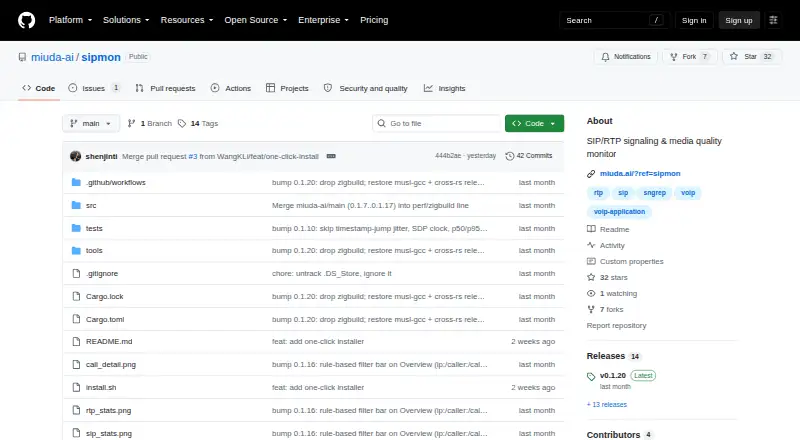
What sipmon is
sipmon is a free, open-source monitor for SIP signaling and RTP media quality. It runs as a standalone Rust executable on Linux and does not require a running PBX. It can process live interface captures, pcap or pcapng files, tcpdump streams from stdin, and recorded event logs. sipmon correlates calls and SIP transactions by Call-ID and supports SIP-over-TCP reassembly. Its media reports include RFC3550 jitter and loss, RTCP round-trip time, one-way delay estimates, and estimated E-model MOS. More than 20 diagnostic rules cover areas such as Contact reachability, Record-Route, SDP/RTP consistency, one-way media, and TURN allocation or refresh. It can learn TURN servers and label client and peer relay legs. The terminal UI includes overview, call detail, SIP statistics, streams, event log, and IP statistics; users can also query a Call-ID flow and export JSONL. Event logs retain summaries and truncated raw SIP messages, not raw RTP payload. Static binaries are available for Linux x86_64 and aarch64, with Cargo installation also documented. On busy relay hosts, capture can compete with rtpengine for CPU.
Good
- Runs without a PBX.
- Accepts live, offline, and recorded captures.
- Reports jitter, loss, delay, and estimated MOS.
- Provides more than 20 diagnostic rules.
- Raw RTP payload is not stored.
Watch out
- Available platforms are Linux and self-hosted.
- Capture competes with rtpengine for CPU on busy relay hosts.
- High packet rates may call for a dedicated mirrored capture box.
Who it suits
sipmon suits Linux operators diagnosing SIP calls and RTP media quality from captured traffic, especially those working with Kamailio or rtpengine. It is not a synthetic call testing tool.
Verdict
sipmon offers detailed call and media diagnostics for teams able to capture and inspect their own SIP/RTP traffic. Its CPU caveat matters on busy relay hosts, where filtering or a dedicated capture box may be needed.
The facts
Each one read from sipmon's own pages, with the date it was checked.
What it does
- Call analysis
- It correlates SIP transactions and calls by Call-ID and supports SIP-over-TCP reassembly.checked 8 Oct 2026
- Capture caveat
- On busy relay hosts capture competes with rtpengine for CPU; the README recommends filtering traffic or using a dedicated mirrored capture box at high packet rates.checked 4 Oct 2026
- Capture inputs
- It can analyze live interfaces, offline pcap/pcapng files, tcpdump streams from stdin, and recorded event logs.checked 8 Oct 2026
- Deployment
- The README describes deployment on a mirrored port or packet-capture box, with live, record, replay, and headless modes.checked 8 Oct 2026
- Diagnostics
- The project describes 20+ diagnostic rules covering Contact reachability, Record-Route, SDP/RTP consistency, one-way media, and TURN allocation or refresh.checked 8 Oct 2026
- Integration
- The README documents capturing Kamailio SIP and rtpengine media together, including a topology where SIP is mirrored to the rtpengine host.checked 8 Oct 2026
- Integrations
- The README documents piping a live tcpdump capture into sipmon and describes capture setups involving Kamailio and rtpengine.checked 4 Oct 2026
- Interface and exports
- It provides a terminal UI with Overview, Call Detail, SIP Stats, Streams, Event Log, and IP Stats pages, plus JSONL exports and Call-ID queries.checked 4 Oct 2026
- Interfaces and exports
- It provides a terminal UI, JSONL exports, and a query command that retrieves a Call-ID flow for scripting.checked 8 Oct 2026
- Media metrics
- It reports RFC3550 jitter and loss, RTCP receiver-report RTT, estimated one-way delay, and estimated E-model MOS.checked 8 Oct 2026
- Packet data
- The event log stores analysis summaries and truncated raw SIP messages, and the README says raw RTP payload is not stored.checked 8 Oct 2026
- Privacy and storage
- The event log stores analysis summaries and truncated raw SIP messages, and the README states that raw RTP payload is not stored.checked 4 Oct 2026
- Purpose
- sipmon is a passive SIP/RTP signaling and media quality monitor that runs as a standalone Rust executable without depending on a running PBX.checked 8 Oct 2026
- SIP analysis
- It correlates SIP calls and transactions by Call-ID and supports SIP-over-TCP reassembly.checked 4 Oct 2026
- Storage limits
- The documented defaults include a 100,000-call memory cap, a 15-minute call TTL, and 50,000-entry caps for RTP streams and diagnostics.checked 8 Oct 2026
- Support
- The maker's site lists [email protected] as a contact email.checked 8 Oct 2026
- TURN support
- sipmon can automatically learn TURN servers and label turn-client and turn-peer relay legs.checked 8 Oct 2026
Where it runs
- Linux binaries
- Prebuilt static Linux binaries are offered for x86_64 and aarch64, and the README also gives a Cargo installation option.checked 8 Oct 2026
- Linux downloads
- The README says prebuilt static binaries are available for Linux x86_64 and aarch64, with installation from GitHub Releases or Cargo.checked 4 Oct 2026
The company
- Maker
- The repository links to miuda.ai, whose linked About page says the company was founded by a team of telecommunications and AI experts; it does not state a founding year or headquarters.checked 8 Oct 2026
Alternatives to sipmon
- 1

Dotcom-Monitor
Free planAndroidiOSWebAPI8.3From $13.33 a month - 2

Obkio
Free planAndroidiOSWebAPI8.2From $249 a month - 3
Exoprise
WebAPIExtensionLinux6.8From $100 a month - 4

Telchemy SQmediator
AndroidWebAPILinux6.7 - 5
VoIP Spear
WebAPImacOSWindows6.5From $14.95 a month - 6
VoIPmonitor
WebAPILinuxSelf-hosted6.5From $259 a year