Siemens Building X
Siemens Building X is a cloud platform for managing building operations and using building data to support sustainability, operations, and performance.
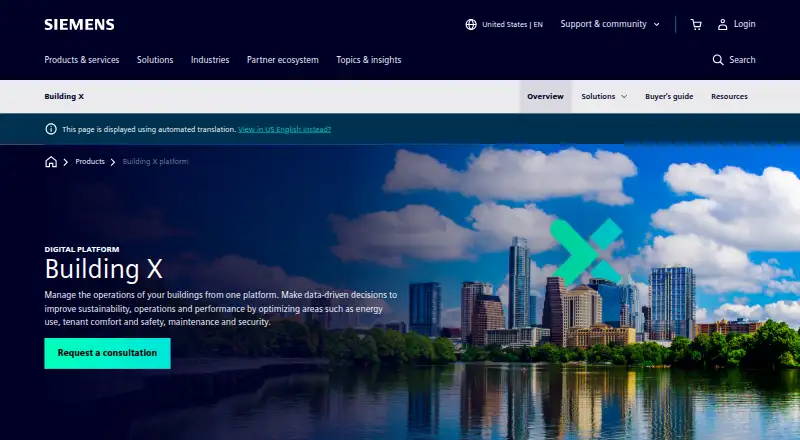
What Siemens Building X is
Siemens Building X is a cloud platform for managing building operations and using building data to support sustainability, operations, and performance. Its applications address energy and sustainability, safety and security, and operations and maintenance. Energy Manager monitors energy use and costs, compares building portfolios, and provides custom performance indicators, analytics, and reporting. The platform supports equipment from different vendors through Siemens solutions, gateways, and standard protocols; Siemens devices are not required. Open APIs support application development and integration, including access to application, building, and user-account data. Siemens hosts Building X on AWS and handles deployment. Siemens says building owners own the building data and decide how it is accessed, shared, and used. It lists ISO/IEC 27001, 27017, and 27018 certifications and a SOC 2 Type II report for Building X; Energy Manager is ISO 50001-certified. Subscriptions are yearly, and pricing and regional availability require contacting Siemens. The Workplace Experience app supports mobile, web, and kiosk access.
Good
- Applications cover energy, safety, and building operations.
- Energy Manager monitors use, costs, and portfolio benchmarks.
- Siemens devices are not required for connectivity.
- Building owners control access to their data.
Watch out
- Subscriptions are yearly.
- Pricing and regional availability require contacting Siemens.
- API Manager limits machine users by partition and group.
Who it suits
Building X suits organizations managing building operations that want energy monitoring, safety and security, or maintenance applications. Its open APIs and vendor-agnostic connectivity may suit teams integrating building systems and data.
Verdict
Building X brings building operations, energy management, and open integration APIs together in a cloud platform. Organizations should confirm pricing, regional availability, and API user limits with Siemens.
Plans and prices
From Siemens Building X's own pricing page, checked 15 Oct 2026.
| Plan | Price | What it gives you |
|---|---|---|
| Building X application or API subscription | — | Applications and APIs purchased separately · scale by adding subscriptions · hosting and deployment included · Yearly; contact Siemens for pricing and cancellation terms |
The facts
Each one read from Siemens Building X's own pages, with the date it was checked.
What it does
- AI and forecasting
- The platform offers AI and machine-learning analytics for real-time analysis and forecasting.checked 15 Oct 2026
- API access limits
- Building X API Manager allows up to 200 machine users per partition and 75 per machine-user group.checked 2 Oct 2026
- API authentication
- Developers authenticate with client credentials and receive a JWT bearer token that typically expires after 24 hours.checked 15 Oct 2026
- API breaking change
- The Operations API moved to a new eu.buildingx.siemens.com endpoint in May 2026; the old endpoint is scheduled for retirement after 31 March 2027.checked 15 Oct 2026
- API change policy
- Siemens reserves the right to change behavior for security fixes and normally gives registered users at least three months’ deprecation notice.checked 15 Oct 2026
- API conventions
- Building X APIs follow JSON:API conventions with Siemens-specific filtering, pagination and error-handling guidance.checked 15 Oct 2026
- API Manager
- API Manager provides API documentation, OpenAPI Specification resources, machine-user authentication, authorization and secret rotation.checked 15 Oct 2026
- API sandbox
- A read-only sandbox is available immediately through the developer dashboard, but Fire, LifecycleTwin and Physical Security APIs are excluded from it.checked 15 Oct 2026
- Central dashboard
- Applications share a common dashboard and central data repository, allowing one login across applications.checked 15 Oct 2026
- Certifications
- Siemens lists ISO/IEC 27001, 27017, and 27018 and a SOC 2 Type II report for Building X, and says Energy Manager is ISO 50001-certified.checked 2 Oct 2026
- Cloud hosting
- Building X is based on AWS, and Siemens includes hosting and performs deployment.checked 2 Oct 2026
- Compliance claims
- The product page lists ISO/IEC 27001, 27017 and 27018, a SOC 2 Type II report, UL Smart System Verified Platinum and ISO 50001 for Energy Manager.checked 15 Oct 2026
- Connectivity
- Building X is vendor-agnostic and can connect Siemens or third-party systems through gateways and standard protocols.checked 15 Oct 2026
- Documentation and support
- Siemens provides online help, developer guides, API references, data sheets, training videos and release notes.checked 15 Oct 2026
- Energy alerts
- Energy Manager can trigger alerts when monitored rules or events indicate deviations and rising costs.checked 15 Oct 2026
- Energy management
- Energy Manager monitors energy use and costs, benchmarks building portfolios, supports custom performance indicators, and provides analytics and reporting.checked 2 Oct 2026
- Energy Manager
- Energy Manager monitors energy, cost, water and equipment KPIs, benchmarks buildings, and supports custom rules, thresholds and baselines.checked 15 Oct 2026
- Energy savings claim
- Siemens says customers achieve up to 30% energy savings through Building X efficiency optimization.checked 15 Oct 2026
The company
- Company database facts
- Crunchbase lists Siemens as a public post-IPO-equity company headquartered in Munich with more than 10,001 employees.checked 15 Oct 2026
- Company founded
- Siemens was founded in 1847.checked 15 Oct 2026
- Company legal name
- The maker is Siemens AG, a public company headquartered in Munich, Germany.checked 15 Oct 2026
- Company size
- LinkedIn lists Siemens as having more than 10,001 employees and around 318,000 worldwide employees as of 30 September 2025.checked 15 Oct 2026
- Data ownership
- Siemens states that the building owner remains the owner of data generated in the property and controls access, sharing and use.checked 15 Oct 2026
- Founded
- 1847checked 28 Sep 2026
The full review of Siemens Building X
Siemens Building X combines cloud applications for building operations with access to building data. It is best suited to owners and operational teams managing connected portfolios, particularly those coordinating energy, maintenance, and safety work. Its broad use cases and open integration options make it more than an energy dashboard, though the yearly subscription and API user ceilings matter when scoping a rollout.
Overview
Building X is designed to help organizations use building data to improve sustainability, operations, and performance. Its applications address energy and sustainability, safety and security, and operations and maintenance, so it can suit teams that need to coordinate several parts of building management rather than buy a standalone energy tool.
Connectivity is vendor-agnostic: Siemens solutions, gateways, and standard protocols can connect buildings without requiring Siemens devices. Open APIs cover application data, building data, and user account management, giving organizations a route to integrate systems or develop applications. Siemens hosts the cloud service on AWS and handles deployment, which avoids making the customer responsible for hosting the platform.
Building owners retain ownership of their data and decide how it is accessed, shared, and used. Siemens describes cybersecurity-by-design requirements for secure communications, data deletion, login protection, and storage, with a cybersecurity management standard modeled after ISO 27001. Building X carries ISO/IEC 27001, 27017, and 27018 certifications and a SOC 2 Type II report; Energy Manager is ISO 50001-certified. These credentials matter to organizations with formal security and energy-management requirements, but they do not remove the need to assess the fit of a particular deployment.
Key features
Energy and portfolio management
Energy Manager monitors energy consumption and costs, benchmarks building portfolios, and supports custom performance indicators alongside analytics and reporting. That makes it relevant to teams comparing performance across properties, not just tracking a single site. Automated utility-data import, carbon tracking, and forecasting workflows add useful inputs for sustainability planning, while the portfolio focus may be excessive for an organization responsible for only one building.
Building operations and integration
The platform supports HVAC control, alarm management, environmental monitoring, and access integration, connecting practical operating needs with its energy and data functions. The vendor-agnostic connectivity and open APIs are particular strengths for organizations working with mixed building systems or planning custom integrations. API Manager allows up to 200 machine users per partition and 75 per machine-user group; larger integrations should account for those ceilings before choosing the platform.
Workplace access and analytics
The Workplace Experience app supports mobile and web access, as well as kiosk-supported access. Building X also supports model evaluation, automated machine learning, time-series modeling, and batch and real-time deployment. These capabilities broaden its appeal to teams using building data for analysis, but organizations seeking only core building controls may not need the analytics and modeling scope.
Pricing
Building X application or API subscription
This plan has custom pricing. Subscriptions are yearly, and customers must contact Siemens for a quote, cancellation policies, and regional availability. Organizations can select applications or APIs for target use cases and begin with one app before scaling, which offers a measured path into the platform. However, an annual commitment and quote-based purchasing make it harder to compare costs upfront or treat the service as a short-term experiment.
Building X is described as freemium, but it has no free plan. There is therefore no no-cost tier for evaluating an ongoing deployment. Siemens offers a personalized walkthrough, live demonstration, and answers to questions through its quote process, which gives prospective customers a way to clarify fit before committing.
Platforms
Building X supports Android, iOS, Linux, macOS, Windows, and web access, along with APIs. The range accommodates varied organizational devices and integration environments. The Workplace Experience app additionally supports kiosk access, useful where staff need a shared access point rather than individual mobile devices.
Who it's for
Building X is a strong fit for building owners and facilities or energy teams coordinating operations across connected properties, especially where mixed-vendor systems, portfolio energy comparisons, and integrations are priorities. Its annual subscriptions, custom pricing, and API user caps make it a less natural choice for small teams seeking a free starting point, organizations with larger machine-user requirements, or buyers who need predictable costs before speaking with a vendor.
Pros and cons
- Pro: Vendor-agnostic connectivity means organizations do not need Siemens devices to connect their buildings.
- Pro: APIs span application, building, and account data, supporting system integration and custom application development.
- Pro: Energy Manager combines consumption and cost monitoring with portfolio benchmarking, custom indicators, analytics, and reporting.
- Pro: Owners control how building data is accessed, shared, and used, while the platform has multiple ISO certifications and a SOC 2 Type II report.
- Con: No free plan is available, and yearly subscriptions require a quote, so there is no free ongoing tier or published price for straightforward budgeting.
- Con: API Manager caps machine users at 200 per partition and 75 per group, which can constrain larger integrations.
- Con: Regional availability and cancellation policies require direct confirmation with Siemens, adding procurement questions for customers planning a rollout.
Alternatives
For a narrower energy-management search, compare the Energy Management Software category; for broader building operations, see Building Management Software. The Electrical Design Software, Predictive Analytics Software, AutoML Software, and Data Science Platforms categories help readers focus on those specific needs instead of a broad building platform.
- Enertiv is worth considering for a free portfolio diagnostic: its plan costs nothing and uses ESPM data with read-only access, with no commitment.
- FTW is a free alternative with a community plan at no cost for private household use; community support is best-effort.
- BEMServer suits buyers seeking free open-source software: it costs nothing, but installation, configuration, and maintenance are part of the customer-side tradeoff.
- Honeywell Forge is another paid platform option, with product-specific offerings and term-based licensing for Advanced Process Control.
- Spacewell offers paid workplace, energy, and asset plans with custom pricing.
- KERO is another paid option.
- Verdigris is another paid option.
- CIM PEAK bases PEAK Platform pricing on data-point volume, with partner and portfolio discounts and no per-building user limit.
Verdict
Choose Siemens Building X if you manage connected buildings and need a vendor-agnostic platform that brings energy management, operations, and open integration together. Its portfolio tools, API breadth, and owner-controlled data make a compelling case for organizations ready to coordinate those functions in one cloud service. Look elsewhere if you need a free plan, upfront pricing, or API capacity beyond its machine-user limits.
Alternatives to Siemens Building X
- 1
Carrier i-Vu
AndroidiOSWebAPI6.8 - 2
Delta Controls enteliWEB
AndroidiOSWebAPI6.7 - 3

Switch Automation
Free planAndroidiOSWebAPI6.6Free plan - 4

Distech Controls EC-Net Facilities (formerly EC-Net 4)
AndroidiOSWebLinux6.5 - 5
Honeywell Enterprise Buildings Integrator
AndroidiOSWebSelf-hosted6.5 - 6
LOYTEC LWEB-900
AndroidiOSWebAPI6.5