Serenity BDD
Serenity BDD is a free, open source library for automated acceptance and regression testing.
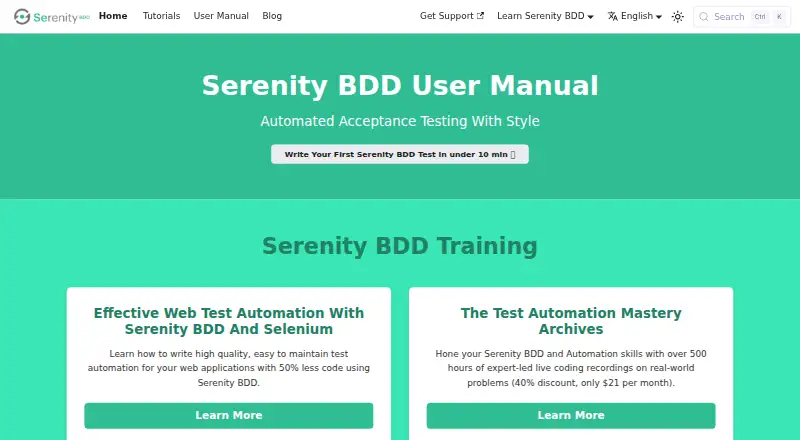
What Serenity BDD is
Serenity BDD is a free, open source library for automated acceptance and regression testing. It generates illustrated narrative reports that can serve as living documentation. Its testing approaches include web testing with Selenium, REST API testing with RestAssured, Screenplay tests, and executable specifications with Cucumber. Reports identify requirements covered by tests and capture step-by-step details, with optional screenshots. Serenity Playwright supports Chromium, Firefox, and WebKit, and can produce interactive HTML reports, screenshots, and HTML snapshots for investigating failures. Teams can structure tests with Page Object or Screenplay; the latter organizes work around actors, tasks, questions, and targets. Playwright setup guidance specifies Java 17 or later and Maven 3.8+ or Gradle. CI/CD guidance covers GitHub Actions, Jenkins, and GitLab CI. BrowserStack and LambdaTest integrations support cloud testing, and LambdaTest requires an account. Serenity also provides mobile testing guidance, including Playwright emulation for responsive designs. JUnit 4 support is deprecated and planned for removal in Serenity 6.0.0.
Good
- Supports Selenium, RestAssured, Screenplay, and Cucumber.
- Reports show tested requirements and test steps.
- Playwright supports Chromium, Firefox, and WebKit.
- CI/CD guidance covers three named services.
- Open source and free.
Watch out
- Playwright setup requires Java 17 or higher.
- LambdaTest integration requires a LambdaTest account.
- JUnit 4 support is deprecated.
- JUnit 4 support is planned for removal in version 6.0.0.
Who it suits
Serenity BDD suits development teams writing automated acceptance or regression tests across web, REST API, and supported Playwright browser workflows. It is relevant to teams that want narrative test reports or CI/CD and cloud-testing integrations.
Verdict
Serenity BDD offers several test styles and detailed reports, with Playwright and CI/CD guidance for development workflows. Teams using JUnit 4 should account for its deprecated status and planned removal.
Plans and prices
From Serenity BDD's own pricing page, checked 2 Oct 2026.
| Plan | Price | What it gives you |
|---|---|---|
| Serenity BDD | Free | Open source library; JUnit 4 support is deprecated and planned for removal in Serenity 6.0.0 |
The facts
Each one read from Serenity BDD's own pages, with the date it was checked.
What it does
- Build tools
- The Playwright setup guide lists Java 17 or higher and Maven 3.8+ or Gradle as prerequisites.checked 2 Oct 2026
- CI integrations
- The CI/CD guide covers GitHub Actions, Jenkins, and GitLab CI.checked 2 Oct 2026
- Cloud testing
- Serenity provides a BrowserStack plugin and uses a RemoteDriver to connect tests to BrowserStack.checked 2 Oct 2026
- Cloud testing scale
- The LambdaTest integration guide says users can extend test coverage across more than 3,000 real devices, browsers, and operating systems, and requires a LambdaTest account.checked 2 Oct 2026
- Mobile coverage
- The Playwright guide describes mobile emulation for testing responsive designs, and the manual includes a Mobile Testing with Serenity section.checked 2 Oct 2026
- Playwright
- Serenity Playwright supports Chromium, Firefox, and WebKit and provides interactive HTML reports, screenshots, and HTML snapshots for debugging failures.checked 2 Oct 2026
- Report detail
- Serenity reports which requirements were tested and records step-by-step test details, with optional screenshots.checked 2 Oct 2026
- Security configuration
- The CI/CD guide demonstrates storing API keys, usernames, and passwords in GitHub Actions secrets and passing them to test jobs as environment variables.checked 2 Oct 2026
- Support and community
- The manual links to Gitter and Stack Overflow and offers links to Serenity Dojo training and personalised coaching.checked 2 Oct 2026
- Test design
- Serenity Playwright supports Page Object and Screenplay approaches, with Screenplay organizing tests around actors, tasks, questions, and targets.checked 2 Oct 2026
- Test frameworks
- The Maven guide recommends JUnit 5 or Cucumber, and says JUnit 4 support is deprecated as of Serenity 5.0.0 and will be removed in 6.0.0.checked 2 Oct 2026
- Testing types
- The manual describes web testing with Selenium, REST API testing with RestAssured, Screenplay testing, and executable specifications with Cucumber.checked 2 Oct 2026
- What it does
- Serenity BDD is an open source library for writing automated acceptance and regression tests and generating illustrated narrative reports as living documentation.checked 2 Oct 2026
The full review of Serenity BDD
Overview
Serenity BDD is an open-source library for automated acceptance and regression testing, built for development teams that want tests to double as readable documentation. Its requirement-focused reports give it a practical edge for teams that need to see what was exercised and how each test ran; it is less suited to readers looking for a standalone testing app.
Key features
Serenity spans browser, API, and behavior-driven testing. Its documented options include Selenium for web tests, RestAssured for REST APIs, and Cucumber executable specifications. Screenplay offers a more structured way to express tests through actors, tasks, questions, and targets; that model can help teams organize complex scenarios, though it is not the only approach available.
Reporting is a central strength. Reports connect test runs to requirements and preserve step-by-step results, with optional screenshots. Serenity Playwright extends browser coverage to Chromium, Firefox, and WebKit, and adds interactive HTML reports, screenshots, and HTML snapshots for investigating failures. It supports both Page Object and Screenplay designs, so teams can choose between a familiar page-oriented structure and a more role-based model.
The tooling fits established development workflows rather than replacing them. Playwright setup requires Java 17 or higher and Maven 3.8+ or Gradle. The CI/CD guidance covers GitHub Actions, Jenkins, and GitLab CI, and shows how to pass API keys and credentials from GitHub Actions secrets to test jobs as environment variables. BrowserStack integration uses a RemoteDriver; LambdaTest can extend coverage across more than 3,000 real devices, browsers, and operating systems, but requires a LambdaTest account.
Mobile emulation in the Playwright guide supports responsive-design testing, and the manual also has a mobile-testing section. For broader device coverage, the cloud integrations are more relevant than local emulation alone. Serenity supports local execution and parallel execution, but those capabilities still depend on a team's own test and build setup.
The Maven guide recommends JUnit 5 or Cucumber. JUnit 4 support is deprecated as of Serenity 5.0.0 and is planned for removal in 6.0.0, so teams starting new work should avoid depending on it. Community touchpoints include Gitter and Stack Overflow, with Serenity Dojo training and personalised coaching for teams wanting more guidance.
Pricing
Serenity BDD — free. The open-source library has a free plan, making it a straightforward option for teams comfortable adopting and maintaining a test framework in their own development workflow. There are no paid plan tiers to weigh against feature caps; the practical costs are the Java and build-tool requirements, integration setup, and any separate cloud-testing account a team chooses to use.
Platforms
Serenity BDD is listed for Android, iOS, Linux, macOS, self-hosted environments, web, and Windows. Its guides cover local test execution, browser testing, mobile emulation, and CI workflows, so platform suitability depends on the project and its configured test environment rather than a consumer-style app installation.
Who it's for
Serenity is a strong fit for teams writing acceptance or regression tests that need traceable requirements and report detail, especially when they work across browser and REST API testing or use Cucumber and Screenplay. It also suits teams already running Maven or Gradle builds and CI pipelines. It is a weaker fit for people seeking a ready-to-run app, or for teams unwilling to maintain Java-based tooling and integrations.
Pros and cons
- Pro: Requirement links and step-by-step reports make failures and test coverage easier to review, with screenshots available when useful.
- Pro: Selenium, RestAssured, Cucumber, Screenplay, and Playwright give teams several ways to cover web, API, and executable-specification testing.
- Pro: CI and cloud-testing guidance can support existing pipelines and broader browser or device coverage.
- Con: Playwright setup requires Java 17+ and Maven 3.8+ or Gradle, which is a meaningful setup commitment for teams outside that toolchain.
- Con: JUnit 4 is deprecated and scheduled for removal in Serenity 6.0.0, making it a poor foundation for new projects.
- Con: LambdaTest coverage requires a separate account, and cloud execution therefore adds an external service dependency.
Alternatives
For a broader comparison, see BDD Testing Tools. Choose Cucumber Open if a free open-source project across Android, API, Linux, macOS, and Windows is a closer match. Ginkgo is another free option for Linux, macOS, and Windows, built as a Go testing framework whose current supported major version is v2.
YAKS is a free alternative for Linux, macOS, self-hosted, and Windows environments. CukeTest may suit teams wanting visual feature editing with JavaScript or Python; its free Lite plan has usage limits on some built-in automation libraries and 500 automation API calls. For API-focused work, Karate offers a free MIT-licensed framework covering REST, GraphQL, and SOAP APIs as well as browser and desktop UI automation. Reqnroll is an alternative with a free Community plan, Visual Studio and Rider integration, community plugins, and community support. Godog is a free MIT-licensed option for API and self-hosted environments, with its API subject to change before version 1.0.0. BDDX is another alternative.
Verdict
Choose Serenity BDD if your team wants open-source acceptance and regression testing with requirement-linked reporting, multiple test styles, and integration into CI. Its clearest advantage is turning test execution into detailed, reviewable documentation. Look elsewhere if Java-based setup is a mismatch or if your project still depends on JUnit 4.
Getting started
- Open the Serenity BDD website.
- For Playwright, prepare Java 17 or higher and Maven 3.8+ or Gradle.
- Choose a documented test approach, such as Selenium, RestAssured, Cucumber, or Playwright.
- Connect the test jobs to GitHub Actions, Jenkins, or GitLab CI if needed.
- For cloud testing, configure the BrowserStack plugin or connect to LambdaTest with an account.
Limits worth knowing
The library is free. JUnit 4 support is deprecated as of Serenity 5.0.0 and is planned for removal in 6.0.0; LambdaTest integration requires an account.
Questions
Is Serenity BDD free?
Yes. It is an open source library, and the listed Serenity BDD plan is 0.00 USD.
Which testing approaches does it cover?
Its documentation covers Selenium web testing, RestAssured REST API testing, Screenplay, and executable specifications with Cucumber.
Which browsers does Serenity Playwright support?
It supports Chromium, Firefox, and WebKit.
Can it connect to cloud testing services?
Yes. Serenity provides a BrowserStack plugin and a LambdaTest integration. LambdaTest requires an account.
What are the Playwright setup prerequisites?
The setup guide lists Java 17 or higher and Maven 3.8+ or Gradle.
What is the JUnit 4 support status?
JUnit 4 support is deprecated as of Serenity 5.0.0 and planned for removal in 6.0.0.
Alternatives to Serenity BDD
- 1

Karate
Free planOpen sourceAPIExtensionLinuxmacOS8.2From $100 a year - 2
FitNesse
Free planWebAPILinuxmacOS6.7Free plan - 3

Reqnroll
Free planWindowsmacOSLinux6.7From €400 a year - 4
BddDotNet
Free planLinuxmacOSWindows6.6Free plan - 5
BDDX
Free planWeb6.6From $9.99 a month - 6

Cucumber Open
Free planAndroidAPILinuxmacOS6.6Free plan