Ginkgo
Ginkgo is a free, MIT-licensed testing framework for Go that helps developers write expressive specifications.
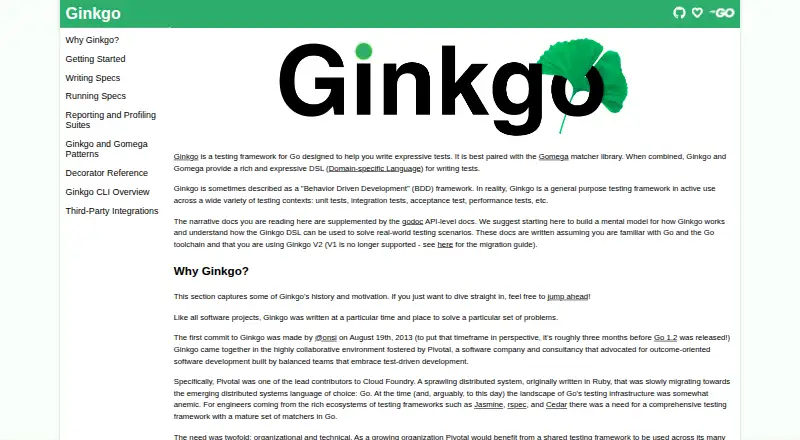
What Ginkgo is
Ginkgo is a free, MIT-licensed testing framework for Go that helps developers write expressive specifications. Its BDD-style DSL organizes specs with nested Describe, Context, and When containers, as well as setup, cleanup, and spec nodes. It can be used for unit, integration, and performance specs. Independent specs can run in parallel and in reproducibly randomized order. The bundled ginkgo command generates, runs, filters, and profiles suites, and can watch for changes to rerun specs. Reporting can produce machine-readable output in multiple formats and can be customized. Ginkgo builds on Go’s testing foundation and is designed to pair with the Gomega matcher library. Its GinkgoT() and GinkgoTB() interfaces also allow use of many Go testing libraries, including Testify and Gomock. Documentation lists completions for Sublime Text and VS Code, plus a VS Code extension for running specs. The current supported major version is V2; V1 is no longer supported. Compatibility is guaranteed for Go versions currently supported under Go’s release policy, N and N−1.
Good
- Supports unit, integration, and performance specs.
- Specs can run in parallel and randomized order.
- CLI can filter and profile suites.
- Reporting supports multiple machine-readable formats.
- Works with Go testing libraries such as Testify.
Watch out
- Ginkgo V1 is no longer supported.
- Fixes are not back-ported.
Who it suits
Ginkgo suits Go developers who want to structure unit, integration, or performance specs with a BDD-style DSL. It may also suit teams that need parallel execution and machine-readable reports.
Verdict
Ginkgo offers a structured way to define and run Go specs, with CLI tools, reporting, and integrations. Use the supported V2 major version; V1 is no longer maintained.
Plans and prices
From Ginkgo's own pricing page, checked 30 Sep 2026.
| Plan | Price | What it gives you |
|---|---|---|
| Ginkgo | Free | Go testing framework · current supported major version is v2 |
The facts
Each one read from Ginkgo's own pages, with the date it was checked.
What it does
- BDD-style DSL
- Its DSL supports nested Describe, Context, and When containers, setup and cleanup nodes, and spec nodes.checked 29 Sep 2026
- CI
- The CLI supports GitHub Actions friendly output, and the docs recommend a set of flags for continuous integration runs.checked 30 Sep 2026
- CLI
- The Ginkgo CLI can bootstrap and generate test files, run suites, watch for changes, and build test binaries.checked 30 Sep 2026
- Compatibility
- The current Ginkgo version is guaranteed to be compatible with the currently supported Go versions N and N−1 under Go's release policy.checked 30 Sep 2026
- Execution
- Ginkgo supports reproducibly randomizing spec order and running specs in parallel.checked 29 Sep 2026
- IDE support
- The documentation lists completions for Sublime Text and VS Code, plus a VS Code extension for running specs.checked 30 Sep 2026
- Integration
- Ginkgo is built on Go's testing foundation and is complemented by the Gomega matcher library.checked 29 Sep 2026
- Integrations
- Ginkgo exposes GinkgoT() and GinkgoTB() so many Go testing libraries, including Testify and Gomock, can be used with it.checked 30 Sep 2026
- Intended users
- The documentation assumes users are familiar with Go and the Go toolchain.checked 30 Sep 2026
- License
- The repository states that Ginkgo is MIT-Licensed.checked 29 Sep 2026
- Matchers
- Ginkgo is designed to be paired with Gomega, which provides its matcher library.checked 30 Sep 2026
- Purpose
- Ginkgo is a testing framework for Go for writing expressive tests, including unit, integration, acceptance, and performance tests.checked 30 Sep 2026
- Reporting
- Ginkgo provides CLI support for generating and aggregating machine-readable reports, plus extensible reporting for custom formats.checked 30 Sep 2026
- Support
- The project directs users with questions, bug reports, and feature requests to GitHub Issues or its Slack channel.checked 29 Sep 2026
- Test execution
- Ginkgo supports randomized and parallel execution of independent specs.checked 30 Sep 2026
- Testing scope
- Ginkgo can be used for unit, integration, and performance specs.checked 29 Sep 2026
- Version limitation
- Ginkgo V1 is no longer supported; the documentation identifies V2 as the current supported major version.checked 30 Sep 2026
- Version policy
- Ginkgo follows semantic versioning in the 2.m.p line, with minor releases intended for new functionality and patch releases for bug fixes; fixes are not back-ported.checked 30 Sep 2026
The company
- Founded
- 2013checked 28 Sep 2026
The full review of Ginkgo
Ginkgo is a Go testing framework for teams that prefer readable, nested specifications over a flat test layout. It suits Go developers building unit, integration, or performance suites who need repeatable randomization, parallel execution, and a capable command-line workflow. The trade-off is focus: its strongest advantages appear in Go projects willing to adopt its DSL and companion matcher library.
Overview
Ginkgo builds on Go's testing foundation while adding a behavior-driven structure around each suite. Describe, Context, and When containers let developers group related scenarios, with dedicated nodes for setup, cleanup, and individual specs. That hierarchy makes shared conditions and variations explicit, which is valuable when a suite has many related cases rather than isolated functions.
The style is likely to feel natural to developers coming from Quick, RSpec, Jasmine, or Busted, but Ginkgo remains a Go-focused framework rather than a language-neutral authoring layer. It is MIT-licensed and free, so adoption does not add a per-seat or usage bill.
Key features
Expressive suites and flexible matchers
Ginkgo covers unit, integration, and performance specifications in the same framework. It is intended to be paired with Gomega, whose matcher library provides the assertion vocabulary. Teams that already use other Go libraries are not forced into a complete rewrite: GinkgoT() and GinkgoTB() expose testing interfaces that allow libraries such as Testify and Gomock to participate in Ginkgo suites.
Controlled execution
Independent specs can run in parallel, potentially reducing suite time on suitable workloads. Reproducible random ordering is equally practical: it can reveal hidden ordering dependencies while preserving a sequence that developers can investigate. Parallelism requires genuinely independent tests, so suites with shared mutable state will need careful organization rather than simply enabling the option.
CLI, reporting, and automation
The bundled ginkgo command generates suites, runs and filters specs, profiles execution, and watches files for changes before rerunning affected tests. That breadth keeps common development tasks in one workflow instead of scattering them across scripts. Reporting can emit machine-readable results in multiple formats and supports custom reporting infrastructure, making it suitable for CI dashboards or organization-specific output.
For continuous integration, the CLI includes GitHub Actions-friendly output and the documentation recommends CI-oriented flags. IDE assistance includes completions for Sublime Text and VS Code, plus a VS Code extension for running specs. Gherkin support is available, while execution remains local.
Pricing
| Plan | Price | What it includes |
|---|---|---|
| Ginkgo | free | Go testing framework; current supported major version is v2 |
The free plan is the whole offering: there are no stated seat charges, quotas, or trial expiry to weigh. That makes it a straightforward choice for individual developers and teams that can run and maintain open-source tooling themselves. The absence of a commercial tier also means there is no paid support or service package described for organizations seeking contractual assistance.
Platforms
Ginkgo runs on Linux, macOS, and Windows. Its local execution model fits developers and CI agents that execute Go suites on their own machines. Compatibility follows Go's release policy: the current version is guaranteed against the currently supported Go versions N and N−1.
Who it's for
Choose Ginkgo for a Go codebase where nested, behavior-oriented specs improve communication, and where parallel runs, randomized ordering, profiling, or structured reports matter. It is also a sensible bridge for teams that want Ginkgo's organization while retaining familiar Go testing libraries through its testing interfaces.
Look elsewhere if your primary need is a cross-language BDD platform, a hosted test service, or a visual authoring environment. Ginkgo's value is concentrated in local Go development and the teams prepared to maintain that workflow.
Pros and cons
- Pros: Free MIT-licensed distribution removes licensing friction for teams of any size.
- Pros: Nested containers and lifecycle nodes give complex suites a clear scenario structure.
- Pros: Reproducible randomization and parallel execution address order bugs and long-running suites.
- Pros: The CLI combines generation, filtering, profiling, watching, and CI-oriented output.
- Pros: GinkgoT() and GinkgoTB() preserve access to libraries such as Testify and Gomock.
- Cons: The framework is specialized for Go, so polyglot teams will not get one shared test authoring model.
- Cons: Gomega is the intended matcher companion, adding another project to standardize alongside Ginkgo.
- Cons: V1 is unsupported and fixes are not back-ported; teams must stay on the maintained V2 line.
Alternatives
Browse the BDD Testing Tools list when you want to compare a wider field. Serenity BDD is a free open-source option spanning mobile, desktop, web, and self-hosted platforms, making it a better fit for broader platform coverage. FitNesse is another free open-source project for teams seeking a web-oriented, multi-platform environment without commercial plans.
BddDotNet suits .NET-focused projects needing MIT-licensed software, while Concordion targets Java teams under Apache License 2.0. Cucumber Open is a free open-source choice with Android, API, Linux, macOS, and Windows coverage. CukeTest is worth considering for visual feature editing in JavaScript and Python, although its Lite plan has automation-library limits and 500 automation API calls.
Karate is the stronger alternative when API testing and browser or desktop UI automation are central. Reqnroll fits Windows, macOS, and Linux teams that want Visual Studio and Rider integration, community plugins, and a paid Professional tier beyond its Community plan.
Verdict
Ginkgo is a strong recommendation for Go teams that want disciplined BDD-style structure, fast and repeatable execution, and useful CLI and reporting controls at no cost. Choose it for a maintainable Go suite that benefits from parallelism and integration with existing testing libraries; look elsewhere when you need a cross-language or hosted BDD workflow.
Alternatives to Ginkgo
- 1
Karate
Free planOpen sourceAPIExtensionLinuxmacOS8.2From $100 a year - 2
FitNesse
Free planWebAPILinuxmacOS6.7Free plan - 3

Reqnroll
Free planWindowsmacOSLinux6.7From €400 a year - 4
BddDotNet
Free planLinuxmacOSWindows6.6Free plan - 5
BDDX
Free planWeb6.6From $9.99 a month - 6

Cucumber Open
Free planAndroidAPILinuxmacOS6.6Free plan