
Sendcloud
Sendcloud is a shipping platform for e-commerce businesses that connects online stores with couriers and supports labels, tracking, and returns.
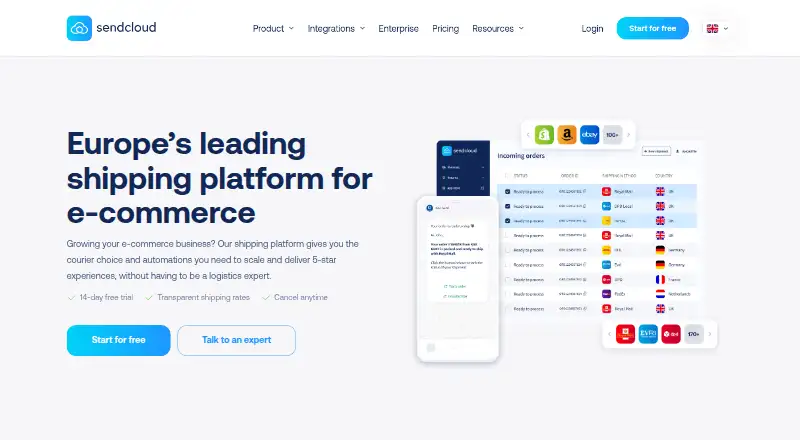
What Sendcloud is
Sendcloud is a shipping platform for e-commerce businesses that connects online stores with couriers and supports labels, tracking, and returns. It imports order details so users can select delivery options and create labels individually or in bulk. Sendcloud lists connections to more than 170 international carriers and over 100 plug-and-play integrations, including Shopify, Etsy, Amazon, Magento, eBay, WooCommerce, Odoo, and Zendesk. Custom connections are available through an API; users can also create shipments manually or upload orders by CSV. Post-purchase tools include branded tracking pages, customer notifications, returns portals, checkout delivery options, and shipping analytics. A free plan covers up to 20 parcels per month without a subscription fee or courier contract. A 14-day free trial is listed with no credit card required. Paid plans have different user, integration, shipping-rule, and annual-label limits; Lite is listed at €280.10 a month and allows up to 4 800 labels per year. Sendcloud says it fully supports shipping from several European countries and applies additional conditions in others.
Good
- Connects stores to more than 170 international carriers.
- Lists over 100 plug-and-play integrations.
- Supports API connections, manual shipments, and CSV uploads.
- Includes tracking pages, notifications, and returns portals.
- Offers a 14-day trial without a credit card.
Watch out
- Free plan is limited to 20 parcels per month.
- Paid plans have annual label-volume limits.
- Shipping support varies by country.
Who it suits
Sendcloud is aimed at e-commerce businesses that want to organize and automate shipping without a full logistics team. Its free plan may suit businesses shipping up to 20 parcels monthly.
Verdict
Sendcloud covers shipping workflows from order import through tracking and returns, with a free plan and trial listed. Check regional conditions and plan limits against your shipping volume.
Plans and prices
From Sendcloud's own pricing page, checked 30 Sep 2026.
| Plan | Price | What it gives you |
|---|---|---|
| Free | Free | up to 20 parcels/month · no subscription fee · no courier contract required |
| Lite | €280.10 a month | 3 users · 3 integrations · 5 shipping rules · max. 4 800 labels/year · Monthly |
| Growth | €870.09 a month | 5 users · 5 integrations · 10 shipping rules · max. 12 000 labels/year · Monthly |
| Premium | €1,750.08 a month | 10 users · unlimited integrations · unlimited shipping rules · max. 120 000 labels/year · Monthly |
| Pro | €6,390.07 a month | unlimited users · unlimited integrations · unlimited shipping rules · max. 360 000 labels/year · Monthly |
| Enterprise | Priced on request | tailored solutions · custom tech stacks · extra support, expertise, and data |
The facts
Each one read from Sendcloud's own pages, with the date it was checked.
What it does
- API
- Sendcloud offers an API for custom connections and says users can also manually create shipments or upload orders by CSV.checked 30 Sep 2026
- Audience
- Sendcloud describes its platform as built for e-commerce businesses that want to structure and automate shipping without needing a full logistics team.checked 30 Sep 2026
- Carriers
- Sendcloud says it connects users to more than 170 international carriers.checked 30 Sep 2026
- Certification
- Sendcloud's security page says its platform and organization are in scope of ISO 27001 certification and references its current ISO 27001:2022 certification.checked 30 Sep 2026
- Integrations
- Sendcloud lists over 100 plug-and-play integrations, including Shopify, Etsy, Amazon, Magento, eBay, WooCommerce, Odoo, and Zendesk.checked 30 Sep 2026
- Limits
- The pricing page lists maximum annual label volumes of 4 800 for Lite, 12 000 for Growth, 120 000 for Premium, and 360 000 for Pro.checked 30 Sep 2026
- Post-purchase features
- Features include branded tracking pages, customer tracking notifications, returns portals, checkout delivery options, and shipping analytics.checked 30 Sep 2026
- Product
- Sendcloud is a shipping platform for e-commerce that connects online stores to couriers and supports labels, tracking, and returns.checked 30 Sep 2026
- Regional availability
- Sendcloud fully supports shipping from Austria, Belgium, France, Germany, Italy, the Netherlands, Spain, and the United Kingdom, with additional conditions for several other European countries.checked 30 Sep 2026
- Security
- Sendcloud says it complies with GDPR, encrypts data at rest and in transit, and hosts data in AWS EU Central and EU North regions.checked 30 Sep 2026
- Shipping workflow
- The platform imports order details and lets users select delivery options and create labels individually or in bulk.checked 30 Sep 2026
- Support
- The Lite plan includes email and live chat support, Growth adds phone support, and Pro lists a Customer Success Manager and guided onboarding.checked 30 Sep 2026
The company
- Company history
- The company says three friends who ran an online store built the first version of Sendcloud in 2012 as a label-printing tool for PostNL parcels.checked 30 Sep 2026
- Founded
- 2012checked 28 Sep 2026
- Headquarters
- Eindhoven, Netherlandschecked 28 Sep 2026
Money
- Trial
- The pricing page offers a 14-day free trial and says no credit card is required.checked 30 Sep 2026
The full review of Sendcloud
Sendcloud is e-commerce shipping software for stores that need to bring order imports, carrier selection, labels and post-purchase tasks into one workflow. It is best suited to online retailers scaling beyond manual dispatch, especially those selling through several storefronts. Its broad carrier and integration network is compelling, but the paid plans’ monthly prices and annual label ceilings make careful volume planning essential.
Overview
Sendcloud connects online stores with couriers and lets teams import orders, choose delivery options, and print labels individually or in batches. More than 170 international carriers and rate shopping give merchants options at dispatch; over 100 plug-and-play integrations connect stores and business tools, including Shopify, Etsy, Amazon, Magento, eBay, WooCommerce, Odoo and Zendesk.
Stores can also connect through the API, upload orders by CSV, or create shipments manually. Branded tracking pages, customer notifications, checkout delivery options, returns portals and shipping analytics extend the platform beyond label production. That breadth can consolidate several shipping tasks, though teams should match plan limits to their parcel volume and staffing needs.
Founded in 2012 in Eindhoven, Netherlands, Sendcloud began as a label-printing tool created by three people running an online store, initially for PostNL parcels.
Key features
- Order import and label creation: Import orders and create labels individually or in bulk, a practical fit for merchants handling recurring dispatches rather than preparing every shipment by hand.
- Carrier choice and rate shopping: Access to more than 170 carriers and rate shopping can help stores compare delivery options within their shipping workflow.
- Store connections and custom routes: More than 100 plug-and-play integrations cover popular commerce platforms and business tools. The API, CSV uploads and manual shipment creation offer alternatives when a store needs a custom connection or does not use a listed integration.
- After dispatch: Branded tracking pages and notifications keep customers informed, while checkout delivery options, returns portals and shipping analytics cover other parts of the order journey. These tools make Sendcloud broader than a label-printing utility.
- Security and regional coverage: Sendcloud says it complies with GDPR, encrypts data in transit and at rest, and hosts data in AWS EU Central and EU North. Its platform and organization are within the scope of its ISO 27001:2022 certification. Full shipping support applies to Austria, Belgium, France, Germany, Italy, the Netherlands, Spain and the United Kingdom; other European countries can have additional conditions.
Pricing
The Free plan costs nothing and allows up to 20 parcels per month, with no subscription fee or courier contract required. It is a low-commitment way for a small store to start, but the parcel cap makes it unsuitable once shipping volume rises. A separate monthly shipment limit of 400 /mo is also stated; merchants should confirm how that limit applies to their account before choosing a plan.
Paid plans are billed monthly. The stated pricing note also says paid plans start at €28/mo (annual), which does not match the listed monthly plan prices below; confirm the applicable rate and billing term before subscribing.
- Lite — €280.10 a month: Three users, three integrations, five shipping rules and up to 4 800 labels per year. Email and live chat support are included. This is the smallest paid tier, but the integration and rule allowances constrain stores with more complex setups.
- Growth — €870.09 a month: Five users, five integrations, ten shipping rules and up to 12 000 labels per year, with phone support added. It raises both capacity and support access, though the label ceiling still calls for volume planning.
- Premium — €1,750.08 a month: Ten users, unlimited integrations and shipping rules, and up to 120 000 labels per year. It suits larger operations that need broader configuration, but carries a substantially higher monthly price than Growth.
- Pro — €6,390.07 a month: Unlimited users, integrations and shipping rules, up to 360 000 labels per year, a Customer Success Manager and guided onboarding. It is aimed at high-volume teams that can use the capacity and onboarding support.
- Enterprise — custom pricing: Tailored solutions, custom tech stacks, and extra support, expertise and data. It is the option for requirements beyond the standard plan structure, with price determined individually.
A 14-day free trial is offered without requiring a credit card. The annual label ceilings are important even where a plan allows many users or integrations: choose based on expected labels as well as team size.
Platforms
Sendcloud is available on the web and through an API. Those routes cover browser-based operation and custom system connections; Android and iOS apps are not among its stated platforms.
Who it's for
Sendcloud is a strong fit for e-commerce businesses that want to organize shipping without building a full logistics team. Stores with multiple sales channels can benefit from its integrations, bulk labels and post-purchase tools. The free tier suits very low parcel volumes, while paid tiers make more sense for teams that need higher label limits, more users, integrations or shipping rules.
It is less suited to merchants whose shipping is outside Sendcloud’s supported regional conditions, or whose requirements exceed a plan’s annual label limit. The sharp jump in stated monthly prices also makes it important to verify the applicable billing rate before moving beyond the free tier.
Pros and cons
- Pro: More than 170 carrier connections and rate shopping provide substantial choice within the shipping workflow.
- Pro: More than 100 integrations, plus API, CSV and manual shipment routes, accommodate different store setups.
- Pro: Tracking, returns, checkout delivery options and analytics extend coverage beyond printing labels.
- Pro: The free plan has no subscription fee or courier contract requirement, and the trial does not require a credit card.
- Con: The free plan’s 20-parcel monthly cap is restrictive for a growing store.
- Con: Paid plans have fixed annual label ceilings, while team, integration and rule allowances also vary by tier.
- Con: The pricing note’s starting rate conflicts with the much higher listed monthly plan prices, so buyers should verify the rate and billing term.
- Con: Full support is limited to eight named countries; other European locations may involve additional conditions.
Alternatives
Easyship is worth comparing for merchants who want a free tier allowing fewer than 50 shipments per month and features such as discounted shipping rates, courier selection, and import tax and duty calculation. Veeqo may suit teams prioritizing a free Shipping plan with unlimited orders, users, products and SKUs, and warehouses and locations.
Centiro is another paid shipping option. Shippo is a candidate for stores comparing a free App plan capped at 30 labels monthly and one user, or an API-oriented plan. Ordoro may be relevant for merchants comparing order-based tiers, including an Essential plan capped at 100 orders per month.
Shiprocket offers a free Lite plan for up to 60 shipments monthly, with shipping starting at Rs 26/500gms and no API access. Shippit is an alternative with paid Plus and Pro plans supporting up to 99,000 bookings per month. ShipStation may fit buyers seeking a paid option with a Starter plan at $14.99 a month for 50 shipments and three users.
For broader category comparisons, see Parcel Management Software, Shipping Software and Order Tracking Software.
Verdict
Choose Sendcloud if your e-commerce operation needs a connected route from order import to labels, tracking and returns, and its carrier coverage and integrations match your markets. Its range of shipping and post-purchase tools is the main reason to shortlist it. Look elsewhere if the free parcel cap, regional conditions, plan ceilings or verified paid-plan pricing do not fit your operation.
Alternatives to Sendcloud
- 1
17TRACK Business
Free planAndroidiOSWebAPI8.1From $9 a month - 2

AfterShip Tracking
Free planAndroidiOSWebAPI8.0From $29 a month - 3

TrackingMore
Free planWebAPI7.5From $9 a month - 4
Route Track
Free planAndroidiOSWebAPI7.3Free plan - 5

CWILL Post-Purchase
Free planWebAPI6.7$11 usage-based - 6
Shipink
Free planWebAPI6.7From 3 TRY a month