
SecurityScorecard Third-Party Risk Management
- Android app
- Not listed
- Free plan
- Yes
- Runs on
- api, Web
Summary
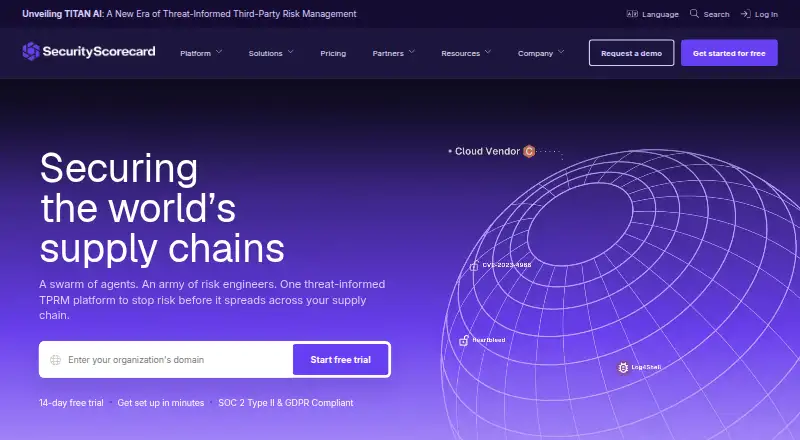
SecurityScorecard Third-Party Risk Management uses TITAN AI and cyber threat intelligence to help organizations identify and respond to supply-chain risks. TITAN AI reviews questionnaires and SOC 2 reports for gaps, comparing vendor responses with observed technical security behavior. TITAN Watch maps third- and fourth-party connections and supports visibility into broader vendor networks. The platform describes continuous monitoring for vulnerabilities, threat actor behavior, and nth-party relationships. TITAN Secure supports threat response and collaborative remediation workflows, including vendor remediation plans. Listed integrations include OneTrust Vendorpedia, ServiceNow, Splunk, Palo Alto Cortex XSOAR, Slack, and Jira. SecurityScorecard says it collects data on entities rather than people and owns 99% of its data; its website also advertises SOC 2 Type II and GDPR compliance. The free plan includes a rating for your own domain, alerts, questionnaire response, and reports. Paid package prices are not listed and depend primarily on how many organizations are monitored. Core APIs have usage limits; Elite includes unlimited APIs for custom integrations.
Who it is for
It is intended for organizations managing vendor ecosystems. Core is aimed at periodic assessments, Premium at continuous monitoring, and Elite at threat-informed risk management at scale.
What is good
- Analyzes questionnaires and SOC 2 reports for gaps
- Identifies third- and fourth-party connections
- Monitors vulnerabilities and threat actor behavior
- Lists integrations with tools including ServiceNow and Slack
- Free plan includes a domain rating and reports
What to know first
- Core APIs have usage limits
- Paid package prices are not listed
- Monitoring-based pricing depends primarily on organization count
Everything Xiaomi review
SecurityScorecard Third-Party Risk Management: the full review
SecurityScorecard combines vendor assessment, ecosystem visibility, monitoring, and remediation capabilities. Organizations should weigh the package API limits and contact-sales pricing against the monitoring scope they need.
Overview
SecurityScorecard Third-Party Risk Management is a vendor-risk platform built around TITAN AI and SecurityScorecard’s cyber threat intelligence. It is best suited to organizations that need visibility beyond direct suppliers and a continuing response process, rather than occasional questionnaire reviews alone. Its breadth is compelling, but the organization-based pricing and package-specific API limits matter for teams planning integrations or broad monitoring.
The product brings together questionnaire and report review, vendor discovery, monitoring, and remediation. SecurityScorecard says it supports more than 3,300 organizations and serves third-party risk management, board reporting, and cyber insurance underwriting. The company was founded in 2013 and is headquartered in New York, New York.
Compare it with other options in Third-Party Risk Management Software and Security Ratings Software.
Key features
Questionnaire and report review
TITAN AI reviews questionnaires and SOC 2 reports for gaps, then compares vendor responses with observed technical security behavior. That comparison can help teams spot a mismatch between what a vendor says and its external security posture. Core provides templated questionnaire management; Premium adds custom questionnaires.
Vendor discovery and monitoring
TITAN Watch identifies third- and fourth-party connections, extending visibility beyond direct vendors. The platform describes always-on monitoring for vulnerabilities, threat actor behavior, and nth-party relationships. That scope suits programs that need to track changing supply-chain exposure, though Premium’s partial visibility for unlimited organizations is not the same as full monitoring of an unlimited vendor list.
Remediation and integrations
TITAN Secure supports threat response and collaborative remediation, including plans for vendors. The marketplace includes OneTrust Vendorpedia, ServiceNow, Splunk, Palo Alto Cortex XSOAR, Slack, and Jira. Core APIs are usage-limited; Elite includes unlimited APIs for custom integrations, a meaningful distinction for teams connecting the platform to internal workflows at scale.
The product supports hybrid assessment, continuous monitoring, a questionnaire library, framework mapping, evidence collection, and workflow automation. SecurityScorecard says it owns 99% of its data and collects information about entities rather than people; its website also advertises SOC 2 Type II and GDPR compliance.
Pricing
The pricing model is freemium, with a free plan and a 14-day trial. Paid plan prices are custom pricing, and monitoring cost depends primarily on the number of organizations monitored. That makes the monitored-organization count central to budgeting; teams should also account for API needs when comparing packages.
- Free forever — 0.00 USD per free: Includes a security rating for your own domain, digital footprint management, issue prioritization and alerts, questionnaire response, a self-monitoring dashboard, reports, help center articles, and technical support. It is useful for monitoring your own domain, but it does not provide the vendor scorecards and ecosystem discovery described in paid TITAN Watch packages.
- TITAN Watch Core — custom pricing, billed Contact sales: Includes monitored organization scorecards, a conversational AI agent, templated questionnaire management, a vendor system of record, rules, and alerts. It is aimed at periodic assessments. Usage-limited APIs may constrain custom integrations.
- TITAN Watch Premium — custom pricing, billed Contact sales: Includes Core, plus custom questionnaires, partial visibility for unlimited organizations, third- and fourth-party identification, advanced integrations, and AI agents. It fits teams moving to continuous monitoring, but partial visibility is an important qualification for large ecosystems.
- TITAN Watch Elite — custom pricing, billed Contact sales: Includes Premium, custom compliance framework mapping, unlimited APIs for custom integrations, and MAX Monitor and MAX Respond readiness. Its added API capacity and threat-informed scope best fit larger programs; the tradeoff is a sales-led purchase with no published price.
- TITAN MAX Services — custom pricing, billed Talk to sales: Provides managed questionnaire, monitoring, and vendor response services, and requires a TITAN platform subscription. It is for organizations that want services alongside the platform rather than a standalone lower-cost option.
Support ranges from self-service documentation and business-hours technical support to dedicated customer success managers for strategic onboarding and platform optimization. The published free-plan features include technical support, while customer success management is described for strategic onboarding and optimization.
Platforms
SecurityScorecard Third-Party Risk Management is available on web and through an API. API usage is limited in Core and unlimited for custom integrations in Elite, so integration-heavy teams should weigh package choice alongside monitoring needs.
Who it's for
This is a strong fit for organizations managing complex vendor ecosystems, especially those that need third- and fourth-party visibility, continuous monitoring, and structured remediation. Core is suited to periodic assessments; Premium is positioned for continuous monitoring; Elite is intended for threat-informed risk management at scale. Smaller teams focused only on their own domain may find the free plan sufficient, while organizations seeking managed risk services need both a TITAN subscription and the MAX Services package.
Pros and cons
- Pros: Questionnaire and SOC 2 review is paired with technical observations, giving teams a way to compare vendor claims with observed behavior.
- Pros: Third- and fourth-party discovery and always-on monitoring address supply-chain exposure beyond direct vendors.
- Pros: Remediation workflows, broad integrations, and framework mapping support follow-through as well as assessment.
- Cons: Paid pricing is custom and depends primarily on monitored organizations, making budgets harder to compare before sales discussions.
- Cons: Core APIs are usage-limited, while unlimited APIs require Elite, which may push integration-heavy programs toward a higher-tier package.
- Cons: Premium offers only partial visibility for unlimited organizations, a limitation to consider when broad ecosystem coverage is a requirement.
Alternatives
- Whistic is worth considering for a freemium option focused on standardized frameworks, a trust catalog, vendor review workflows, automated reassessments, notifications, and vendor risk scoring.
- Diligent Audit is a paid alternative with Android, iOS, API, and web platforms; choose it if those device platforms matter to your evaluation.
- Drata is a paid option with a free trial and broad platform support, including desktop, mobile-independent web, API, and extension access; consider it if those access channels suit your team.
- Black Kite Third-Party Cyber Risk is a paid web-based alternative whose Standard plan includes onboarding, enablement, configuration, environment tuning, and unlimited users.
- ProcessUnity Third-Party Risk Management may suit small and medium businesses willing to start at 25,000.00 USD per contact for companies up to $500M in revenue and 1,000 employees.
- Bitsight External Attack Surface Management is a paid API and web option with pricing based on solution, capabilities, and support needs.
- UpGuard is another freemium web-based option.
- Venminder is a paid API and web alternative whose Professional plan includes key vendor-risk capabilities and unlimited users, vendors, and contracts.
Verdict
Choose SecurityScorecard Third-Party Risk Management if your organization needs continuous, threat-informed oversight across direct and extended vendor relationships, backed by remediation workflows. Its strongest case is the combination of ecosystem visibility and monitoring with vendor response; look elsewhere if you need predictable published pricing or unlimited API access without moving to Elite.
SecurityScorecard Third-Party Risk Management plans and pricing
All plansCompared on third-party risk management software
- Free plan
- Yessecurityscorecard.com
Facts
- Purpose
- TITAN AI combines third-party risk management data with real-time cyber threat intelligence for continuous supply-chain risk detection and response.securityscorecard.com · 29 Sept 2026
- Questionnaire review
- TITAN AI analyzes questionnaires and SOC 2 reports for gaps and compares vendor answers with observed technical security behavior.securityscorecard.com · 29 Sept 2026
- Vendor discovery
- TITAN Watch identifies third- and fourth-party connections and supports visibility into extended vendor ecosystems.securityscorecard.com · 29 Sept 2026
- Monitoring
- The platform describes always-on third-party monitoring for vulnerabilities, threat actor behavior, and nth-party relationships.securityscorecard.com · 29 Sept 2026
- Remediation
- TITAN Secure provides threat response and collaborative remediation workflows, including remediation plans for vendors.securityscorecard.com · 29 Sept 2026
- Integrations
- The marketplace lists integrations including OneTrust Vendorpedia, ServiceNow, Splunk, Palo Alto Cortex XSOAR, Slack, and Jira.securityscorecard.com · 29 Sept 2026
- Security and data
- SecurityScorecard says it owns 99% of its data and collects data on entities rather than people; its website also advertises SOC 2 Type II and GDPR compliance.securityscorecard.com · 29 Sept 2026
- Plan limits
- Pricing depends primarily on the number of organizations monitored, and the Core package has usage-limited APIs while Elite includes unlimited APIs for custom integrations.securityscorecard.com · 29 Sept 2026
- Support
- The pricing page describes self-service documentation, business-hours technical support, and dedicated customer success managers for strategic onboarding and platform optimization.securityscorecard.com · 29 Sept 2026
- Intended customers
- The product is presented for organizations managing vendor ecosystems, with Core aimed at periodic assessments, Premium at continuous monitoring, and Elite at threat-informed risk management at scale.securityscorecard.com · 29 Sept 2026
- Company
- SecurityScorecard says it supports third-party risk management, board reporting, and cyber insurance underwriting, and reports that more than 3,300 organizations rely on its services.securityscorecard.com · 29 Sept 2026
Company
- Founded
- 2013securityscorecard.com · 23 Sept 2026
- Headquarters
- New York, NY, United Statessecurityscorecard.com · 23 Sept 2026
Best SecurityScorecard Third-Party Risk Management alternatives
See all 20

Where it ranks on Everything Xiaomi
Is SecurityScorecard Third-Party Risk Management yours?
Claim it for free: prove the domain, then correct facts, plans and screenshots. An editor reviews every change.
Sources
- securityscorecard.com/platform/· checked 29 Sept 2026
- securityscorecard.com/solutions/use-cases/third-party-risk-ma· checked 29 Sept 2026
- securityscorecard.com/partners/marketplace/· checked 29 Sept 2026
- securityscorecard.com/trust/· checked 29 Sept 2026
- securityscorecard.com/pricing/· checked 29 Sept 2026
- securityscorecard.com/company/· checked 29 Sept 2026
- securityscorecard.com· checked 23 Sept 2026