
SeaRates Container Tracking
SeaRates Container Tracking tracks sea shipments using a container number, Bill of Lading, or booking reference, and displays shipment location and status.
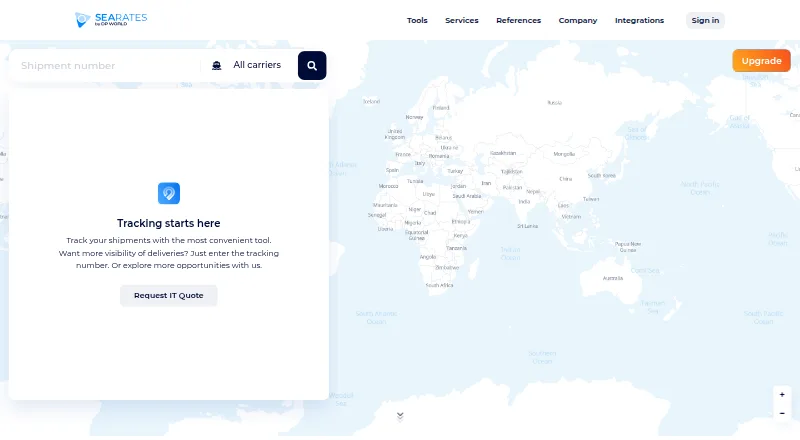
What SeaRates Container Tracking is
SeaRates Container Tracking tracks sea shipments using a container number, Bill of Lading, or booking reference, and displays shipment location and status. Users can view a container on a world map, see route visibility and port activity, and get estimated arrival insights. The system calculates storage time at transshipment ports and offers alerts for status events, departures, arrivals, delays, and early delivery. SeaRates says its visibility and arrival estimates draw on AIS data from ships, satellites, and port stations. The mobile app offers laptop synchronization, live updates, and instant notifications. For business use, the API can pass status events to a website or connect data to a TMS, ERP, or other software; a website widget is also available. API requests use HTTPS and an API key, and the documented general quota is 100 requests per 20 seconds per organization. SeaRates describes online tracking as free to try, while API pricing is usage-based; the listed product information does not provide a price. Updates are daily, with more frequent updates available by contacting an account manager.
Good
- Accepts container, Bill of Lading, or booking references.
- Shows container positions on a world map.
- Alerts cover delays, arrivals, and early delivery.
- API can connect data to a TMS or ERP.
- Mobile app offers live updates and notifications.
Watch out
- API pricing is not listed.
- Tracking updates are daily by default.
- More frequent updates require contacting an account manager.
- API quota is 100 requests per 20 seconds per organization.
Who it suits
It suits shippers and logistics teams that need sea-shipment status, map positions, port storage information, and arrival estimates. Logistics service providers can also connect tracking data to their own websites or software.
Verdict
SeaRates provides shipment visibility through map tracking, status information, alerts, and estimated arrivals. It also supports business integrations, but API pricing is usage-based and not specified here.
Plans and prices
From SeaRates Container Tracking's own pricing page, checked 30 Sep 2026.
| Plan | Price | What it gives you |
|---|---|---|
| Container Tracking API | Priced on request | Usage-based; additional frequency available by contacting an account manager · Monthly or yearly billing periods are offered; pricing is per-container usage, with volume discounts for annual commitments. |
The facts
Each one read from SeaRates Container Tracking's own pages, with the date it was checked.
What it does
- AIS data
- SeaRates says it uses AIS vessel movement information from ships, satellites, and port stations to support tracking visibility and estimated arrival times.checked 30 Sep 2026
- API and website integration
- The tracking API can pass container status events to a website and display them by container number or Bill of Lading.checked 29 Sep 2026
- API quota
- The documented general quota is 100 requests per 20 seconds per organization, and the documentation says quotas may change.checked 30 Sep 2026
- API security
- The tracking API documentation says endpoints are HTTPS-only and API requests use an API key.checked 30 Sep 2026
- Business integrations
- The API can connect tracking data to a TMS, ERP, or other software, and the product page also describes passing status events to a website.checked 30 Sep 2026
- Coverage
- The API page claims 97% worldwide shipping coverage and data from more than 180 providers, including carriers, NVOCCs, ports, terminals, and leasing companies.checked 30 Sep 2026
- Integration formats
- SeaRates says its digital logistics tools are available through SaaS access, APIs, and white-label web integrations.checked 29 Sep 2026
- Intended users
- SeaRates presents multi-tracking as a tool for logistics service providers to offer tracking on their websites and improve customer retention.checked 29 Sep 2026
- Map and port activity
- The tracking system shows container positions on a world map and calculates storage time at transshipment ports.checked 30 Sep 2026
- Map tracking
- The system can show a container’s current position on a world map after the user enters its number and shipping line.checked 29 Sep 2026
- Port storage
- The tracking system calculates storage time in transshipment ports.checked 29 Sep 2026
- Pricing availability
- The product page links to credits and pricing, but the pricing links opened during this research redirected to the SeaRates homepage without showing tracking prices.checked 29 Sep 2026
- Privacy and data controller
- SeaRates’ privacy policy identifies DP World Logistics FZE as the data controller for GDPR purposes and describes personal-data handling for its site and apps.checked 29 Sep 2026
- Purpose
- SeaRates Container Tracking provides real-time sea shipment tracking, container status, route visibility, port activity, and estimated arrival insights.checked 29 Sep 2026
- Sensitive data
- SeaRates says a tracking request needs only a Bill of Lading, container, or booking number and does not require sensitive business information to be received or stored.checked 30 Sep 2026
- Shipment alerts
- The product lists status events from booked to delivered, departure and arrival notices, and delay or early-delivery alerts.checked 30 Sep 2026
- Support
- SeaRates says its team handles integration and troubleshooting, and its API integration FAQ offers a free guide intended to help users get started in under 48 hours.checked 30 Sep 2026
- Supported references
- The tracking FAQ says users can enter a container number, Bill of Lading, or booking reference to check shipment status.checked 29 Sep 2026
- Update frequency
- SeaRates says it provides tracking updates daily and asks customers to contact an account manager for more frequent updates.checked 30 Sep 2026
The company
- Company founding
- SeaRates states that it was founded in August 2005.checked 30 Sep 2026
- Company history
- SeaRates says it launched in 2005; its site footer specifies August 2005.checked 29 Sep 2026
- Founded
- 2005checked 28 Sep 2026
Money
- Free access
- SeaRates describes its online tracking tool as free to try, while API pricing is usage-based and subject to a subscription offer.checked 30 Sep 2026
Where it runs
- Mobile app
- The tracking product page describes a mobile app with synchronization with a laptop, live updates, and instant notifications.checked 30 Sep 2026
The full review of SeaRates Container Tracking
Overview
SeaRates Container Tracking is a sea-freight visibility service for following shipments from booking through arrival. It suits shippers and logistics providers who need shipment status for customers or internal operations, especially when they want to connect tracking to a website or business system.
Its useful distinction is the mix of map-based tracking, port-storage calculations, alerts and integration options. It is less compelling for buyers who need predictable API costs before committing: the API is priced by container usage, and no price is available to compare.
Key features
Lookups work with a container number, Bill of Lading or booking reference, so users can check a shipment without relying on a single identifier. The map view and route information make location easier to interpret than a status-only feed, while the transshipment-port storage calculation adds operational context during transfers.
SeaRates says its visibility and arrival estimates use AIS data from ships, satellites and port stations. It supports ocean and intermodal tracking, ETA predictions and exception alerts. Alerts cover logistics status events, departures and arrivals, delays, and early delivery; this range is useful for teams that need to react to schedule changes rather than repeatedly check a dashboard. SeaRates says updates are daily, with more frequent updates available by contacting an account manager, so daily cadence may not suit operations that depend on near-real-time refreshes.
The mobile app provides live updates, instant notifications and synchronization with a laptop. For organizations, the API can feed container events into a TMS, ERP or other software, and status events can also be displayed on a website by container number or Bill of Lading. A documented HTML and JavaScript widget supports website embedding. SeaRates claims 97% worldwide shipping coverage and data from more than 180 providers, including carriers, NVOCCs, ports, terminals and leasing companies; actual usefulness still depends on the shipment and provider coverage.
API endpoints use HTTPS and requests require an API key. The general documented quota is 100 requests per 20 seconds per organization, and SeaRates says quotas may change. Tracking requests require a shipment reference rather than sensitive business information. The company identifies DP World Logistics FZE as the GDPR data controller for its site and apps. It advertises logistics-expert support 24 hours a day, every day of the year.
Pricing
SeaRates uses a freemium model, with a free online tool to try and a 72-day trial. The free option is best for occasional lookups or evaluating whether the tracking workflow fits; the available terms do not establish a shipment cap or seat allowance, so it is not possible to judge how far free access will stretch for a team.
The Container Tracking API has custom pricing. Billing periods are monthly or yearly, and charges are based on per-container usage, with volume discounts for annual commitments. Additional update frequency can be arranged through an account manager. This structure can suit organizations whose shipment volumes justify integration, but usage-based charges and the daily update cadence make cost and service fit harder to forecast without a subscription offer. No seat count or renewal terms are stated.
Platforms
SeaRates supports web, Android, iOS and API access. The mobile app’s laptop synchronization helps users move between devices; the API and website widget are the more relevant options for businesses embedding tracking into existing workflows.
Who it's for
SeaRates is a sensible fit for logistics service providers that want to offer customer-facing tracking through their own sites, and for shippers that need shipment visibility alongside existing TMS or ERP tools. It is also practical for users who value port-transfer context and exception notifications. Teams requiring frequent refreshes or a firm API budget should confirm those terms before choosing it.
Pros and cons
- Pros: Multiple shipment references, map position, ETA information and transshipment storage time combine to give users more operational context than a basic status lookup.
- Pros: API, business-system connections and a website widget support customer-facing and internal integrations.
- Pros: Mobile notifications and alerts for delays, early delivery and milestone events help users follow changes without constant manual checks.
- Cons: Daily updates may be too infrequent for teams needing rapid visibility; more frequent updates require contacting an account manager.
- Cons: Per-container API pricing and unspecified seat or free-use limits make budgeting and team sizing difficult in advance.
- Cons: The general API quota may change, which matters for integrations that depend on stable request capacity.
Alternatives
For a free option with explicit ocean-tracking allowances, Panvaya Ocean Container Tracking offers five ocean shipments, ten developer API credits, live AIS vessel tracking, a port congestion monitor and marine route planner, with standard email support.
Tracktainer is a better match for buyers who want a small, clear entry point: it gives three tracking credits forever, then charges $1 a month for its volume-based plan, with a ten-credit minimum and one credit per shipment.
GoComet is another option to compare for container tracking.
Choose Terminal49 if a capped free workspace is a priority: its free plan allows up to ten active containers, three users, basic notifications and 50 document credits.
ShipsGo may suit buyers who prefer prepaid tracking credits: its one-time 1000.00 USD purchase includes 500 credits, each valid for one year and used per new shipment tracking.
For a broad ocean-visibility product with Movement UI or API access and 150+ ocean carrier and forwarder connections, consider project44 Ocean Visibility.
Traxens is an alternative to assess with a carrier or freight forwarder, since coverage and data vary by device.
Mati Logistics may fit users who need a free, small-scale starting point: its free track-and-trace plan includes ten shipments with an account or three lookups without one, app access and no API.
Browse the Container Tracking Software category to compare more options.
Verdict
SeaRates is a strong choice for logistics providers and shippers who need map-based sea-shipment visibility plus website or business-system integration. Its port-storage context, broad alert types and mobile notifications are useful strengths. Look elsewhere if you need guaranteed frequent updates or a predictable API bill before signing up; daily refreshes and usage-based pricing make those the key trade-offs.
Alternatives to SeaRates Container Tracking
- 1
Hapag-Lloyd Live Position
Free planAndroidiOSWebAPI7.8$15 one-time - 2
Tracking One
Free planWebAPI7.3Free plan - 3

Terminal49
Free planWebAPI7.0Free plan - 4
Tracktainer
Free planWebAPI6.8From $1 a year - 5

Portcast
WebAPI6.7From $45,000 a year - 6
Mati Logistics
Free planWebAPI6.6From $1 a month