SDSA
SDSA is a self-hostable web app for sanitizing tabular data before it leaves a trusted environment.
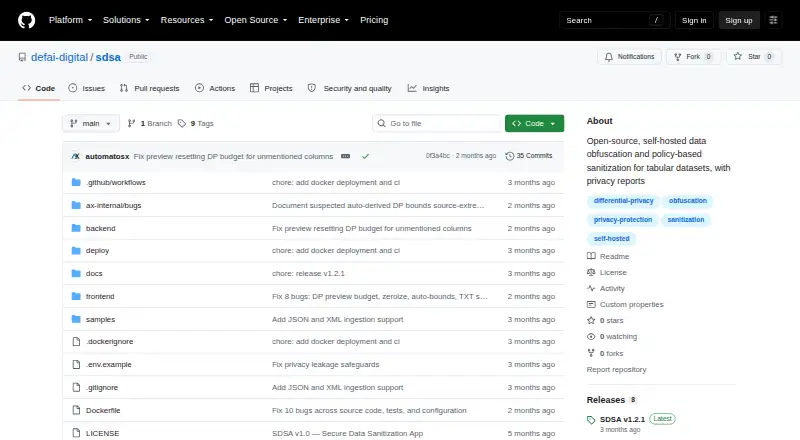
What SDSA is
SDSA is a self-hostable web app for sanitizing tabular data before it leaves a trusted environment. It accepts CSV, delimited TXT, single-table SQL INSERT dumps, JSON records, and XML records through a browser interface or REST API. SDSA infers a schema and detects likely sensitive fields, including emails, phone numbers, card numbers, government IDs, dates of birth, names, and addresses. Users can apply masking, HMAC hashing, tokenization, redaction, dropping, numeric binning, date or string truncation, and bounded Laplace noise. It supports k-anonymity for selected quasi-identifiers and can measure or enforce l-diversity for sensitive cleartext attributes. Exports include sanitized CSV and JSON and Markdown privacy reports with before-and-after utility summaries. A headless command-line pipeline is available for CI/CD and data workflows. Installation is documented as a Python package or Docker deployment, including a production Compose profile with nginx. Uploaded data and outputs use an in-memory session store with a 30-minute default lifetime. SDSA is licensed under AGPL-3.0.
Good
- Accepts five tabular data formats.
- Offers multiple field transformation methods.
- Exports privacy reports with utility summaries.
- Browser, REST API, and command-line interfaces are available.
- Open source under AGPL-3.0.
Watch out
- Sessions use in-memory storage with a 30-minute default lifetime.
- Multiple workers or replicas can break the upload-to-download flow.
- It does not claim dataset-level differential privacy.
- Auxiliary-data linkage attacks may still succeed.
Who it suits
SDSA suits teams handling data for testing, QA, analytics, or external processing who want a self-hosted sanitization workflow. It also fits pipelines that use a REST API or command-line processing.
Verdict
SDSA combines data transformations, privacy controls, and reviewable reports for self-hosted tabular-data workflows. Its in-memory session constraint and stated privacy limits matter when planning a deployment.
The facts
Each one read from SDSA's own pages, with the date it was checked.
What it does
- Data handling
- Uploaded data, parsed dataframes, HMAC keys, and generated outputs stay in process memory and expire after the configured session TTL, which defaults to 30 minutes.checked 9 Oct 2026
- Deployment
- The maker documents installation as a Python package or Docker deployment, including a production Docker Compose profile with nginx TLS termination.checked 9 Oct 2026
- Deployment constraint
- Deployments should run one SDSA application process unless the in-memory session store is replaced with shared storage, because multiple workers or replicas break the upload-to-download flow.checked 8 Oct 2026
- Deployment limit
- The maker says to run one SDSA application process per deployment while sessions use in-memory storage, because multiple workers or replicas can break the upload-to-download flow.checked 9 Oct 2026
- Deployment security
- The production Compose profile uses nginx for TLS termination, upload limits, security headers, and basic rate limits.checked 8 Oct 2026
- Input formats
- It accepts CSV, delimited TXT, single-table SQL INSERT dumps, JSON records, and XML records through its browser UI or REST API.checked 9 Oct 2026
- Intended users
- The maker describes SDSA for enterprise data-sharing workflows such as testing, QA, analytics, and external processing, with explicit policies and reviewable reports.checked 9 Oct 2026
- Interfaces
- Users can process data through a browser UI, REST API, or headless command-line pipeline for CI/CD and data pipelines.checked 8 Oct 2026
- License
- The repository states SDSA is licensed under AGPL-3.0.checked 9 Oct 2026
- PII detection
- It infers schema and detects likely sensitive fields such as email, phone, card number, government ID, date of birth, name, and address.checked 8 Oct 2026
- Privacy controls
- SDSA enforces k-anonymity over operator-selected quasi-identifiers and can measure or enforce l-diversity for sensitive cleartext attributes.checked 9 Oct 2026
- Privacy limitation
- SDSA does not claim dataset-level (epsilon, delta) differential privacy and says auxiliary-data linkage attacks may still succeed.checked 9 Oct 2026
- Purpose
- SDSA is a self-hostable web app for sanitizing tabular data before it leaves a trusted environment.checked 8 Oct 2026
- Reports
- Each processed release includes sanitized data and JSON and Markdown privacy reports with before-and-after utility summaries.checked 9 Oct 2026
- Security limits
- SDSA says it does not provide dataset-level differential privacy or guarantee that auxiliary-data linkage attacks are impossible.checked 8 Oct 2026
- Supported data
- It accepts CSV, delimited TXT, single-table SQL INSERT dumps, JSON records, and XML records.checked 8 Oct 2026
- Transformations
- Available field actions include masking, HMAC hashing, tokenization, redaction, dropping, numeric binning, date or string truncation, and bounded Laplace noise.checked 9 Oct 2026
- What it does
- SDSA is a self-hostable web app for sanitizing tabular data before it leaves a trusted environment, with privacy reports.checked 9 Oct 2026
- Workflow integrations
- SDSA provides a REST API and a headless command-line pipeline for CI/CD and data pipelines.checked 9 Oct 2026
Alternatives to SDSA
- 1

MySQL
Free planAPILinuxmacOSSelf-hosted7.9Free plan - 2
DataVeil
Free planLinuxSelf-hostedWindows7.5From $5,690 a year - 3

Tonic Fabricate
Free planWebAPISelf-hosted6.8$29 usage-based - 4

Automic Continuous Delivery Automation
WebAPILinuxSelf-hosted6.5 - 5

MOSTLY AI
Free planWebAPILinuxSelf-hosted6.4Free plan - 6

ARX Data Anonymization Tool
Free planAPILinuxmacOSSelf-hosted6.3Free plan