ScaleOps
ScaleOps is a Kubernetes platform that continuously allocates and scales CPU, GPU, and memory using workload context.
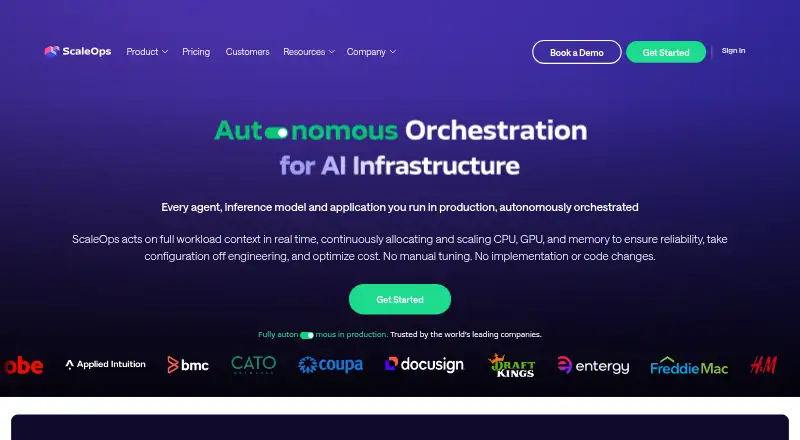
What ScaleOps is
ScaleOps is a Kubernetes platform that continuously allocates and scales CPU, GPU, and memory using workload context. It adjusts pod CPU and memory requests in real time according to workload behavior and live cluster conditions. Node selection, Karpenter instance selection, and disruption budgets are optimized to reduce underused capacity. GPU capabilities include dynamic sharing, workload rightsizing, and replica scaling based on pod-level utilization. Cost monitoring breaks Kubernetes costs down by cluster, namespace, team, application, annotations, or labels. ScaleOps is self-hosted on Kubernetes, stores data locally, and operates without external dependencies. Supported environments include EKS, GKE, AKS, OpenShift, Rancher, Oracle Cloud, and Alibaba. It also describes air-gapped operation and FIPS compatibility for FedRAMP-certified environments, and lists SOC 2 Type II. Integrations include HPA, KEDA, Karpenter, Cluster Autoscaler, Argo CD, Flux, and CI/CD pipelines. Pricing is by custom quote, and a free trial is available.
Good
- Adjusts pod resources using live workload conditions
- Includes GPU sharing, rightsizing, and replica scaling
- Breaks costs down across Kubernetes dimensions
- Supports air-gapped and FIPS-compatible deployments
- Works with major autoscaling and delivery tools
Watch out
- Pricing is available only by custom quote
- No free plan is listed
- Requires Kubernetes deployment
- Data is stored locally without external dependencies
Who it suits
ScaleOps suits teams running production applications, AI agents, or inference and training models on Kubernetes. It is relevant where self-hosting, local data storage, workload rightsizing, and cost visibility are required.
Verdict
ScaleOps combines workload rightsizing, GPU controls, node optimization, and Kubernetes cost monitoring in a self-hosted platform. Teams should verify supported cluster environments and deployment requirements before requesting a quote.
Plans and prices
From ScaleOps's own pricing page, checked 7 Oct 2001.
| Plan | Price | What it gives you |
|---|---|---|
| Custom quote | Priced on request | Pricing depends on factors specific to your environment; contact ScaleOps for an accurate quote |
The facts
Each one read from ScaleOps's own pages, with the date it was checked.
Where it runs
- Air-gapped and regulated use
- The platform says it operates in air-gapped environments and is FIPS-compatible for deployment inside FedRAMP-certified environments.checked 7 Oct 2001
Money
- Cost monitoring
- Cost monitoring breaks down Kubernetes costs by cluster, namespace, team, application, annotations, or labels.checked 7 Oct 2001
What it does
- Deployment model
- ScaleOps describes itself as self-hosted, deployed on Kubernetes clusters with data stored locally and no external dependencies.checked 7 Oct 2001
- GPU optimization
- Its GPU platform includes dynamic GPU sharing, workload rightsizing, and replica scaling based on pod-level GPU utilization.checked 7 Oct 2001
- Installation
- The company says ScaleOps can be installed with a single Helm command.checked 7 Oct 2001
- Integrations
- ScaleOps says it works alongside HPA, KEDA, Karpenter, and Cluster Autoscaler, and supports Argo CD, Flux, and CI/CD pipelines.checked 7 Oct 2001
- Intended users
- The product is presented for teams running production applications, AI agents, and inference or training models on Kubernetes.checked 7 Oct 2001
- Node and Karpenter optimization
- The platform optimizes node selection and Karpenter instance selection and disruption budgets to reduce underused capacity.checked 7 Oct 2001
- Pod rightsizing
- It automatically adjusts pod CPU and memory requests in real time based on workload behavior and live cluster conditions.checked 7 Oct 2001
- Security
- ScaleOps lists SOC 2 Type II among its credentials.checked 7 Oct 2001
- Support
- ScaleOps offers a demo with a platform expert and invites prospective customers to contact its team for help.checked 7 Oct 2001
- Supported environments
- It lists EKS, GKE, AKS, OpenShift, Rancher, Oracle Cloud, and Alibaba among the Kubernetes environments it supports.checked 7 Oct 2001
- Troubleshooting
- Its troubleshooting feature shows policy changes, restarts, rescheduling, and scaling actions to help teams investigate production issues.checked 7 Oct 2001
- What it does
- ScaleOps continuously allocates and scales CPU, GPU, and memory using workload context to support reliability and optimize costs.checked 7 Oct 2001
Alternatives to ScaleOps
- 1

KubeAdapt
Free planWebAPILinuxmacOS7.7From $0.60 a month - 2
Krossboard
Free planOpen sourceWebAPILinuxSelf-hosted7.2Free plan - 3

Atmosly Kubernetes Cost Optimization
Free planWebLinuxSelf-hosted6.8From $399 a month - 4

Flexera One IT Asset Management
WebSelf-hosted6.3 - 5

Varcio Kubernetes Cost Management
WebAPISelf-hosted6.3From $49 a month - 6
CloudBolt
Free planWebAPISelf-hosted6.2Free plan