RVM
RVM is a command-line tool for installing and managing multiple Ruby environments, from interpreters to gem sets.
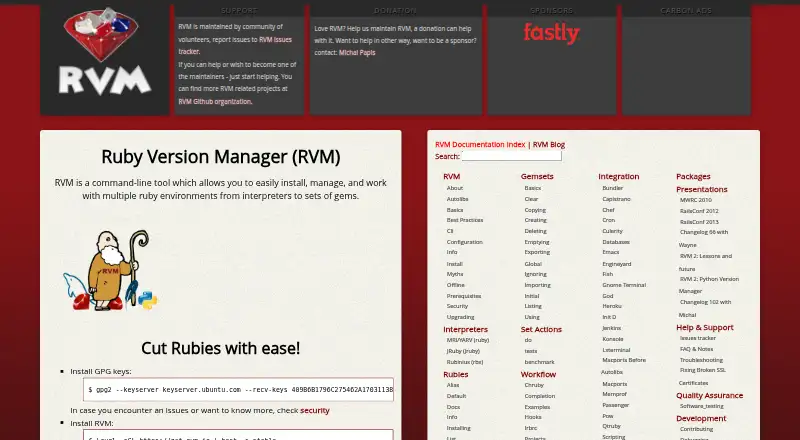
What RVM is
RVM is a command-line tool for installing and managing multiple Ruby environments, from interpreters to gem sets. It can create a self-contained environment for each project with a selected Ruby version and its required gems. Named gemsets help manage gems across Ruby versions, and a shared cache keeps one on-disk copy of each downloaded gem. RVM can run test suites, rake tasks, benchmarks and gem commands against multiple Ruby versions. Its documented integrations include Bundler, Capistrano, Chef, Jenkins, Heroku and Passenger. Commands cover installing, selecting, upgrading, reinstalling, uninstalling and removing Ruby versions. RVM supports most UNIX-like systems and Windows through Cygwin or Bash on Ubuntu on Windows. Basic installation requires Bash, curl, gpg2 and GNU tools; git is needed to install head Ruby versions. It documents single-user, multi-user and mixed-mode setups, and recommends single-user installation for an isolated home-directory environment. RVM says it signs releases and the installer with GPG and verifies signatures during updates. Community volunteers maintain the project, with support through issue trackers and pull requests.
Good
- Creates isolated environments for projects.
- Runs tests and commands against multiple Ruby versions.
- Named gemsets organize gems across versions.
- Supports common Ruby ecosystem integrations.
- Release and installer signatures are verified.
Watch out
- Installation requires Bash, curl, gpg2 and GNU tools.
- Git is required to install head Ruby versions.
- Windows support is through Cygwin or Bash on Ubuntu on Windows.
- Community volunteers provide support through issue trackers and pull requests.
Who it suits
RVM suits Ruby developers who need separate project environments or need to run commands across multiple Ruby versions. It also fits teams seeking consistent Ruby environments across development, CI, QA, staging and production.
Verdict
RVM brings Ruby versions, gemsets and project environments under command-line management. It is a fit for Ruby workflows that need isolation or multi-version testing, provided the installation requirements suit your system.
The facts
Each one read from RVM's own pages, with the date it was checked.
What it does
- CLI actions
- The CLI includes commands to install, use, upgrade, reinstall, uninstall, and remove Ruby versions.checked 30 Sep 2026
- Deployment environments
- RVM provides self-contained, dedicated Ruby and gem environments for individual projects.checked 30 Sep 2026
- Development parity
- RVM supports identical environments across development, CI, QA, staging, and production.checked 30 Sep 2026
- Funding
- RVM requests donations and sponsorship to help maintain the project.checked 30 Sep 2026
- Gem management
- Named gemsets let users manage gems across Ruby versions, and RVM uses a shared cache so each downloaded gem has one on-disk copy.checked 30 Sep 2026
- Installation limitation
- RVM states that outside installation tutorials are unsupported and recommends using installation processes from its own site.checked 30 Sep 2026
- Installation modes
- RVM documents single-user, multi-user, and mixed-mode installations, and recommends single-user installation for an isolated setup in a user's home directory.checked 30 Sep 2026
- Installation requirements
- The installation page lists bash, curl, gpg2, and GNU versions of tools as basic requirements.checked 30 Sep 2026
- Install modes
- RVM documents single-user, multi-user, and mixed-mode installations.checked 30 Sep 2026
- Integrations
- RVM documents integrations including Bundler, Capistrano, Chef, Jenkins, Heroku, Passenger, TeamCity, Vagrant, Vim, and Zsh.checked 30 Sep 2026
- Origin
- RVM was started as a personal project by Wayne E. Seguin in October 2007 and later grew through Ruby community feedback.checked 30 Sep 2026
- Project isolation
- RVM can give each project a self-contained environment with a specific Ruby version and the gems it needs.checked 30 Sep 2026
- Purpose
- RVM is a command-line tool for installing and managing multiple Ruby environments, from interpreters to gem sets.checked 30 Sep 2026
- Release security
- RVM cryptographically signs releases and the installer script with GPG, with automatic verification during updates.checked 30 Sep 2026
- Requirements
- RVM requires Bash, curl, gpg2, and GNU tools, and it requires git for installing head Ruby versions.checked 30 Sep 2026
- Ruby implementations
- RVM supports installing official Ruby interpreter releases and maintains a list of known interpreters and versions.checked 30 Sep 2026
- Ruby testing
- RVM can run test suites, rake tasks, benchmarks, and gem commands against multiple Ruby versions.checked 30 Sep 2026
- Security
- RVM says it cryptographically signs releases and the installer script, and verifies signatures during updates.checked 30 Sep 2026
- Security model
- RVM keeps Ruby processes in user space to encourage non-root operation and reduce the impact of a compromised Ruby process.checked 30 Sep 2026
- Support
- RVM is maintained by community volunteers, with support through issue trackers and pull requests.checked 30 Sep 2026
- Supported systems
- RVM supports most UNIX-like systems and Windows through Cygwin or Bash on Ubuntu on Windows.checked 30 Sep 2026
- Testing
- RVM can run test suites, rake tasks, benchmarks, and gem commands against multiple Ruby versions at the same time.checked 30 Sep 2026
- User permissions
- RVM says its user-space setup encourages non-root use and limits a compromised Ruby process from compromising the entire system.checked 30 Sep 2026