Rogue
Rogue is a self-hosted platform for evaluating AI agents and probing their security.
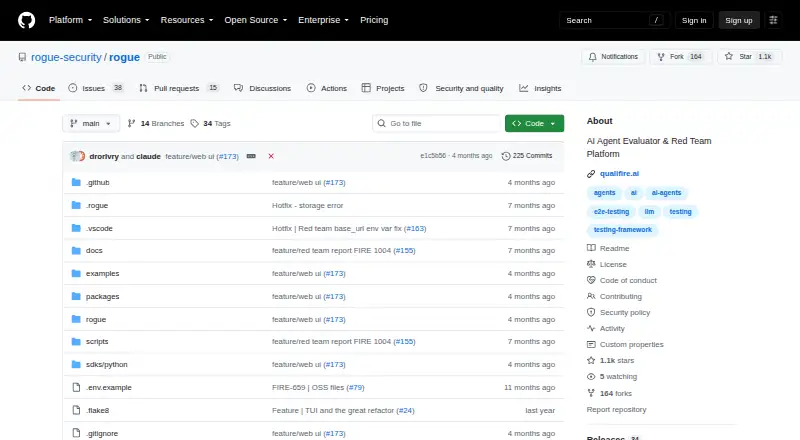
What Rogue is
Rogue is a self-hosted platform for evaluating AI agents and probing their security. Its automatic evaluations check agent behavior against business policies and expected outcomes, then produce pass/fail reports with reasoning. Red-team coverage includes more than 75 vulnerabilities across 12 security categories, using techniques such as encoding, social engineering, and injection. It assigns vulnerabilities CVSS-based scores from 0 to 10 and maps tests to frameworks including OWASP LLM Top 10, MITRE ATLAS, NIST AI RMF, ISO/IEC 42001, the EU AI Act, GDPR, and OWASP API Top 10. Rogue offers a server, terminal interface, and CLI for CI/CD pipelines. It supports A2A over HTTP, MCP over SSE or Streamable HTTP, and direct Python calls. OpenAI, Anthropic, and Google models are available through LiteLLM, and getting started requires an LLM API key. Scans can use a random seed for reproducibility, and reports export to Markdown, CSV, or JSON. The free plan covers personal and internal use; commercial hosting requires licensing.
Good
- Evaluations produce pass/fail reports with reasoning.
- Coverage spans 75+ vulnerabilities and 12 categories.
- Supports A2A, MCP, and direct Python agents.
- Reports export to Markdown, CSV, and JSON.
- Free for personal and internal use.
Watch out
- An LLM API key is required to start.
- Commercial hosting requires licensing.
- Self-hosted deployment is required.
- The license excludes selling the software.
Who it suits
Rogue is aimed at security teams and developers building or deploying AI agents. It may suit teams that need regression testing, security audits, or compliance reporting.
Verdict
Rogue combines agent behavior checks with security testing and framework mappings. Its free use is limited to personal and internal use, while commercial hosting requires licensing.
Plans and prices
From Rogue's own pricing page, checked 1 Oct 2026.
| Plan | Price | What it gives you |
|---|---|---|
| Personal and internal use | Free | Free for personal and internal use |
| Commercial hosting | Priced on request | Requires licensing · Contact [email protected] |
The facts
Each one read from Rogue's own pages, with the date it was checked.
What it does
- Commercial use
- The README says Rogue is free for personal and internal use and that commercial hosting requires licensing; it provides [email protected] for contact.checked 30 Sep 2026
- Compliance
- Rogue maps testing to eight compliance frameworks including OWASP, MITRE, NIST, GDPR and the EU AI Act.checked 1 Oct 2026
- Coverage
- The repository states that Rogue covers 75+ vulnerabilities across 12 security categories and 20 attack techniques.checked 1 Oct 2026
- Evaluation
- Automatic Evaluation tests agents against business policies and expected behaviors with pass/fail reports and reasoning.checked 1 Oct 2026
- Frameworks
- The documented framework coverage includes OWASP LLM Top 10, MITRE ATLAS, NIST AI RMF, ISO/IEC 42001, EU AI Act, GDPR, and OWASP API Top 10.checked 30 Sep 2026
- Interfaces
- Rogue provides a server, terminal user interface and non-interactive CLI for CI/CD pipelines.checked 1 Oct 2026
- License
- The repository license is the Qualifire OSS License, combining MIT terms with a Commons Clause that excludes selling the software or offering it as a paid hosted service.checked 30 Sep 2026
- Model providers
- Rogue lists OpenAI, Anthropic, and Google models via LiteLLM and requires an LLM API key to get started.checked 30 Sep 2026
- Models
- Rogue supports OpenAI, Anthropic and Google models through LiteLLM.checked 1 Oct 2026
- Product
- Rogue is an AI agent evaluation and red teaming platform for testing agent reliability and security.checked 30 Sep 2026
- Protocols
- Supported agent protocols are A2A over HTTP, MCP over SSE or streamable HTTP, and direct Python function calls.checked 1 Oct 2026
- Purpose
- Rogue is an AI agent evaluator and red team platform for stress-testing agents before attackers do.checked 1 Oct 2026
- Reports
- Rogue exports comprehensive reports in Markdown, CSV and JSON formats.checked 1 Oct 2026
- Reproducibility
- Scans can use a random seed to make results reproducible.checked 30 Sep 2026
- Requirements
- The quick start lists uvx, Python 3.10+, and an API key from OpenAI, Anthropic, or Google as prerequisites.checked 30 Sep 2026
- Risk scoring
- Rogue assigns vulnerabilities a CVSS-based risk score from 0 to 10.checked 30 Sep 2026
- Runtime integrations
- The AI AppSec product page lists LangChain, CrewAI, AutoGen, custom builds, SIEM systems and webhooks, including Splunk, Datadog and PagerDuty.checked 1 Oct 2026
- Scan limits
- Basic scans use 5 curated vulnerabilities and 6 attacks, while full scans use 75+ vulnerabilities and 40+ attacks.checked 1 Oct 2026
- Security posture
- Rogue Security states that its Trust Center provides information about SOC 2 compliance and data handling, and that it supports end-to-end encryption and zero-data-egress in-VPC deployment.checked 1 Oct 2026
- Target users
- The product is presented for security teams and developers building or deploying AI agents, including teams needing regression testing, security audits and compliance reporting.checked 1 Oct 2026
The company
- Maker
- The license identifies Qualifire ltd as Rogue's licensor.checked 30 Sep 2026
- Red teaming
- Red Teaming simulates adversarial attacks to find security vulnerabilities.checked 1 Oct 2026
Alternatives to Rogue
- 1
OpenSecureAI Scanner
Free planOpen sourceWebAPILinuxmacOS8.1From $49 a month - 2

AgentSeal
Free planOpen sourceWebAPILinuxmacOS8.0From $19 a month - 3

Promptfoo
Free planOpen sourceWebAPILinuxmacOS7.8Free plan - 4

Giskard
Free planOpen sourceWebAPILinuxSelf-hosted7.6Free plan - 5

Confident AI
Free planWebAPISelf-hosted6.9From $200 a month - 6
NVADER
Free planWeb6.7From $49 a month