ReText
ReText is a free Linux editor for markup documents stored in local files.
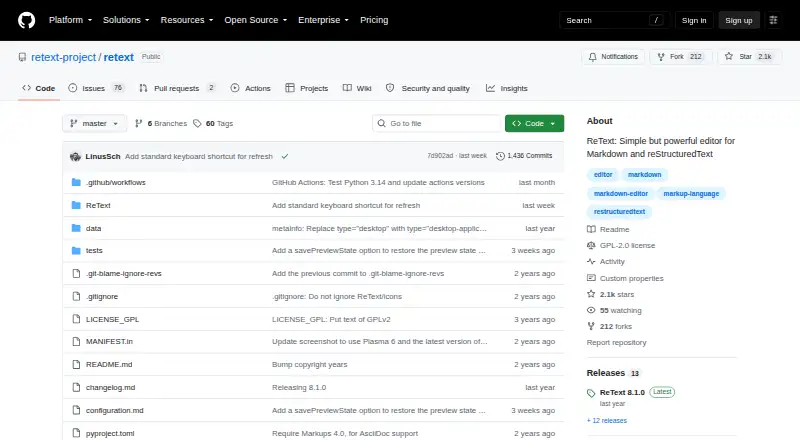
What ReText is
ReText is a free Linux editor for markup documents stored in local files. Its Markups module handles Markdown, reStructuredText, Textile, and AsciiDoc, and Python modules can add support for custom markups. Documents can be exported to PDF or HTML, but ReText has no publishing workflow, so it focuses on editing and file export. Installation requires Python 3.9 or later, PyQt6, and Markups 4.0 or later; the project provides a pip command, source tarball, and repository options. Optional packages add spell checking, encoding detection, and a preview engine with JavaScript support. New tabs can open in editor, normal-preview, or live-preview modes. Configurable tools include document statistics, line numbers, spell checking, synchronized scrolling, and a directory tree. Wiki documentation covers export extensions, Markdown syntax extensions, table editing mode, and FakeVim mode. Configuration is stored in a text file whose path is printed at startup. ReText is licensed under GNU GPL version 2 or later.
Good
- Supports four markup languages
- Allows custom markups through Python modules
- Exports documents to PDF and HTML
- Offers configurable preview and editing modes
- Free under GNU GPL version 2 or later
Watch out
- Linux only
- Requires Python 3.9 or later, PyQt6, and Markups 4.0+
- No publishing workflow
- Spell checking and JavaScript preview need optional packages
Who it suits
ReText suits Linux users who edit Markdown and other markup files locally and need PDF or HTML export. It is less suited to users seeking built-in publishing workflow management.
Verdict
ReText provides a focused Linux workspace for editing several markup formats and exporting finished files. Its local-file approach, configurable previews, and open-source license fit technical writers who do not need publication management inside the editor.
Plans and prices
From ReText's own pricing page, checked 9 Oct 2026.
| Plan | Price | What it gives you |
|---|---|---|
| Free | Free | GNU GPL v2 or later · Python 3.9 or later required |
The facts
Each one read from ReText's own pages, with the date it was checked.
What it does
- Configuration
- ReText stores its configuration in a text file, and prints that file's path to stdout at startup.checked 9 Oct 2026
- Custom markup
- Users can add support for custom markups using Python modules.checked 9 Oct 2026
- Dependencies
- ReText requires PyQt6 and Markups 4.0 or later.checked 9 Oct 2026
- Editing options
- Document statistics, line numbers, spell checking, synchronized scrolling and a directory tree are configurable options.checked 9 Oct 2026
- Export and editing extensions
- The project wiki lists documentation for export extensions, Markdown syntax extensions, table editing mode and FakeVim mode.checked 9 Oct 2026
- Export formats
- PDF,HTMLchecked 20 Sep 2026
- Install
- The project says to install Python 3.9 or later and run `pip3 install ReText`, or download the source tarball or clone the repository.checked 9 Oct 2026
- License
- ReText is licensed under the GNU GPL, version 2 or later.checked 9 Oct 2026
- Local file support
- Yeschecked 20 Sep 2026
- Maintainer
- The project README credits Dmitry Shachnev and Maurice van der Pot for copyright.checked 9 Oct 2026
- Optional features
- The project recommends pyenchant for spell checking, chardet for encoding detection, and PyQt6-WebEngine for a preview engine with JavaScript support.checked 9 Oct 2026
- Preview
- The configuration supports editor, normal-preview and live-preview modes for new tabs.checked 9 Oct 2026
- Publishing workflow
- nonechecked 20 Sep 2026
- Purpose
- ReText is an editor for markup languages.checked 9 Oct 2026
- Supported markup
- Its Markups module supports Markdown, reStructuredText, Textile and AsciiDoc.checked 9 Oct 2026
- Translation
- The project says users can translate ReText through Transifex.checked 9 Oct 2026
Money
- Free plan
- Yeschecked 20 Sep 2026
Where it runs
- Supported platforms
- linuxchecked 20 Sep 2026