
Reproxy
Reproxy is a free, self-hosted HTTP(S) edge server and reverse proxy for routing requests to destination servers.
What Reproxy is
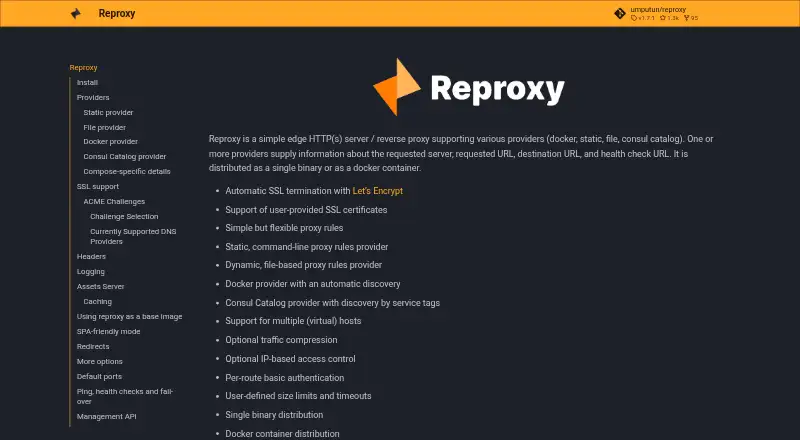
Reproxy is a free, self-hosted HTTP(S) edge server and reverse proxy for routing requests to destination servers. Routing rules can come from static configuration, files, Docker, or Consul Catalog, and Docker discovery can automatically find running containers. It supports automatic Let’s Encrypt certificates, user-provided certificates, and TLS termination. Traffic features include health checks, failover, load balancing, response caching, and rate limiting. Per-route basic authentication and IP-based access controls restrict routes. A static asset server includes an optional single-page-application mode. An optional management server exposes route information and Prometheus metrics. External plugins run as separate processes or containers over RPC. DNS-01 certificate challenges support Cloudflare and AWS Route53. Distribution includes a self-contained binary, Docker image, and Debian or RPM packages, with Linux, macOS, and Windows support on listed x86_64 and ARM architectures. The container runs as root by default; documentation recommends a less-privileged user when Docker discovery is unnecessary. The project is under active development and may introduce breaking changes before version 1.
Good
- Free self-hosted deployment
- Automatic Let’s Encrypt certificates
- Health checks and load balancing
- Docker service discovery
- Prometheus route metrics
Watch out
- Container runs as root by default
- Breaking changes may occur before version 1
- Forwarded IP headers require trusted proxy control
Who it suits
It suits operators deploying a self-hosted proxy across Linux, macOS, or Windows who need routing, TLS, health checks, and traffic controls. Teams using Docker, Consul, or Prometheus can use the listed integration points.
Verdict
Reproxy provides routing, TLS, balancing, access controls, and monitoring in a self-hosted package. Its active pre-1.0 development and default container privileges require attention during deployment.
The facts
Each one read from Reproxy's own pages, with the date it was checked.
What it does
- Access controls
- It supports IP-based route restrictions and global or per-route basic authentication.checked 5 Oct 2026
- Container security
- The container runs as root by default, and the documentation recommends using a less-privileged user when Docker discovery is not needed.checked 4 Oct 2026
- Distribution
- Reproxy is distributed as a self-contained binary and Docker image, with Homebrew installation and Debian and RPM packages also documented.checked 5 Oct 2026
- Docker discovery
- Its Docker provider can automatically discover running containers and configure them as routing destinations.checked 5 Oct 2026
- Extensibility
- It supports external plugins implemented as independent processes or containers using RPC.checked 4 Oct 2026
- Health and balancing
- Reproxy provides live health checks and fail-over/load-balancing for destinations.checked 5 Oct 2026
- Integrations
- Documented service-discovery integrations include Docker and Consul Catalog; SSL DNS challenge providers include Cloudflare and AWS Route 53.checked 5 Oct 2026
- Management
- The management server provides route information and Prometheus metrics.checked 5 Oct 2026
- Monitoring
- Its optional management server exposes route information and Prometheus metrics.checked 4 Oct 2026
- Project status
- The project says it is under active development and may have breaking changes before version 1; it describes version 0.4.x as suitable for real-life use.checked 5 Oct 2026
- Purpose
- Reproxy is an HTTP(S) edge server and reverse proxy that routes requests to destination servers using configured providers.checked 5 Oct 2026
- Routing providers
- The documented providers are static, file, Docker, and Consul Catalog, and multiple providers can be used at once.checked 5 Oct 2026
- Security
- The documentation recommends running the container as a less-privileged user when Docker discovery is not needed and warns that forwarded IP headers can be spoofed unless controlled by a trusted proxy.checked 5 Oct 2026
- Service discovery
- Its Docker provider can automatically discover running containers as routing destinations.checked 4 Oct 2026
- SSL
- It supports automatic Let’s Encrypt certificates and user-provided certificates.checked 4 Oct 2026
- Static assets
- It includes a static assets server with an optional SPA-friendly mode.checked 5 Oct 2026
- Supported systems
- The installation documentation lists Linux, macOS, and Windows builds, including x86_64 and ARM variants for some systems.checked 5 Oct 2026
- TLS
- Reproxy supports automatic SSL certificates through ACME/Let’s Encrypt and user-provided certificates.checked 5 Oct 2026
- Traffic management
- It supports health checks, failover, and load balancing.checked 4 Oct 2026
Alternatives to Reproxy
- 1

Pomerium
Free planOpen sourceWebAPILinuxmacOS8.3From $7 a month - 2

ngrok
Free planWebAPILinuxmacOS7.8From $10 a month - 3

Traefik Proxy
Free planOpen sourceWebAPILinuxmacOS7.7Free plan - 4
HAProxy Community Edition
Free planOpen sourceAPILinuxmacOSSelf-hosted7.4Free plan - 5

Apache Traffic Server
Free planOpen sourceAPILinuxmacOSSelf-hosted7.2Free plan - 6
Openport
Free planWebAPILinuxmacOS7.1From $1 a month