Report URI DMARC Monitoring
Report URI DMARC Monitoring turns aggregate mail reports into visibility about systems sending mail as your domain and whether messages authenticate.
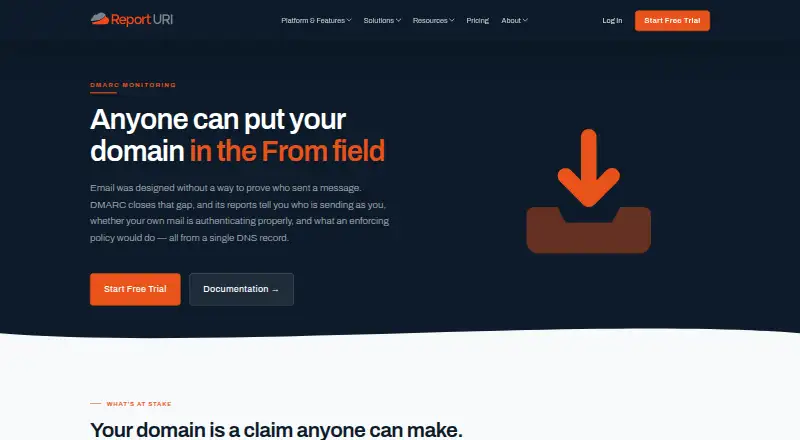
What Report URI DMARC Monitoring is
Report URI DMARC Monitoring turns aggregate mail reports into visibility about systems sending mail as your domain and whether messages authenticate. Reports show sending sources, message volumes, source IPs, SPF and DKIM results, alignment, and disposition. The service parses compressed XML reports and adds organization information to source addresses to help identify senders. It accepts aggregate rua reports, not failure ruf reports, and says it never receives message content. Mail does not pass through the service, which does not touch messages. Setup requires SPF and DKIM to be configured and a single DMARC TXT record; reports usually begin arriving within a day. Report URI recommends starting with p=none to observe results without changing mail handling, then tightening the policy once legitimate senders authenticate cleanly. The product is paid, has no free plan, and offers a 30-day free trial without a credit card. It is available on the web and through a REST API with read access to account data. DMARC monitoring does not inspect message content, filter inbound mail, or secure connections between mail servers.
Good
- Reports include SPF, DKIM, alignment, and disposition.
- Source addresses are enriched with organization information.
- Mail is not routed through the service.
- 30-day trial requires no credit card.
Watch out
- No free plan.
- Accepts aggregate rua reports, not failure ruf reports.
- Does not inspect message content or filter inbound mail.
- Does not secure connections between mail servers.
Who it suits
It suits organizations seeking to identify legitimate senders and impersonators before enforcing a DMARC policy. SPF and DKIM should be configured before enabling DMARC.
Verdict
Report URI DMARC Monitoring provides visibility into domain authentication through aggregate reports, without routing or inspecting message content. Its scope is specifically DMARC reporting, so it is not a substitute for inbound filtering or other email protections.
The facts
Each one read from Report URI DMARC Monitoring's own pages, with the date it was checked.
What it does
- API
- The REST API provides read access to account data and its setup endpoint returns the account's DMARC reporting address.checked 9 Oct 2026
- Data scope
- Report URI accepts aggregate rua reports but not failure ruf reports because those may contain message content; it says it does not receive message content.checked 9 Oct 2026
- Integrations
- The DMARC product page does not name third-party integrations; the platform page describes general delivery options including webhooks, APIs, email, and MCP.checked 9 Oct 2026
- Intended users
- The product is presented for organisations seeking to identify legitimate mail senders and impersonators before enforcing a DMARC policy.checked 9 Oct 2026
- Mail flow
- Report URI says mail is not routed through its service and the product does not touch messages.checked 9 Oct 2026
- Policy rollout
- The product recommends starting with p=none to observe reports without changing delivery, then tightening the policy when legitimate mail authenticates cleanly.checked 9 Oct 2026
- Prerequisites
- SPF and DKIM should be configured before enabling DMARC.checked 9 Oct 2026
- Purpose
- DMARC Monitoring turns receiver reports into visibility about who is sending mail as your domain and whether that mail authenticates.checked 9 Oct 2026
- Readable reports
- The service parses and aggregates compressed XML reports and enriches source addresses to help identify organisations.checked 9 Oct 2026
- Report details
- Aggregate reports include source IP and volume, SPF and DKIM results, alignment, and disposition.checked 9 Oct 2026
- Report enrichment
- The service parses and aggregates compressed XML reports and enriches source addresses with organization information.checked 9 Oct 2026
- Safe rollout
- The product recommends starting with p=none, which gathers reports without changing mail handling, and moving to quarantine or reject when legitimate senders authenticate cleanly.checked 9 Oct 2026
- Scope limit
- DMARC reports domain authentication; the page says it does not inspect message content, filter inbound mail, or secure connections between mail servers.checked 9 Oct 2026
- Security documentation
- Report URI's Security & Compliance page links to data protection information and analysis, a penetration test report, and a PCI DSS SAQ A AoC.checked 9 Oct 2026
- Security documents
- Report URI's security page links data protection information and analysis, a penetration test report, and a PCI DSS SAQ A Attestation of Compliance.checked 9 Oct 2026
- Sender visibility
- Aggregate reports show sending sources, message volumes, and authentication results, with source IPs enriched using Report URI data.checked 9 Oct 2026
- Setup
- Setup requires SPF and DKIM to be in place and a single DMARC TXT record; the page says reports usually begin arriving within a day.checked 9 Oct 2026
- Who it serves
- The product helps organizations identify forgotten legitimate senders and impersonators before enforcing a DMARC policy.checked 9 Oct 2026
The company
- Company history
- Report URI's history page says it launched in 2015 and added DMARC reporting in 2020.checked 9 Oct 2026
- Founded
- Report URI says it launched in 2015, initially offering CSP and HPKP violation reporting.checked 9 Oct 2026
Money
- Trial
- The DMARC product page advertises a 30-day free trial with no credit card required.checked 9 Oct 2026
Alternatives to Report URI DMARC Monitoring
- 1

DMARC Report
Free planAndroidiOSWebAPI7.9From $25 a month - 2

Postmark
Free planWebAPI7.6Free plan - 3

Folderly
Free planWebAPI7.4Free plan - 4

GlockApps
Free planWebAPI7.4From $59 a month - 5

Unspam.email
Free planWebAPI7.4From $5 a month - 6

dmarcian
Free planWebAPIExtension7.3From $24 a month