
DMARC Report
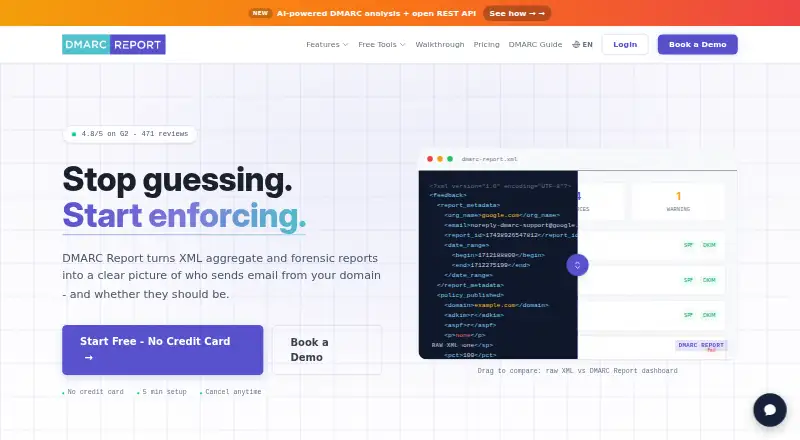
DMARC Report processes aggregate and forensic DMARC reports and presents authentication results and sending sources in dashboards.
What DMARC Report is
DMARC Report processes aggregate and forensic DMARC reports and presents authentication results and sending sources in dashboards. It monitors SPF, DKIM, and DMARC records for changes, failures, and issues, with notifications through email, webhooks, or Slack. Forensic reports provide per-message details such as sender IP, header information, authentication failures, and receiver disposition. Teams can use the platform while moving DMARC policy toward quarantine or reject across domains. It also offers AI analysis, a REST API, and MCP integration for compatible AI tools including Claude and ChatGPT. MSPs can manage clients through a multi-tenant portal with white-label reports, role-based access, and bulk domain onboarding. The free Core plan is free and covers one domain, subdomains, 10,000 monthly messages, 30 days of data history, and aggregate reports. DMARC Report was founded in 2014 and is headquartered in California.
Good
- Monitors SPF, DKIM, and DMARC records.
- Alerts can go by email, webhook, or Slack.
- Forensic reports include per-message details.
- Free tools check several email-authentication records.
- Offers a REST API and MCP integration.
Watch out
- Free Core plan covers one domain.
- Free Core plan allows 10,000 messages monthly.
- Free Core plan has 30 days of data history.
Who it suits
DMARC Report suits teams monitoring email authentication and working toward stronger DMARC policies. MSPs may find its multi-tenant client portal and white-label reports relevant.
Verdict
DMARC Report combines authentication monitoring, forensic detail, and tools for managing multiple client accounts. The free Core plan is limited by domain, message volume, and data history.
Plans and prices
From DMARC Report's own pricing page, checked 15 Oct 2026.
| Plan | Price | What it gives you |
|---|---|---|
| Core | Free | 10,000 monthly messages · 1 domain · subdomains · 30 days data history · aggregate reports · Free forever |
| Guard | $25 a month | 250,000 monthly messages · 5 domains · subdomains · 6 months data history · aggregate and failure reports · email vendor ID · group and permission management · $25 /mo |
| Shield | $75 a month | 1,000,000 monthly messages · 10 domains · subdomains and parked domains · 1 year data history · aggregate and failure reports · MTA-STS and TLS-RPT · API and MCP access · email support and alerts · $75 /mo |
| Defender | $200 a month | 3,000,000 monthly messages · 25 domains · Shield features · advanced API and MCP access · advanced failure reports · advanced support · email vendor ID · $200 /mo |
| Ultimate | Priced on request | Everything in Defender · unlimited domains · 3 years data history · done-with-you enforcement · dedicated DMARC engineer · 90-day p=quarantine pct=100 guarantee · $3,900; billing term is not shown |
The facts
Each one read from DMARC Report's own pages, with the date it was checked.
What it does
- Aggregate reporting
- Its dashboards turn XML aggregate reports into visual sender and authentication summaries.checked 15 Oct 2026
- AI analysis
- Built-in AI analyzes sender patterns, highlights anomalies and explains recommended actions in natural language.checked 15 Oct 2026
- AI and integrations
- The product offers AI analysis, a REST API, and MCP integration for compatible AI tools including Claude and ChatGPT.checked 10 Oct 2026
- Alerts
- Alerts can be delivered by email, webhook or Slack for authentication and record issues.checked 15 Oct 2026
- API authentication
- API requests use an HTTP Authorization header containing a token created in the account profile.checked 15 Oct 2026
- API documentation depth
- API documentation lists CRUD routes, filtering, pagination, statistics, trends, alignment failures, PDF exports and hosted-record verification endpoints.checked 15 Oct 2026
- Data residency
- The company says DMARC data is stored exclusively in AWS eu-central-1 in Frankfurt with no replication outside the EU.checked 15 Oct 2026
- DMARC enforcement
- The platform supports teams progressing DMARC policy toward quarantine or reject across their domains.checked 10 Oct 2026
- Forensic analysis
- Forensic reports provide per-message failure details, including sender IP, header information, authentication failures, and receiver disposition.checked 10 Oct 2026
- Forensic reporting
- Forensic reports provide per-message failure details, causes, source information, anomaly detection and threat classification.checked 15 Oct 2026
- Forensic-report limitation
- The support documentation says some email providers do not send forensic reports and external-domain report authorization may require DNS changes; reports can take one to two days.checked 15 Oct 2026
- Hosted SaaS
- The maker describes DMARC Report as SaaS operated by DuoCircle LLC; the reviewed official pages do not describe a self-hosted or on-premises edition.checked 15 Oct 2026
- Integration limitation
- The SuperOps integration requires manual synchronization for new clients because SuperOps lacks outbound webhooks.checked 15 Oct 2026
- Limit: G2 users
- Reviewers report that technical terminology, navigation and documentation can overwhelm nontechnical users and that remediation guidance could be more prioritized.checked 15 Oct 2026
- Limit: Software Advice users
- Software Advice reviews mention a clunky interface, incomplete documentation, unclear MTA-STS instructions, integration gaps and a 75,000-message monthly limit viewed as insufficient by one reviewer.checked 15 Oct 2026
- Limit: Trustpilot users
- One detailed reviewer describes the interface as clunky, documentation as insufficiently detailed and integrations or advanced features as less extensive than competitors.checked 15 Oct 2026
The company
- Company headquarters
- The listed headquarters address is 5965 Village Way Suite 105-234, San Diego, California 92130, United States.checked 15 Oct 2026
- Company legal name
- The service is operated by DuoCircle LLC.checked 15 Oct 2026
- Company size and founding
- LinkedIn lists DMARC Report as a privately held technology and internet company founded in 2018 with 11–50 employees.checked 15 Oct 2026
- Founded
- 2014checked 28 Sep 2026
- Headquarters
- California, United Stateschecked 28 Sep 2026
Money
- Free tools
- The site offers free tools to check DMARC, SPF, DKIM, BIMI, and MTA-STS records without signup.checked 10 Oct 2026
Where it runs
- Limit: AppSumo users
- AppSumo reviewers report occasional portal outages or support-login problems, setup complexity for nontechnical users and concern about message limits or recurring charges.checked 15 Oct 2026
- Limit: GetApp users
- Reviewers say navigation is unintuitive and global multi-domain views are difficult to use.checked 15 Oct 2026
The full review of DMARC Report
DMARC Report is built for organisations that need sustained control of email authentication across their own domains or client portfolios. It suits security, deliverability and managed-service teams that need both aggregate trends and message-level investigation. The strongest case is a clear path from monitoring to enforced DMARC policy, provided your domain and message volumes fit the selected tier.
Overview
The service converts aggregate and forensic DMARC reports into dashboards covering authentication results and the sources sending mail on a domain’s behalf. It continuously watches SPF, DKIM and DMARC records, identifying failures, record changes and other issues that require attention. Email, webhook and Slack alerts can warn when authentication rates fall, an unauthorised sender appears or DNS changes.
That monitoring is useful while moving domains toward quarantine or reject. Forensic reports support incident work by showing per-message sender IPs, headers, failed authentication checks and the receiver’s disposition. AI analysis, a REST API and MCP integration for compatible tools such as Claude and ChatGPT make the data easier to feed into operational workflows, although API and MCP access is reserved for higher plans.
Key features
Reporting and enforcement
Core’s aggregate reporting gives a single-domain operator a baseline view of legitimate and suspicious sending. Guard is the first tier with failure reports, making it the practical entry point for message-level troubleshooting. Shield adds MTA-STS and TLS-RPT, plus API and MCP access; Defender expands failure reporting and API capability. Ultimate adds done-with-you enforcement and a dedicated DMARC engineer, including a 90-day guarantee for reaching p=quarantine at 100 percent.
Managed-service controls
MSPs get a multi-tenant portal for client accounts, white-label reports, role-based access and bulk domain onboarding. Those controls are a meaningful reason to choose DMARC Report over a single-organisation dashboard, particularly when branding and permission separation matter. Individual teams with one or two domains may not benefit enough to justify the higher tiers.
Security and data handling
DMARC data is stored exclusively in AWS eu-central-1 in Frankfurt, with no storage or replication outside the EU. The service is in scope for DuoCircle’s SOC 2 Type II examination, has a CSA STAR Level 1 registry entry and states that it undergoes annual third-party penetration testing. Free record-checking tools for DMARC, SPF, DKIM, BIMI and MTA-STS require no signup.
Pricing
A 30-day trial is offered, and paid service starts at $25 per month. Core is free and includes one domain, subdomains, 10,000 DMARC messages per month, 30 days of history and aggregate reports. That cap makes it suitable for a small domain or initial policy work, but not for multiple brands or high-volume senders.
Guard costs $25.00 per month for 250,000 messages, five domains and six months of history. It adds aggregate and failure reports, email-vendor identification, and group and permission management. It is the sensible choice for a small team that needs investigations and shared administration, though the five-domain ceiling remains restrictive for larger portfolios.
Shield is $75.00 per month for 1,000,000 messages, 10 domains and one year of history. MTA-STS, TLS-RPT, API and MCP access, email support and alerts make it better suited to security or deliverability teams integrating DMARC data into other systems.
Defender costs $200.00 per month and covers 3,000,000 messages, 25 domains and advanced API, MCP, failure-reporting and support capabilities. It targets sizeable organisations and MSPs that have outgrown Shield’s domain or volume limits. Ultimate is $3900.00 per contact, with unlimited domains, three years of history, assisted enforcement, a dedicated engineer and the 90-day p=quarantine pct=100 guarantee; it is an enterprise engagement rather than a budget upgrade.
Platforms
DMARC Report is available through web and API access. MCP support on Shield and above connects compatible AI tools to the service.
Who it's for
Choose it if your team is responsible for enforcing DMARC across several domains, needs forensic evidence when authentication breaks, or operates an MSP with client-level separation and branded reporting. Core fits a single low-volume domain testing the waters. Guard suits smaller professional teams; Shield and Defender fit organisations that need integrations, longer retention and larger quotas. It is less suitable when you only need occasional inbox or spam-placement tests rather than authentication governance.
Pros and cons
- Pro: Continuous SPF, DKIM and DMARC monitoring with email, webhook and Slack alerts turns policy changes and sender failures into actionable notifications.
- Pro: Forensic reports expose per-message headers, IPs and receiver disposition for focused troubleshooting.
- Pro: Multi-tenant, white-label and role controls directly support MSP operations.
- Pro: EU-only data storage and stated security programmes help organisations with residency requirements.
- Con: Core is limited to one domain, 10,000 messages and 30 days of history, so it is quickly outgrown by active senders.
- Con: API, MCP, MTA-STS and TLS-RPT begin at $75.00 per month, putting automation beyond the entry tiers.
- Con: Ultimate’s $3900.00-per-contact price makes assisted enforcement a specialist enterprise purchase.
Alternatives
EasyDMARC is worth choosing when a free plan with 1,000 emails per month, one domain and 14 days of history is sufficient, or when its annually billed DMARC Plus option better matches your budget. GlockApps is a better fit if you also want spam tests, uptime monitoring and IP-reputation checks alongside 10,000 DMARC messages on its free tier. Suped suits teams preferring a web-only service with 1,000 monthly emails, one domain, 14 days of retention and unlimited users for free. Postmark is the alternative when transactional email delivery is the priority, with a free 100-email monthly plan and no overages. Folderly is an option for inbox-focused deliverability workflows. TrueSend is aimed at sending campaigns with domains, templates and basic analytics. Unspam.email is suited to occasional spam and inbox-placement checks. Microsoft SNDS is a free web service for viewing IP data and managing feedback-loop settings.
See the broader Email Deliverability Software category for more options.
Verdict
DMARC Report is a strong recommendation for security and deliverability teams, especially MSPs, that need forensic depth, policy-enforcement guidance and multi-domain administration in one service. Choose it for the monitoring-to-enforcement workflow and operational integrations; look elsewhere if your needs are limited to occasional tests or a very small, low-volume domain portfolio.
Alternatives to DMARC Report
- 1

Postmark
Free planWebAPI7.6Free plan - 2

Folderly
Free planWebAPI7.4Free plan - 3

GlockApps
Free planWebAPI7.4From $59 a month - 4

Unspam.email
Free planWebAPI7.4From $5 a month - 5
dmarcian
Free planWebAPIExtension7.3From $24 a month - 6

MxToolbox Inbox Placement
Free planWebAPI7.3From $129 a month