redroid
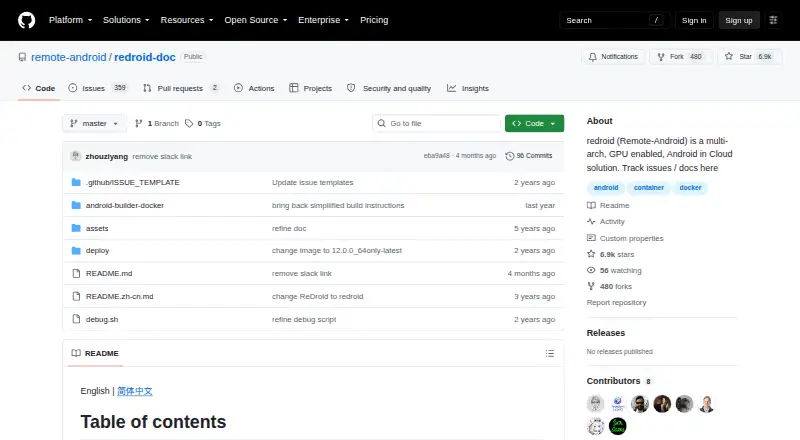
redroid runs Android in containers on Linux, with GPU rendering options and support for multiple instances.
What redroid is
redroid runs Android in containers on Linux, with GPU rendering options and support for multiple instances. The project describes cloud gaming, virtualized phones, and automation testing as possible uses. It can run on Linux hosts through Docker, Podman, or Kubernetes and supports arm64 and amd64 architectures. Documented images span Android 8.1 through Android 16, including 64-bit-only variants for Android 12 and later.
GPU rendering can use software rendering, host GPU acceleration, or automatic detection. Users can configure display width, height, frame rate, and DPI; documented defaults are 720×1280 and 320 DPI, with 30 FPS using GPU rendering or 15 FPS without it. The documentation describes running ARM apps in x86 instances with libhoudini, libndk_translation, or QEMU translator; published images include libndk_translation. Google services can be added through Open GApps, MicroG, or MindTheGapps. The quick start uses Android Debug Bridge to connect and scrcpy to view the instance screen. Deployment requires Linux kernel features including binderfs, ashmem or memfd, IPv6, ION or DMA-BUF heaps, and 4KB page size. The project warns that exposing the ADB port publicly can compromise the container and host OS. redroid is free open-source software under Apache License, while its kernel modules are under GPL v2.
Good
- Supports multiple Android instances on Linux.
- Runs with Docker, Podman, or Kubernetes.
- Offers software, host GPU, and automatic rendering modes.
- Images cover Android 8.1 through Android 16.
- Free open-source software under Apache License.
Watch out
- Requires Linux kernel features including binderfs and IPv6.
- Publicly exposing the ADB port can compromise the host.
- Kernel modules are under GPL v2.
Who it suits
redroid suits users who want to run Android instances in Linux containers for cloud gaming, virtualized phones, or automation testing. It may fit setups needing multiple instances or configurable rendering and display settings.
Verdict
redroid provides containerized Android instances with configurable rendering and display settings. Check the Linux kernel requirements and keep the ADB port off public networks.
Plans and prices
From redroid's own pricing page, checked 8 Oct 2026.
| Plan | Price | What it gives you |
|---|---|---|
| redroid | Free | Open-source software; Linux host with required kernel features |
The facts
Each one read from redroid's own pages, with the date it was checked.
Where it runs
- Android versions
- The documentation lists images for Android 8.1 through Android 16, including 64-bit-only variants for Android 12 and later.checked 8 Oct 2026
- App compatibility
- The documentation describes running ARM apps in x86 instances through libhoudini, libndk_translation, or QEMU translator, and says published images include libndk_translation.checked 8 Oct 2026
- Desktop platforms
- Linuxchecked 19 Sep 2026
What it does
- Architectures
- redroid supports arm64 and amd64 architectures.checked 8 Oct 2026
- Display configuration
- Users can configure display width, height, frame rate, and DPI; the documented defaults are 720×1280, 30 FPS with GPU or 15 FPS without GPU, and 320 DPI.checked 8 Oct 2026
- Google services
- The docs describe adding Google Mobile Services through Open GApps, MicroG, or MindTheGapps.checked 8 Oct 2026
- GPU rendering
- Its GPU mode can use software rendering, host GPU accelerated rendering, or automatic detection.checked 8 Oct 2026
- Host and container support
- It can run many instances on Linux hosts using Docker, Podman, or Kubernetes.checked 8 Oct 2026
- Host requirements
- Deployment requires Linux kernel features including binderfs, ashmem or memfd, IPv6, ION or DMA-BUF heaps, and 4KB page size.checked 8 Oct 2026
- License
- redroid is under the Apache License; its kernel modules are under GPL v2, and the documentation advises checking third-party module licenses.checked 8 Oct 2026
- Management tools
- The quick start uses Android Debug Bridge to connect and scrcpy to view the instance screen.checked 8 Oct 2026
- Multi-instance
- Yeschecked 19 Sep 2026
- Root access
- Yeschecked 19 Sep 2026
- Security guidance
- The quick-start instructions warn that exposing the ADB port on a public network can compromise the container and even the host OS.checked 8 Oct 2026
- Use cases
- The project describes cloud gaming, virtualized phones, and automation testing as suitable uses.checked 8 Oct 2026
- What it is
- redroid is a GPU-accelerated Android-in-the-cloud solution that runs Android in containers.checked 8 Oct 2026
Alternatives to redroid
- 1

Genymotion Desktop
Free planLinuxmacOSWindows8.2From $49 a year - 2

Android Emulator
Free planAndroidLinuxmacOSWindows7.9Free plan - 3

BlueStacks App Player
Free planmacOSWindows7.9From $7.99 a month - 4

Appetize
Free planAndroidiOSWebAPI7.9From $59 a month - 5
QEMU
Free planOpen sourceAPILinuxmacOSSelf-hosted7.8Free plan - 6
VMOS Cloud
AndroidiOSWebAPI7.5