
Red Hat OpenShift Dev Spaces
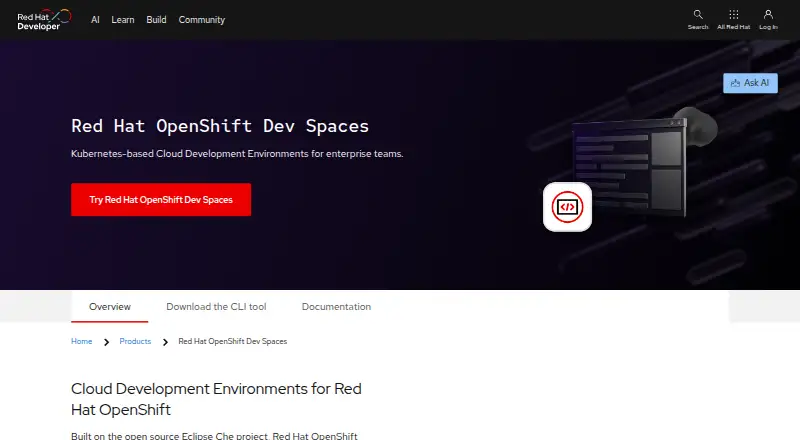
Red Hat OpenShift Dev Spaces provides cloud development environments for enterprise developers and AI agents.
What Red Hat OpenShift Dev Spaces is
Red Hat OpenShift Dev Spaces provides cloud development environments for enterprise developers and AI agents. It is built on the open source Eclipse Che project and runs on Red Hat OpenShift with Kubernetes and containers. Browser-based IDE choices include Microsoft Visual Studio Code - Open Source and JetBrains IntelliJ IDEA. Development environments are defined as code with the devfile format, covering runtime environments, source code, and tools so workspaces can be reproduced. The service connects with the OpenShift developer console, allowing an application workspace to launch from the Topology view. Enterprise environments can use proxies, trusted TLS certificate bundles, and OpenShift OAuth with LDAP or Active Directory. Security controls include project isolation, role-based access control, security context constraints, resource quotas, and limit ranges. The software is available on the web or as a self-hosted deployment, with persistent storage and support for multiple VCS hosts. Version 3.26 supports OpenShift 4.15–4.21 on AMD64/Intel 64, IBM Z, IBM Power, and ARMv8. Pricing is available on request; a Red Hat OpenShift subscription is required for the included plan.
Good
- Browser IDEs include VS Code Open Source and IntelliJ IDEA
- Devfiles define reproducible workspaces as code
- Integrates with OpenShift Topology view
- Supports enterprise OAuth, proxies, and TLS bundles
- Available web or self-hosted with persistent storage
Watch out
- Embedded Open VSX registry has a limited extension set
- Requires a Red Hat OpenShift subscription for included plan
- Pricing is available only on request
Who it suits
It suits enterprise development teams and AI-agent workflows using Red Hat OpenShift. It is also relevant to organizations needing browser IDEs, reproducible devfiles, persistent storage, and enterprise identity or security controls.
Verdict
OpenShift Dev Spaces combines browser IDEs, devfile-based workspaces, and OpenShift security controls for enterprise development. Check the supported OpenShift versions and architecture requirements before selecting it.
Plans and prices
From Red Hat OpenShift Dev Spaces's own pricing page, checked 9 Oct 2026.
| Plan | Price | What it gives you |
|---|---|---|
| Included with Red Hat OpenShift subscription | Priced on request | Requires a Red Hat OpenShift subscription |
The facts
Each one read from Red Hat OpenShift Dev Spaces's own pages, with the date it was checked.
Where it runs
- Browser IDEs
- Includes Microsoft Visual Studio Code - Open Source and JetBrains IntelliJ IDEA in the browser.checked 9 Oct 2026
- Supported platform
- OpenShift Dev Spaces 3.26 is supported on OpenShift 4.15–4.21 and the AMD64/Intel 64, IBM Z, IBM Power, and ARMv8 architectures.checked 9 Oct 2026
What it does
- Enterprise integration
- Supports enterprise proxies and trusted TLS certificate bundles, and uses OpenShift OAuth with LDAP or Active Directory.checked 9 Oct 2026
- Extension limits
- The embedded Open VSX registry contains a limited set of extensions for Visual Studio Code - Open Source; administrators can configure another registry.checked 9 Oct 2026
- How it runs
- Uses Kubernetes and containers to provide development environments on Red Hat OpenShift.checked 9 Oct 2026
- OpenShift integration
- Integrates with the OpenShift developer console so users can launch an application workspace from the Topology view.checked 9 Oct 2026
- Purpose
- Provides cloud development environments for enterprise developers and AI agents, built on the open source Eclipse Che project.checked 9 Oct 2026
- Reproducible workspaces
- Defines development environments as code using the devfile format, including runtime environments, source code, and tools.checked 9 Oct 2026
- Security controls
- Uses OpenShift project isolation, role-based access control, security context constraints, resource quotas, and limit ranges.checked 9 Oct 2026
- Support
- Red Hat provides support for deployment, configuration, and use of OpenShift Dev Spaces 3.26.checked 9 Oct 2026
The company
- Founded
- 1993checked 28 Sep 2026
- Headquarters
- Raleigh, North Carolina, USAchecked 28 Sep 2026
- Maker
- Red Hat lists its headquarters at 100 E. Davie Street, Raleigh, North Carolina, and says it was founded in 1993.checked 9 Oct 2026
Money
- No-cost access
- Red Hat says its Developer Sandbox includes OpenShift Dev Spaces to try at no cost.checked 9 Oct 2026
Alternatives to Red Hat OpenShift Dev Spaces
- 1

Replit
Free planAndroidiOSWebLinux9.2From $18 a month - 2

StackBlitz
Free planAndroidiOSWebAPI8.9Free plan - 3

Playcode
Free planAndroidiOSWebAPI8.9From $25 a month - 4
Paperspace Gradient
Free planOpen sourceWebAPIExtensionLinux8.7From $8 a month - 5
GitHub Codespaces
Free planAndroidiOSWebAPI8.6Free plan - 6

JDoodle
Free planAndroidiOSWebAPI8.6From $4 a month