Recognition Technologies Speaker Recognition
Recognition Technologies Speaker Recognition is a language- and text-independent voice biometrics system for identifying and verifying speakers.
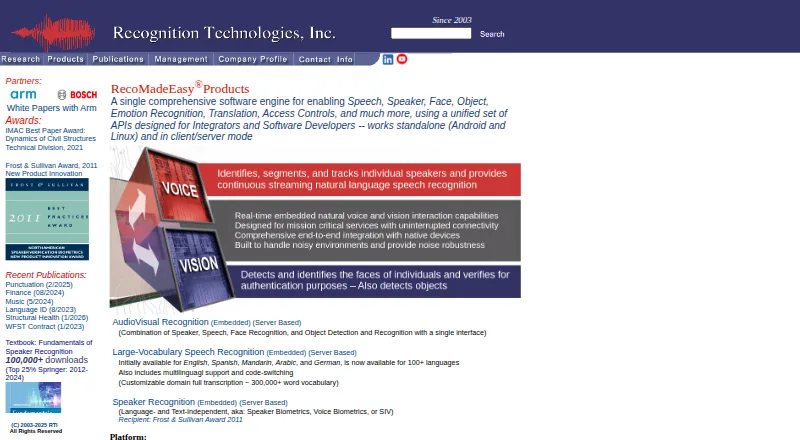
What Recognition Technologies Speaker Recognition is
Recognition Technologies Speaker Recognition is a language- and text-independent voice biometrics system for identifying and verifying speakers. A person can enroll in one language and be identified or verified in another. The engine also supports speaker classification, detection, tracking, and segmentation. Identification can use open-set or closed-set approaches; closed-set identification can return the closest enrolled voice even when that person is not in the database. The maker describes verification enrollment as using about 30 seconds of speech, followed by a few seconds when the speaker returns. Interfaces include C++ API, command line, web, Android, and iOS; the engine can also be used as a module of the maker’s IVR system. Deployment options include embedded, server-based, standalone, hosted by Recognition Technologies, or hosted at the customer’s facilities. The product page lists Linux, Apple Macintosh OS X, and Windows support. Its telephony version supports speaker verification and identification for telephone authentication and access-level control. Pricing is on request, and an evaluation account for the hosted version may be made available to interested organizations.
Good
- Supports identification, verification, classification, detection, tracking, and segmentation.
- Enrollment and recognition can use different languages.
- Offers embedded, server-based, standalone, and hosted deployment.
- Interfaces include C++, command line, web, Android, and iOS.
Watch out
- Pricing is on request.
- Evaluation access may be made available to interested organizations.
- Reducing false acceptance can increase false rejections.
Who it suits
It suits organizations looking for speaker identification or verification in software or telephone authentication workflows. Deployment choices include customer-hosted and maker-hosted options, with an evaluation account potentially available to interested organizations.
Verdict
The product offers several recognition modes, interfaces, and deployment choices for voice biometrics workflows. Organizations should assess the false-acceptance and false-rejection trade-off for their use case.
The facts
Each one read from Recognition Technologies Speaker Recognition's own pages, with the date it was checked.
What it does
- Audio and telephony
- The page lists microphone devices, major audio file formats, and Dialogic JCT T1 and analog telephony cards as supported audio interfaces.checked 30 Sep 2026
- Audio compatibility
- The server-based page says the engine is compatible with all microphone devices and most audio file formats, and lists Dialogic JCT T1 and analog telephony cards as natively supported.checked 29 Sep 2026
- Customization
- The maker says the engine may be customized, including modifications for the operating environment of a customer’s application.checked 30 Sep 2026
- Deployment
- The engine is offered as embedded, standalone, client-server, hosted at the maker’s facilities, or hosted at a customer’s facilities.checked 30 Sep 2026
- Enrollment
- For speaker verification, the page describes enrollment using about 30 seconds of speech, followed by a few seconds of speech when the speaker returns.checked 30 Sep 2026
- Evaluation
- An evaluation account for the hosted version may be made available to interested organizations.checked 29 Sep 2026
- Evaluation access
- An evaluation account for the hosted software may be made available to interested organizations.checked 30 Sep 2026
- Interfaces
- The engine provides a C++ API, web, Android, iOS, and command-line interfaces.checked 29 Sep 2026
- Interfaces and API
- The engine can be used through a C++ SDK/API, command line, web service, or as a module of the maker’s IVR system; the main product page also lists web, Android and iOS interfaces.checked 30 Sep 2026
- Language independence
- A user may enroll in one language and be identified or verified in a different language.checked 30 Sep 2026
- Open and closed set
- Identification supports open-set and closed-set approaches; the page says closed-set identification can return the closest enrolled voice even when the speaker is not in the database.checked 30 Sep 2026
- Operating systems
- The server-based page lists Linux, Microsoft Windows and Apple Macintosh support, while the embedded page lists Android and Ubuntu 22.04 Mate Linux on aarch64.checked 30 Sep 2026
- Purpose
- RecoMadeEasy Speaker Recognition is a language- and text-independent speaker biometrics system for speaker identification and verification.checked 30 Sep 2026
- Recognition modes
- The system supports speaker identification, verification, classification, detection, tracking and segmentation.checked 30 Sep 2026
- Security use
- The telephony version is described as supporting speaker verification and identification for telephone authentication and access-level control.checked 30 Sep 2026
- Standards work
- The maker says its staff consulted with VoiceXML, M1, and ISO committees on speaker verification and identification standards.checked 29 Sep 2026
- Support contact
- The maker lists 1-800-215-0841 in the U.S., +1-914-997-5676 internationally, and [email protected] for further information.checked 30 Sep 2026
- Telephony use
- The telephony version supports speaker verification and identification for telephone authentication and access-level control, and complements the company’s IVR product.checked 29 Sep 2026
- Verification trade-off
- The maker describes a trade-off in which reducing false acceptance can increase false rejections.checked 30 Sep 2026
- What it does
- The product provides language- and text-independent speaker recognition, also described as voice biometrics or SIV.checked 29 Sep 2026
The company
- Founded
- 2003checked 28 Sep 2026
- Headquarters
- Westchester County, New York, United Stateschecked 28 Sep 2026
- Maker background
- Recognition Technologies describes itself as a research and development organization with speaker recognition clients using its engine since 2007.checked 30 Sep 2026
The full review of Recognition Technologies Speaker Recognition
Recognition Technologies Speaker Recognition is a language- and text-independent voice biometrics engine for identifying and verifying speakers, with additional modes for analyzing speech. It is best suited to organizations building multilingual identity or telephone-authentication workflows. Its deployment flexibility is a strength; custom pricing and consequential recognition trade-offs make evaluation important.
Overview
Also called RecoMadeEasy Speaker Recognition, the engine can identify, verify, classify, detect, track, and segment speakers. Language independence lets a person enroll in one language and be identified or verified in another, a useful distinction for services that cannot rely on a fixed spoken phrase or a single language.
Identification supports both open-set and closed-set approaches. In closed-set use, it can return the closest enrolled voice even when the speaker is not in the database. That behavior may suit workflows seeking the nearest candidate, but systems that must clearly reject unknown speakers should account for it.
Key features
Verification and telephony
The described verification flow uses about 30 seconds of speech for enrollment and a few seconds when the speaker returns. That relatively brief return interaction may fit telephone authentication and access-level control, which the telephony version supports and can complement the maker’s IVR product. The important qualification is the stated error trade-off: reducing false acceptance can increase false rejections. Organizations should determine which error is more costly before choosing settings and deploying it for access decisions.
Interfaces and audio
The engine is offered through a C++ SDK/API, command line, web service, and Android and iOS interfaces; it can also be used as a module of the maker’s IVR system. The server-based version is described as compatible with all microphone devices and most audio file formats, and it lists Dialogic JCT T1 and analog telephony cards as natively supported. This combination gives teams several integration routes, including telephony hardware, though the exact fit depends on their operating environment.
Deployment and customization
Deployment choices include embedded, server-based, standalone, hosted by Recognition Technologies, and hosted at the customer’s facilities. The maker says the engine can be customized for specific needs and operating environments. That breadth can accommodate organizations with different hosting constraints, but buyers should clarify the scope and cost of customization during evaluation.
The product page says the engine runs on most Linux distributions, Apple Macintosh OS X, and Microsoft Windows. The company says its staff consulted with VoiceXML, M1, and ISO committees on speaker verification and identification standards; that background is relevant context for standards-conscious buyers, not a substitute for assessing the engine against their own requirements.
Pricing
Recognition Technologies is a paid product with custom pricing. A free trial is available in the form of an evaluation account for the hosted version, which may be made available to interested organizations. This offers a route to assess the hosted engine before committing, but organizations should contact the maker for access and pricing rather than expect a self-serve plan.
Platforms
Supported platforms include Android, iOS, Linux, macOS, Windows, web, API, and self-hosted deployment. The range spans mobile interfaces, integration through APIs, and customer-hosted installations; teams should confirm which interface and deployment option match their intended workflow.
Who it's for
This is a strong candidate for organizations that need language-independent speaker identification or verification, especially for telephone authentication, access-level control, or systems that need multiple recognition modes. It is less compelling for buyers seeking a published, straightforward subscription or for workflows where a closed-set nearest match could be mistaken for a confirmed identity. Recognition Technologies describes itself as a research and development organization, and says clients have used its RecoMadeEasy engine since 2007.
Pros and cons
- Pros: Cross-language enrollment and recognition can support multilingual identity workflows without requiring a matching language at enrollment and return.
- Pros: Identification, verification, classification, detection, tracking, and segmentation give teams more than a single authentication function.
- Pros: Embedded, hosted, standalone, and customer-facility deployment options provide flexibility for differing operating environments.
- Cons: Lowering false acceptance can increase false rejection, a material trade-off for any workflow making access decisions.
- Cons: Closed-set identification may return the closest enrolled voice for an unknown speaker, so it should not be treated automatically as a confirmed match.
- Cons: Custom pricing and evaluation access by request make early cost and trial planning dependent on contacting the maker.
Alternatives
For a free-lifetime developer plan and a freemium option, consider armour365 Voice Biometrics; its listed platforms include Android, API, iOS, self-hosted, and web, and its small-business plan gives the first 10K transactions free before per-transaction charges.
Resemble Detect is a better fit when the task is audio, image, and video detection rather than speaker identification or verification; its Flex plan includes one team seat, pay-as-you-go credits, and platform and API access.
Consider Voiceme VoiceKey as another paid voice biometrics option with a broad set of listed platforms and pricing by demo request.
VoiceVantage VoiceCheck offers SDK and SaaS SDK options for buyers willing to contact the vendor for licensing details.
LumenVox Active Voice Biometrics is another paid option, including a Capacity Private Cloud plan.
AwareSDK Voice is a paid Android and iOS option with pricing available by demo or contact.
Spiron Voice Biometrics API is a paid API option with a free trial, while GoVivace Speaker Verification API is another paid API and self-hosted alternative.
Browse more options in AI Voice Biometrics Software.
Verdict
Choose Recognition Technologies Speaker Recognition if your organization needs language-independent speaker biometrics, varied recognition modes, and a deployment model that can fit its environment. Its short described verification interaction and telephony support make it relevant to authentication workflows, but the false-acceptance and false-rejection balance needs careful consideration. Look elsewhere if you need transparent plan pricing or cannot accommodate the possibility of increased false rejections when reducing false acceptance.
Getting started
- Open the Recognition Technologies product website
- Choose embedded, server-based, standalone, or hosted deployment
- Select an available interface such as C++, web, Android, iOS, or command line
- Contact Recognition Technologies for pricing and requirements
- Request a hosted evaluation account if available
Questions
How is Recognition Technologies Speaker Recognition priced?
It is a paid product with pricing available on request.
Is a free trial available?
Yes. An evaluation account for the hosted version may be made available to interested organizations.
Which platforms and interfaces are supported?
The engine runs on most Linux distributions, Apple Macintosh OS X, and Microsoft Windows. Interfaces include C++ SDK/API, command line, web, Android, and iOS.
Can it support telephone authentication?
Yes. The telephony version supports speaker verification and identification for telephone authentication and access-level control.
How does verification enrollment work?
The product describes enrollment with about 30 seconds of speech, followed by a few seconds of speech when the speaker returns.
Can the engine be customized?
The maker says it may be customized for specific needs and operating environments.
Alternatives to Recognition Technologies Speaker Recognition
- 1
armour365 Voice Biometrics
Free planAndroidiOSWebAPI6.7Free plan - 2

Azure AI Speech
Free planWebAPISelf-hosted6.7Free plan - 3

Lexis+
AndroidiOSWeb6.5 - 4

Aculab Cloud
AndroidiOSWebAPI6.4 - 5

Auraya ArmorVox
AndroidiOSWebAPI6.3 - 6
Voiceme VoiceKey
AndroidiOSWebAPI6.2