GoVivace Speaker Verification API
GoVivace Speaker Verification API enrolls a speaker’s voice and checks later speech against the resulting voiceprint.
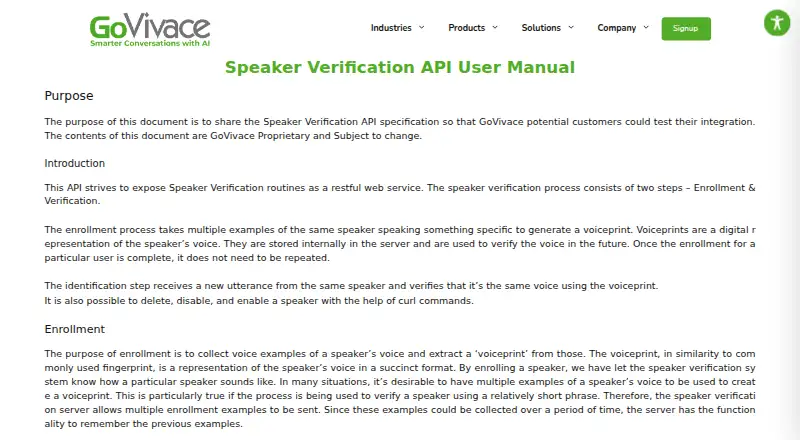
What GoVivace Speaker Verification API is
GoVivace Speaker Verification API enrolls a speaker’s voice and checks later speech against the resulting voiceprint. Enrollment uses multiple voice samples; the manual recommends collecting at least 60 seconds of total enrollment audio. Developers can use REST requests or a WebSocket API, and the manual includes a Python client example. Its audio example uses 16-bit linear PCM at 8 kHz. Documented actions include enrolling, searching, deleting, disabling, and enabling speakers; search returns closest matches and accepts a maximum match count and score threshold. Voiceprints are stored on the server, and deleting a speaker permanently removes that speaker’s information. GoVivace generates API keys for authentication. Its developer materials describe encryption in transit, configurable encryption at rest, access controls, and audit logging. Authenti deployment options include managed cloud and private cloud or on-premise, with regional hosting choices including US public cloud, India sovereign hosting, and EU-localized hosting. Audio and voiceprint retention can be configured per deployment. Pricing is on request, and access is through API or self-hosted platforms.
Good
- Supports REST and WebSocket interfaces.
- Speaker records can be searched, disabled, or deleted.
- Offers managed cloud and private deployment options.
- Retention settings can be configured per deployment.
Watch out
- Enrollment guidance recommends at least 60 seconds of audio.
- Voiceprints are stored on the server.
- Pricing is on request.
- The manual says its contents may change.
Who it suits
GoVivace suits organizations integrating voice verification into applications, contact centers, voicebots, or enterprise workflows. It is positioned for banking, healthcare, government, telecom, and contact centers.
Verdict
GoVivace provides voice enrollment and verification with multiple interfaces and deployment choices. Review its enrollment guidance, server-side voiceprint handling, and requested pricing before integrating it.
The facts
Each one read from GoVivace Speaker Verification API's own pages, with the date it was checked.
What it does
- Audience
- GoVivace positions the product for banking, healthcare, government, telecom, and contact centers.checked 3 Oct 2026
- Audio format
- The manual’s example request sends audio in 16-bit linear PCM at 8 kHz.checked 4 Oct 2026
- Authenti capabilities
- GoVivace’s Authenti API page lists speaker verification, speaker identification, voice enrollment, speaker characteristics, anti-spoofing, and streaming processing.checked 4 Oct 2026
- Authentication
- The manual says API keys are generated by GoVivace and used for authentication.checked 3 Oct 2026
- Data controls
- Authenti’s page says audio and voiceprint retention can be configured per deployment and API activity can be logged.checked 4 Oct 2026
- Data handling
- The manual says voiceprints are stored internally on the server, and speaker deletion permanently removes that speaker’s information.checked 3 Oct 2026
- Deployment
- Authenti is offered in managed cloud and private cloud or on-premise deployment models, including air-gapped deployment.checked 4 Oct 2026
- Enrollment
- The manual recommends sending repeated voice samples until enrollment audio totals 60 seconds or more.checked 3 Oct 2026
- Enrollment guidance
- The manual recommends sending new enrollment examples until enrollment audio time reaches 60 seconds or more.checked 4 Oct 2026
- Integrations
- Authenti is described as integrating into applications, contact centers, voicebots, and enterprise workflows through APIs and SDKs.checked 4 Oct 2026
- Interfaces
- The API manual documents HTTP requests and a WebSocket interface, with a Python client example.checked 4 Oct 2026
- Limit
- The manual says its contents are proprietary and subject to change.checked 3 Oct 2026
- Purpose
- The API provides speaker verification as a RESTful web service using enrollment and later voice comparison.checked 4 Oct 2026
- Regional hosting
- GoVivace’s policy lists US public cloud, customer-hosted private cloud, India sovereign hosting, and EU-localized hosting options.checked 4 Oct 2026
- Security
- The Authenti page states that API requests are authenticated, data in transit is encrypted, and stored data is encrypted according to deployment configuration.checked 4 Oct 2026
- Security posture
- The product page describes GDPR-aligned handling and SOC 2 and ISO 27001 readiness; it says certification status is not confirmed where applicable.checked 3 Oct 2026
- Speaker management
- The API supports deleting, disabling, and enabling a speaker.checked 4 Oct 2026
- Speaker search
- The search action returns the closest matches from the list of enrolled speakers and accepts a maximum match count and score threshold.checked 4 Oct 2026
- Support
- GoVivace’s contact page lists a support email address and a US office at 1775 Tysons Blvd, Tysons, Virginia 22102.checked 4 Oct 2026
- Voiceprints
- Enrollment uses multiple voice examples to create a voiceprint that is stored on the server for future verification.checked 4 Oct 2026
Alternatives to GoVivace Speaker Verification API
- 1
Recognition Technologies Speaker Recognition
AndroidiOSWebAPI6.8 - 2
armour365 Voice Biometrics
Free planAndroidiOSWebAPI6.7Free plan - 3

Azure AI Speech
Free planWebAPISelf-hosted6.7Free plan - 4

Lexis+
AndroidiOSWeb6.5 - 5

Aculab Cloud
AndroidiOSWebAPI6.4 - 6

Auraya ArmorVox
AndroidiOSWebAPI6.3