
rConfig
rConfig is a Network Configuration Management platform for managing network device configurations.
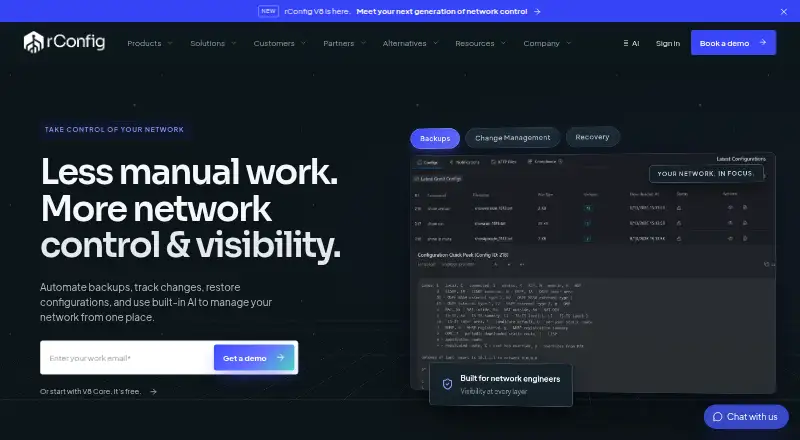
What rConfig is
rConfig is a Network Configuration Management platform for managing network device configurations. V8 supports configuration backups, historical change tracking, drift validation, automated rollbacks, and compliance-ready reports. Its listed controls include role-based access, audit trails, encryption, and compliance reporting. V8 Pro adds SAML SSO, immutable audit logs, encryption at rest, and optional air-gapped deployment. The maker says V8 supports any device, vendor, and protocol. Listed integrations include device synchronization with Zabbix, NetBox, Nautobot, Statseeker, AKIPS, Checkmk, PRTG, and Infrahub, alongside HashiCorp Vault credentials and SAML/OIDC identity. Core is open source, free, and runs on customer hardware. Starter costs $3,900 once and supports up to 300 devices; V8 Pro costs €3,999 per year, with a perpetual licence after Year 1 and first-year updates and priority support. Pro, Enterprise, and Vector are tailored deployments rather than downloads. The founder began building rConfig in 2010 and released it publicly as an open-source project in 2012.
Good
- Backs up configurations and tracks historical changes.
- Supports automated rollbacks and compliance-ready reports.
- Core is free, open source, and runs on customer hardware.
- V8 Pro exposes every platform action through its REST API.
Watch out
- Starter costs $3,900 once.
- V8 Pro costs €3,999 per year.
- Some connectors are planned or still on the bench.
- Pro, Enterprise, and Vector are tailored deployments, not downloads.
Who it suits
rConfig suits IT teams managing device configurations, including regulated networks. Core offers a free, customer-hosted option; the maker describes Enterprise as designed for large, distributed, regulated networks and MSPs.
Verdict
rConfig covers configuration backups, change tracking, recovery, and compliance reporting, with Core available at no cost on customer hardware. Check device limits, deployment format, and plan pricing against the needs of your network.
Plans and prices
From rConfig's own pricing page, checked 30 Sep 2026.
| Plan | Price | What it gives you |
|---|---|---|
| Core | Free | No device limit · MIT-licensed · Runs on your hardware |
| Starter | $3,900, paid once | Up to 300 devices · Restore and deploy configuration changes · Policy checks and compliance · 5 business days support |
| V8 Pro | €3,999 a year | Up to 1,000 devices · Year 1 updates and priority support included · €3,999/year; perpetual licence after Year 1 |
| Standard | $6,500, paid once | Up to 1,000 devices · Restore and deploy configuration changes · Policy checks and compliance · Built-in AI and script automation · 8x5 next business day support |
| Enterprise / MSP | Priced on request | Custom pricing beyond 1,000 devices · Per-device pricing · 24x7 support with four-hour response |
The facts
Each one read from rConfig's own pages, with the date it was checked.
What it does
- API
- V8 Pro describes itself as API-first and says its REST API exposes every platform action.checked 30 Sep 2026
- Backups and recovery
- V8 supports configuration backups, historical change tracking, drift validation, automated rollbacks, and compliance-ready reports.checked 30 Sep 2026
- Deployment
- V8 Core is open source and runs on the customer's hardware; the download page says Pro, Enterprise, and Vector are tailored deployments rather than downloads.checked 30 Sep 2026
- Integration licensing
- The maker says production connectors are included in V8 Pro, Enterprise, and Vector without per-connector licences or extra modules.checked 30 Sep 2026
- Integrations
- The integrations page lists device sync for Zabbix, NetBox, Nautobot, Statseeker, AKIPS, Checkmk, PRTG, and Infrahub, plus HashiCorp Vault credentials and SAML/OIDC identity.checked 30 Sep 2026
- Intended users
- The maker describes V8 Pro as suited to IT teams and regulated networks, and Enterprise as designed for large, distributed, regulated networks and MSPs.checked 30 Sep 2026
- Notable integration limits
- LibreNMS and Observium are listed as planned connectors, while CyberArk and Delinea Secret Server are described as being on the bench.checked 30 Sep 2026
- Product
- rConfig is a Network Configuration Management platform for managing network device configurations.checked 30 Sep 2026
- Pro security
- V8 Pro supports SAML SSO, immutable audit logs, encryption at rest, and optional air-gapped deployment.checked 30 Sep 2026
- Security
- V8 lists role-based access control, audit trails, encryption, and compliance reporting as built-in controls.checked 30 Sep 2026
- Support
- V8 Pro includes updates and priority support in Year 1; the licence becomes perpetual afterward, with renewals only for continued support and updates.checked 30 Sep 2026
Where it runs
- Device compatibility
- The maker says rConfig V8 supports any device, vendor, and protocol.checked 30 Sep 2026
The company
- Headquarters
- The maker describes rConfig as having roots in Ireland and identifies OS Informatics Ltd. as registered in the Republic of Ireland.checked 30 Sep 2026
- Maker history
- Founder Stephen Stack began building rConfig in 2010 and released it publicly as an open-source project in 2012.checked 30 Sep 2026
The full review of rConfig
rConfig is network configuration management software for teams that need to back up, track, validate, and recover network-device configurations. It best suits network operations teams that can run software on their own hardware or need paid compliance and support options. Core’s no-device-limit, open-source offer is unusually broad; paid buyers must weigh sharply different device caps, licence terms, and deployment formats.
Overview
rConfig brings configuration backups and change control together with drift validation, automated rollbacks, and compliance-ready reporting. That mix is more useful than backup alone for teams that need to investigate configuration changes or restore a previous state. The maker says V8 supports any device, vendor, and protocol, a broad compatibility claim that may appeal to mixed-vendor networks.
Core is MIT-licensed and runs on customer hardware. Paid editions are tailored deployments rather than downloads, so organizations evaluating a self-managed setup should distinguish Core from the paid options before settling on a plan. The product has an open-source history: founder Stephen Stack began building it in 2010, and it was released publicly in 2012.
Key features
Backups, change tracking, and compliance
Scheduled backups, configuration comparisons, historical change tracking, drift validation, rollback, and compliance reporting cover the main stages of configuration control: retain a known state, spot differences, and recover when needed. Starter and Standard explicitly include restore and deployment of configuration changes plus policy checks and compliance. These capabilities make rConfig relevant to teams with audit or recovery responsibilities, though the number of devices covered depends on the paid plan.
Security and integrations
V8 includes role-based access control, audit trails, encryption, and compliance reporting. V8 Pro adds SAML SSO, immutable audit logs, encryption at rest, and optional air-gapped deployment, making it the stronger fit for organizations with stricter identity or isolation requirements.
Device-sync integrations include Zabbix, NetBox, Nautobot, Statseeker, AKIPS, Checkmk, PRTG, and Infrahub, alongside HashiCorp Vault credentials and SAML/OIDC identity. Production connectors are included in V8 Pro, Enterprise, and Vector without per-connector licences or extra modules. LibreNMS and Observium are planned connectors; CyberArk and Delinea Secret Server are still on the bench. V8 Pro is described as API-first, with a REST API exposing every platform action, which gives teams a route to automate against the platform.
Pricing
The free Core plan costs nothing, has no device limit, and runs on customer hardware under the MIT license. It is the clearest starting point for teams able to manage their own deployment. The trade-off is that the stated Starter and Standard capabilities and support are attached to paid plans.
Starter costs $3,900, paid once and covers up to 300 devices. It includes restore and deployment of configuration changes, policy checks and compliance, and five business days of support. It suits smaller networks seeking those paid functions, but its device ceiling is substantially lower than the 1,000-device options.
V8 Pro costs €3,999 a year, billed €3,999/year. It covers up to 1,000 devices and includes Year 1 updates and priority support; the licence becomes perpetual after Year 1, with renewals only for continued support and updates. Its security additions, connectors, and API-first approach make it the more suitable choice for IT teams and regulated networks that need those controls. Buyers should account for the distinction between the initial licence and ongoing support or update renewals.
Standard costs $6,500, paid once for up to 1,000 devices. It adds built-in AI and script automation, policy checks and compliance, restore and deployment of configuration changes, and 8x5 next-business-day support. It may suit teams prioritizing those capabilities and support, but the listed plan does not state Pro’s specific security additions or connector terms.
Enterprise / MSP uses custom pricing beyond 1,000 devices, with per-device pricing and 24x7 support with a four-hour response. It is aimed at large, distributed, regulated networks and MSPs; the per-device model and custom quote make it a more tailored commitment than the fixed-price plans.
Platforms
rConfig is listed for API, Linux, self-hosted, and web use, with a hybrid deployment model. Core is explicitly run on customer hardware, while Pro, Enterprise, and Vector are tailored deployments rather than downloads. That distinction matters to teams choosing between a downloadable self-managed installation and a vendor-shaped deployment.
Who it's for
rConfig is a strong candidate for network teams that need configuration recovery, change visibility, and compliance workflows, especially when they can operate Core themselves or have a clear reason to buy Pro or a larger plan. Regulated organizations may value the audit and identity controls, while large networks and MSPs have an Enterprise / MSP option beyond 1,000 devices. It is less compelling for buyers who need a paid edition as a standard downloadable package or whose requirements depend on connectors still in the pipeline.
Pros and cons
- Pros: Core has no device limit and is open source, giving self-managed teams a broad no-cost entry point.
- Pros: Backups, comparisons, drift validation, rollback, and compliance reporting support both recovery and change oversight.
- Pros: Pro adds SAML SSO, immutable audit logs, encryption at rest, and optional air-gapped deployment for stricter environments.
- Pros: Included production connectors across Pro, Enterprise, and Vector avoid per-connector licence costs.
- Cons: Paid plans vary in device caps, support, features, and deployment format, so moving beyond Core calls for a careful plan match.
- Cons: Starter is capped at 300 devices, while larger plans cost more or shift to custom per-device pricing.
- Cons: LibreNMS and Observium connectors are planned, and CyberArk and Delinea Secret Server are not yet presented as production connectors.
Alternatives
ManageEngine Network Configuration Manager is worth comparing if broad device-platform coverage matters: it lists Android, iOS, Linux, self-hosted, web, and Windows, plus a free edition capped at two devices and a free trial. Unimus is a better fit for a small free deployment if 10 devices are enough; its free tier includes all features except Compliance and SAML/OIDC and has no time limit.
Oxidized offers a free, Apache-2.0-licensed, self-hosted option for readers seeking an alternative without a paid plan. Arista NG Firewall is another freemium option, but it is a web-based firewall rather than a direct configuration-management comparison. Netpicker offers a free-for-life Foundation tier with unlimited network devices and one user, with Professional features for 10 devices; it may suit a single-user setup prioritizing an unlimited device allowance.
RANCID is a free option for readers seeking Linux, macOS, and self-hosted support. NetKeep is a free, self-hosted Linux server option under AGPL-3.0. Gluware offers a renewable one-year Community Edition for up to 20 devices, with the full application suite except Topology; it may suit teams looking for a time-bounded free edition and community support.
See the Network Configuration Management Software category for more options.
Verdict
Choose rConfig if your team needs configuration backup and recovery alongside change tracking and compliance, and either can run Core on its own hardware or has a clear reason to pay for Pro or a larger tier. Core’s unlimited-device, open-source model is its strongest draw; look elsewhere if you need a conventional downloadable paid edition, a low-cost paid plan for a small network, or connectors not yet in production.
Alternatives to rConfig
- 1

ManageEngine Network Configuration Manager
Free planAndroidiOSWebAPI8.2From $238 a year - 2
Configuration Center
APIWindows6.8$99 one-time - 3

NetBrain
WebAPILinuxSelf-hosted6.8 - 4

Netpicker
Free planWebAPILinuxSelf-hosted6.8From $7,500 a year - 5
Nexsparkle ConfigVault
LinuxSelf-hostedWindows6.7From $495 a year - 6
Oxidized
Free planWebAPILinuxSelf-hosted6.6Free plan