Oxidized
Oxidized is a free, self-hosted tool for backing up network device configurations and is described as a RANCID replacement.
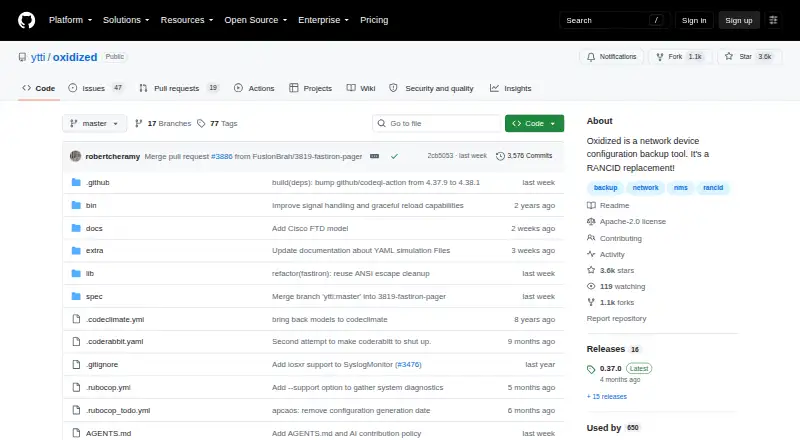
What Oxidized is
Oxidized is a free, self-hosted tool for backing up network device configurations and is described as a RANCID replacement. It supports over 130 operating system types, with SSH and Telnet among its documented input methods. Node data can come from CSV, SQLite, MySQL or HTTP sources. Backup outputs include files, Git, Git-Crypt and HTTP; Git records a commit for each configuration change, while Git-Crypt encrypts configuration pushes using git-crypt. Oxidized adjusts its threads to meet a configured retrieval interval. Its REST API can list nodes, fetch configurations, display versions and differences, reload nodes or move a node to the front of the queue. Syslog examples can trigger a fetch after a configuration change. The web interface and API are provided by the optional oxidized-web gem, which is disabled by default and configured for port 8888 by default. A remove_secret option strips sensitive data before storage. The software uses Apache License 2.0; its maintainers say they are very few and invite additional involvement.
Good
- Supports over 130 operating system types.
- Git output records commits for configuration changes.
- Git-Crypt encrypts configuration pushes.
- REST API can fetch, compare and reload configurations.
- A remove_secret option strips sensitive data before storage.
Watch out
- The web interface and API are disabled by default.
- The project is maintained by very few people.
- Free software must be self-hosted.
Who it suits
Oxidized suits network administrators seeking a self-hosted way to back up device configurations. It may fit environments that need multiple input and output backends or event-triggered configuration fetches.
Verdict
Oxidized provides varied configuration sources and backup outputs, plus API operations and change-triggered fetch examples. Its optional web interface is disabled by default, and the project reports a small maintainer base.
Plans and prices
From Oxidized's own pricing page, checked 2 Oct 2026.
| Plan | Price | What it gives you |
|---|---|---|
| Oxidized | Free | Apache-2.0 licensed software · self-hosted |
The facts
Each one read from Oxidized's own pages, with the date it was checked.
What it does
- Backup outputs
- Supported output backends include File, Git, Git-Crypt, and HTTP; Git creates a commit when a configuration changes.checked 2 Oct 2026
- Change-triggered backups
- The REST API can move a node to the head of the queue to schedule a configuration fetch after an event such as a syslog message.checked 2 Oct 2026
- Change triggers
- A syslog UDP and file example can catch IOS or JunOS configuration changes and trigger a configuration fetch.checked 1 Oct 2026
- Data sources
- Supported source backends are CSV, SQLite, MySQL and HTTP.checked 1 Oct 2026
- Encrypted output
- The Git-Crypt output backend encrypts configuration pushes using the git-crypt tool.checked 2 Oct 2026
- Input methods
- Documented input methods include SSH and Telnet.checked 2 Oct 2026
- Installation
- The README documents installation on Debian or Ubuntu, Rocky Linux or RHEL, and FreeBSD, as well as running with Docker or Podman.checked 2 Oct 2026
- Integrations
- Hooks support GitHub repository pushes, AWS SNS, Slack, Cisco Spark and XMPP notifications.checked 1 Oct 2026
- License
- The repository identifies Oxidized as licensed under Apache License 2.0.checked 2 Oct 2026
- Maintenance
- The README says Oxidized is maintained by very few people and asks users and companies to contribute.checked 2 Oct 2026
- Node sources
- Supported source backends include CSV, SQLite, MySQL, and HTTP.checked 2 Oct 2026
- Purpose
- Oxidized is a network device configuration backup tool and a RANCID replacement.checked 2 Oct 2026
- REST API
- The optional oxidized-web extension provides a REST API for listing nodes, fetching configurations, reloading the node list, and viewing versions and diffs.checked 2 Oct 2026
- Scale
- The project describes Oxidized as light and extensible and says it supports over 130 operating system types.checked 1 Oct 2026
- Scheduling
- Oxidized automatically adjusts its worker threads to meet the configured retrieval interval.checked 2 Oct 2026
- Secret handling
- A remove_secret option runs model filters to strip configured sensitive values, such as SNMP community strings, before storing configurations.checked 2 Oct 2026
- Storage outputs
- Supported outputs are File, GIT, GIT-Crypt and HTTP; GIT creates a commit for each configuration change.checked 1 Oct 2026
- Support
- The project points users to Gitter, GitHub, and the LibreNMS community forum for help and support.checked 2 Oct 2026
- Web interface
- The RESTful API and web interface are provided by the optional oxidized-web gem, disabled by default and configured on port 8888 by default.checked 1 Oct 2026
Where it runs
- Device support
- The project says it supports over 130 operating system types.checked 2 Oct 2026
The full review of Oxidized
Oxidized is self-hosted software for backing up network-device configurations as an open-source alternative to RANCID. It best suits infrastructure teams that want control over collection and storage; its broad device support and flexible outputs are compelling, but the optional web interface and small maintainer base merit consideration.
Overview
Oxidized supports scheduled backups and configuration comparisons across more than 130 operating system types. The project describes it as light and extensible, but running it on-premises means your team takes responsibility for deployment and ongoing operation. Its Apache License 2.0 allows use without charge subject to the license terms.
SSH and Telnet are documented input methods, and Oxidized adjusts its worker threads to meet the configured retrieval interval. That is useful for teams tuning collection cadence across a device inventory. For event-driven collection, syslog UDP or file examples can catch IOS or JunOS changes and trigger a fetch; the API can also move a node to the front of the queue.
Key features
Inventory, storage, and history
Node inventories can come from CSV, SQLite, MySQL, or HTTP, accommodating simple files, databases, and external sources. Output options include File, Git, Git-Crypt, and HTTP. Git creates a commit when a configuration changes, making change history and comparisons part of the backup workflow rather than a separate recordkeeping task.
API and optional web interface
The REST API can reload nodes, fetch configurations, list nodes, show versions and diffs, and prioritize a node for collection. The web interface is supplied through the optional oxidized-web gem and is disabled by default; its default port is 8888. Teams that want a browser interface must account for that separate component and configuration rather than assuming it is active on installation.
Secrets and integrations
The remove_secret option strips sensitive data from fetched configurations before storage, while Git-Crypt encrypts configuration pushes using git-crypt. These provide distinct controls for sanitizing stored content and encrypting pushes, but teams should choose the appropriate handling for their requirements. Hooks support GitHub repository pushes, AWS SNS, Slack, Cisco Spark, and XMPP notifications.
Pricing
Oxidized is free: the Oxidized plan costs nothing and covers configuration backup, comparison, and scheduled backups. There is no paid tier or trial to weigh, and the software is self-hosted under Apache-2.0. The trade-off is operational ownership rather than a hosted service.
Platforms
Oxidized is listed for API, Linux, self-hosted, and web use, with on-premises deployment. Installation guidance covers Debian or Ubuntu, Rocky Linux or RHEL, and FreeBSD, as well as Docker and Podman. This gives teams several deployment routes, though it remains software they must run themselves.
Who it's for
Oxidized is a strong fit for network teams that need configuration backups across varied operating system types, want Git-based change history, or need to trigger retrieval after a detected change. Its multiple inventory and output backends suit teams integrating backup collection with existing systems. It is less suitable for organizations that require a managed service or want the web interface active without extra setup. The project says it is maintained by very few people and invites more individuals and companies to contribute, a relevant concern for teams that depend on sustained maintenance.
Pros and cons
Pros
- Supports more than 130 operating system types, giving teams with varied network equipment broad stated coverage.
- CSV, SQLite, MySQL, and HTTP sources plus four output backends allow flexible inventory and storage choices.
- Git commits on configuration changes, supporting version history and comparison; Git-Crypt adds encrypted pushes.
- REST API operations and syslog-triggered fetch examples support both manual and event-driven collection.
- Free, self-hosted software with an Apache 2.0 license avoids a software subscription cost.
Cons
- The optional web interface is disabled by default, so teams seeking a ready-to-use browser experience must configure oxidized-web.
- The project reports a very small maintainer base, which may concern organizations relying on consistent ongoing maintenance.
- On-premises deployment places installation and operation on the adopting team.
Alternatives
Consider Network Configuration Management Software to compare options across the category. ManageEngine Network Configuration Manager may suit teams seeking a product with a free edition capped at two devices and a paid Professional Edition priced at $238 a year. Unimus is worth considering for a 10-device free plan with no time limit and all features except Compliance and SAML/OIDC. rConfig offers a no-device-limit free Core plan for teams that prefer MIT-licensed software running on their hardware. Arista NG Firewall is another option with a free plan focused on basic security and connectivity features. Netpicker may fit teams wanting a free-for-life plan with unlimited network devices and a single user. NetKeep is another free, self-hosted Linux option for amd64 or arm64 servers. Gluware offers a one-year renewable Community Edition for up to 20 devices, with its full application suite except Topology. Infoblox Cloud Network Automation uses token-based licensing, with custom pricing.
Verdict
Choose Oxidized if your team can run its own software and wants flexible configuration collection, Git-backed change history, and API or event-triggered fetches without a license fee. Look elsewhere if a small maintainer base is too much operational uncertainty or you need a browser interface ready without enabling and configuring an optional component.
Getting started
- Open https://github.com/ytti/oxidized
- Install on Debian or Ubuntu, Rocky Linux or RHEL, FreeBSD, Docker or Podman
- Configure SSH or Telnet input methods and a supported node source
- Choose File, GIT, GIT-Crypt or HTTP output
- Enable the optional oxidized-web gem for the API and web interface
- Configure retrieval intervals, hooks or syslog-triggered fetches
Questions
What does Oxidized back up?
It backs up network-device configurations and supports more than 130 operating system types.
Is Oxidized free and open source?
Yes. The Oxidized plan is free, and the software uses Apache License 2.0.
Where can backups be stored?
Supported outputs are File, GIT, GIT-Crypt and HTTP. GIT creates a commit for each configuration change.
Does Oxidized provide a web interface?
The optional oxidized-web gem provides the RESTful API and web interface. It is disabled by default and uses port 8888 by default.
Can configuration changes trigger backups?
Yes. Syslog UDP or file examples can catch IOS or JunOS changes and trigger a configuration fetch.
Which installation environments are documented?
Documentation covers Debian or Ubuntu, Rocky Linux or RHEL, FreeBSD, Docker and Podman.
Alternatives to Oxidized
- 1

ManageEngine Network Configuration Manager
Free planAndroidiOSWebAPI8.2From $238 a year - 2
Configuration Center
APIWindows6.8$99 one-time - 3

NetBrain
WebAPILinuxSelf-hosted6.8 - 4

Netpicker
Free planWebAPILinuxSelf-hosted6.8From $7,500 a year - 5

rConfig
Free planWebAPILinuxSelf-hosted6.8From €3,999 a year - 6
Nexsparkle ConfigVault
LinuxSelf-hostedWindows6.7From $495 a year