RANCID
RANCID monitors network-device configurations, preserves configuration and hardware or software history in version control, and emails detected differences.
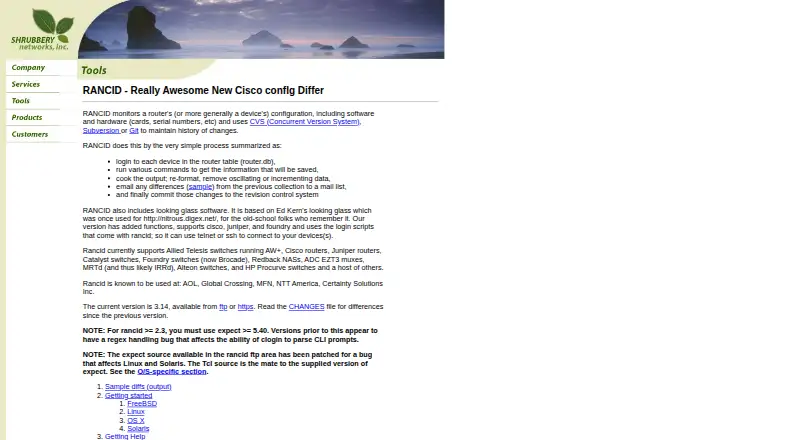
What RANCID is
RANCID monitors network-device configurations, preserves configuration and hardware or software history in version control, and emails detected differences. It logs in to devices, runs commands, filters out data that changes or increments without indicating a meaningful configuration change, then sends differences to a mailing list and commits updates. CVS, Subversion, and Git are listed as supported version-control systems. Login scripts connect using Telnet or SSH, and the software includes a looking-glass tool for device access. The maker lists support for devices from vendors including Allied Telesis, Cisco, Juniper, Catalyst, Foundry/Brocade, Redback, ADC, Alteon, and HP Procurve, among others. RANCID is free, with Linux, macOS, and self-hosted deployment listed. The product page identifies version 3.14 as current. It has no GUI or web interface for configuration, though separate tools can show diffs and repositories. Setup instructions generally assume basic Unix and tool knowledge; version 2.3 and later requires Expect 5.40 or later.
Good
- Emails detected configuration differences.
- Commits changes to CVS, Subversion, or Git.
- Connects to devices over Telnet or SSH.
- Supports a range of listed network-device makers.
Watch out
- No GUI or web interface for configuration.
- Setup assumes basic Unix and tool knowledge.
- Version 2.3+ requires Expect 5.40 or later.
Who it suits
RANCID suits network administrators who need configuration history, change alerts, and backups in version control. Users should be comfortable with basic Unix and tool setup.
Verdict
RANCID automates configuration collection, change notification, and revision-controlled history for supported network devices. Its lack of a configuration interface and assumed Unix knowledge make setup a consideration.
Plans and prices
From RANCID's own pricing page, checked 8 Oct 2026.
| Plan | Price | What it gives you |
|---|---|---|
| Free | Free | No paid plans or usage limits stated |
The facts
Each one read from RANCID's own pages, with the date it was checked.
What it does
- Access permissions
- The FAQ says RANCID needs permission to read device configurations and other data, while TACACS+ can restrict which commands its user may run.checked 8 Oct 2026
- Change alerts
- RANCID emails configuration differences to a mailing list and commits changes to a revision control system.checked 8 Oct 2026
- Collection workflow
- It logs in to devices, runs commands, reformats output to remove oscillating or incrementing data, emails differences, and commits changes to version control.checked 8 Oct 2026
- Contributed modules
- Modules for unsupported devices in the contrib directory are not supported or tested by the maker.checked 8 Oct 2026
- Current version
- The maker's page identifies version 3.14 as the current release.checked 8 Oct 2026
- Latest listed release
- The product page identifies version 3.14 as the current version and links to its download.checked 8 Oct 2026
- License
- The published license permits redistribution and use in source and binary forms subject to its stated conditions.checked 8 Oct 2026
- Looking glass
- RANCID includes looking-glass software that connects to devices using Telnet or SSH login scripts.checked 8 Oct 2026
- Purpose
- RANCID monitors network-device configurations, records configuration and hardware/software history in a revision control system, and emails detected differences.checked 8 Oct 2026
- Requirements
- The product page says RANCID version 2.3 and later requires Expect version 5.40 or later.checked 8 Oct 2026
- Security and warranties
- The license provides the software 'as is' and disclaims express or implied warranties.checked 8 Oct 2026
- Setup knowledge
- The maker says the distribution's setup instructions generally require or assume basic Unix and tool knowledge.checked 8 Oct 2026
- Support
- The maker directs users to [email protected] and the rancid-announce and rancid-discuss mailing lists for problems, contributions, and suggestions.checked 8 Oct 2026
- Supported operating systems
- The site provides getting-started links for FreeBSD, Linux, OS X, and Solaris.checked 8 Oct 2026
- Version control
- The product page lists CVS, Subversion, and Git as supported systems for maintaining change history.checked 8 Oct 2026
- Web interface
- The maker says RANCID has no GUI or web interface for configuration, though separate tools can be used to view diffs and repositories.checked 8 Oct 2026
- Web interface limit
- The maker says RANCID has no GUI or web interface for configuration, though third-party tools can be used to view diffs and the repository.checked 8 Oct 2026
The company
- Company location
- Shrubbery Networks lists its address as 1111 NW 53rd Dr, Portland, Oregon 97210-1033, USA.checked 8 Oct 2026
Where it runs
- Device access
- RANCID's login scripts can connect to devices using telnet or SSH.checked 8 Oct 2026
- Device support
- The maker lists support for devices including Allied Telesis, Cisco, Juniper, Catalyst, Foundry/Brocade, Redback, ADC, Alteon, and HP Procurve, plus others.checked 8 Oct 2026
- Extra device modules
- Community modules for unsupported devices are available in the contrib directory, but the maker says it does not support or maintain them.checked 8 Oct 2026
Alternatives to RANCID
- 1

ManageEngine Network Configuration Manager
Free planAndroidiOSWebAPI8.2From $238 a year - 2
Configuration Center
APIWindows6.8$99 one-time - 3

NetBrain
WebAPILinuxSelf-hosted6.8 - 4

Netpicker
Free planWebAPILinuxSelf-hosted6.8From $7,500 a year - 5

rConfig
Free planWebAPILinuxSelf-hosted6.8From €3,999 a year - 6
Nexsparkle ConfigVault
LinuxSelf-hostedWindows6.7From $495 a year