Rake
Rake is a Make-like task runner written in Ruby for defining tasks and their dependencies.
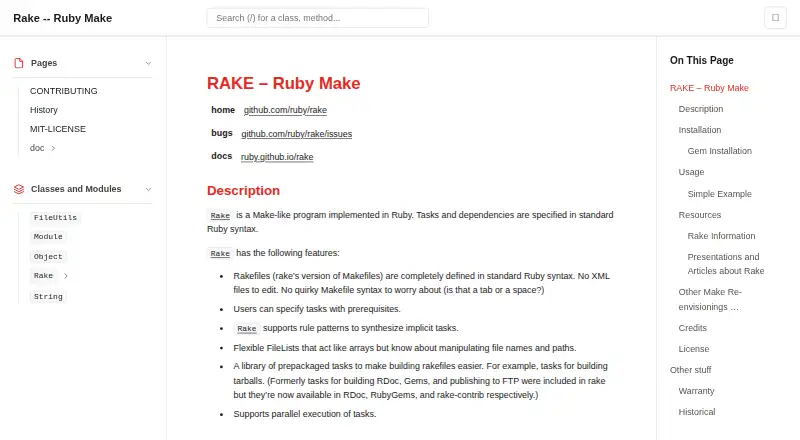
What Rake is
Rake is a Make-like task runner written in Ruby for defining tasks and their dependencies. Its Rakefiles use standard Ruby syntax, and tasks can name prerequisite tasks. Rule patterns can generate implicit tasks, while flexible FileLists support working with file names and paths. Rake includes packaged tasks, including tasks for building tarballs, and can run tasks in parallel. Its documentation gives an example of a default task that invokes a test task running a Ruby unit test file.
The project supports Linux, macOS, and Windows, and lists Ruby 2.0.0 or later as a requirement. Installation instructions use `gem install rake`. Rake is free under an MIT-style license; its stated capabilities also include build caching and artifact packaging. The project credits Jim Weirich as the original creator and Hiroshi SHIBATA as maintainer from Rake 10 onward. It provides the software as-is without express or implied warranties.
Good
- Rakefiles use standard Ruby syntax.
- Supports prerequisite and implicit tasks.
- Can run tasks in parallel.
- Includes packaged tasks such as tarball building.
- Available for Linux, macOS, and Windows.
Watch out
- Requires Ruby 2.0.0 or later.
- Provided as-is without express or implied warranties.
Who it suits
Rake suits Ruby users who want to describe task dependencies in code and run build or test tasks across Linux, macOS, and Windows. It may also fit workflows needing parallel tasks or artifact packaging.
Verdict
Rake offers a Ruby-based way to define task dependencies, with parallel execution and packaged tasks. Check the Ruby requirement and its as-is warranty terms before adopting it.
Plans and prices
From Rake's own pricing page, checked 7 Oct 2001.
| Plan | Price | What it gives you |
|---|---|---|
| Rake | Free | MIT-style license · Install with gem install rake |
The facts
Each one read from Rake's own pages, with the date it was checked.
What it does
- Example use
- The documentation shows a default task invoking a test task that runs a Ruby unit test file.checked 7 Oct 2001
- FileLists
- Flexible FileLists act like arrays and support manipulating file names and paths.checked 7 Oct 2001
- Implicit tasks
- Rule patterns can synthesize implicit tasks.checked 7 Oct 2001
- Installation
- The project’s installation instructions say to install Rake with gem install rake.checked 7 Oct 2001
- License
- Rake is available under an MIT-style license.checked 7 Oct 2001
- Maintainer
- The project credits Hiroshi SHIBATA as maintainer of Rake 10 and later.checked 7 Oct 2001
- Original creator
- The project credits Jim Weirich as Rake’s original creator.checked 7 Oct 2001
- Packaged tasks
- Rake includes prepackaged tasks, including tasks for building tarballs.checked 7 Oct 2001
- Parallel execution
- Rake supports parallel execution of tasks.checked 7 Oct 2001
- Prerequisites
- Tasks can specify prerequisite tasks.checked 7 Oct 2001
- Purpose
- Rake is a Make-like program implemented in Ruby for specifying and running tasks and their dependencies.checked 7 Oct 2001
- Rakefiles
- Rakefiles are defined in standard Ruby syntax.checked 7 Oct 2001
- Ruby requirement
- The Rake project page lists Ruby 2.0.0 or later as a requirement.checked 7 Oct 2001
- Warranty
- The project states that the software is provided as is without express or implied warranties.checked 7 Oct 2001
Alternatives to Rake
- 1

AWS CodeBuild
Free planWebAPILinuxmacOS7.9From $0.01 a month - 2

fastlane
Free planAndroidiOSLinuxmacOS7.4Free plan - 3

Nx
Free planWebLinuxmacOSSelf-hosted7.2From $29 a month - 4

Bazel
Free planLinuxmacOSWindows6.7Free plan - 5

FASTBuild
Free planLinuxmacOSWindows6.6Free plan - 6
Open Build Service
Free planWebAPILinuxSelf-hosted6.6Free plan