QuickDup
QuickDup is a structural code clone detector that identifies candidate duplicates using indentation changes and the first word on each line.
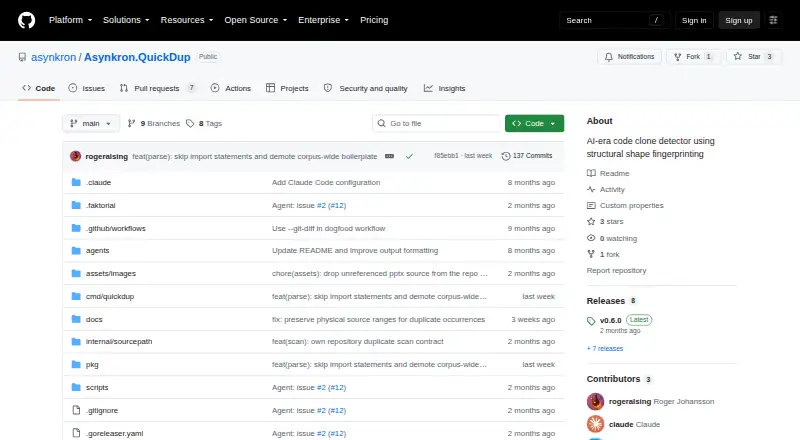
What QuickDup is
QuickDup is a structural code clone detector that identifies candidate duplicates using indentation changes and the first word on each line. It skips comments and blank lines, tokenizes source lines, and applies Jaccard similarity filtering with a default threshold of 75%. It does not parse abstract syntax trees. Detection options include normalized-indent, word-indent, word-only, and inlineable strategies. The README lists comment-prefix support for many languages, including Go, C and C++, Java, JavaScript and TypeScript, C#, Python, Ruby, SQL, and Lua. QuickDup can emit GitHub Actions annotations for inline pull request comments and restrict them to files changed against a Git reference. Results are written as machine-readable JSON in a .quickdup directory. The project is free and open source under the MIT License, with installers for Linux, macOS, and Windows, plus installation from source with Go. Its README reports processing about 100,000 lines in about 500 ms on 8 cores. QuickDup is intended to surface candidates for AI-assisted review, not decide whether code is truly duplicated; it can produce false positives and miss differently structured semantic duplicates.
Good
- Free software under the MIT License.
- Supports Linux, macOS, and Windows.
- GitHub Actions annotations can target changed files.
- Supports multiple detection strategies.
- JSON results are machine-readable.
Watch out
- Heuristic results can include false positives.
- Different code structures can hide semantic duplicates.
- Incremental caching works only with word-indent.
- Other strategies re-parse files on each run.
Who it suits
QuickDup suits developers and teams looking for repository-wide duplicate-code candidates, including those using GitHub Actions. It is aimed at workflows where an AI agent and a human reviewer verify the results.
Verdict
QuickDup can help narrow code review to likely structural clones, with broad language and GitHub Actions support. Treat its output as candidates to verify, not definitive findings.
The facts
Each one read from QuickDup's own pages, with the date it was checked.
What it does
- Caching
- Incremental caching is available only for the word-indent strategy; the other listed strategies re-parse files on each run.checked 4 Oct 2026
- Caching limit
- Incremental parsed-file caching is supported only by the word-indent strategy; the other listed strategies re-parse files on each run.checked 5 Oct 2026
- Detection strategies
- It offers normalized-indent, word-indent, word-only, and inlineable detection strategies.checked 5 Oct 2026
- GitHub Actions integration
- It can emit GitHub Actions annotations for inline pull request comments and can limit annotations to files changed against a Git reference.checked 5 Oct 2026
- GitHub integration
- QuickDup can emit GitHub Actions annotations for inline pull request comments and limit annotations to files changed against a Git reference.checked 4 Oct 2026
- How it works
- It fingerprints indentation changes and the first word on each line, skips comments and blank lines, and detects patterns without AST parsing.checked 5 Oct 2026
- Installation
- The README provides installer commands for Linux and macOS, a PowerShell installer for Windows, and installation from source with Go.checked 4 Oct 2026
- Intended use
- It is designed to generate candidate duplicates for AI-assisted code review, with an AI agent and human decision maker verifying candidates.checked 4 Oct 2026
- Languages
- The README lists comment-prefix support for languages including Go, C/C++, Java, JavaScript/TypeScript, C#, Python, Ruby, SQL, Lua, and others.checked 5 Oct 2026
- Language support
- The README lists comment-prefix detection for languages including Go, C#, JavaScript, TypeScript, Python, Ruby, SQL, Lua, and MATLAB, among others.checked 4 Oct 2026
- License
- QuickDup is released under the MIT License.checked 5 Oct 2026
- Limitations
- The project describes QuickDup as a heuristic candidate generator that can produce false positives and miss semantically duplicate code with different structure.checked 5 Oct 2026
- Output
- Results are written as machine-readable JSON files in a .quickdup directory.checked 5 Oct 2026
- Performance
- The README reports scanning about 100,000 lines of code in about 500 ms on 8 cores.checked 5 Oct 2026
- Purpose
- QuickDup is a structural code clone detector that finds duplicate code patterns using indent-delta fingerprinting and is designed to generate candidates for AI-assisted code review.checked 5 Oct 2026
- Release
- The GitHub releases page lists v0.6.0 as the latest release.checked 5 Oct 2026
- Similarity filtering
- QuickDup tokenizes source lines, computes Jaccard similarity, and filters patterns below a default similarity threshold of 75%.checked 5 Oct 2026
Where it runs
- Detection approach
- QuickDup fingerprints indentation changes and the first word on each line, and does not use AST parsing.checked 4 Oct 2026
The company
- Headquarters
- Huddinge, Swedenchecked 28 Sep 2026
- Maker location
- The maker's GitHub organization profile lists Stockholm, Sweden.checked 5 Oct 2026