qmux
qmux is a free, MIT-licensed macOS desktop terminal multiplexer for launching and managing coding agents.
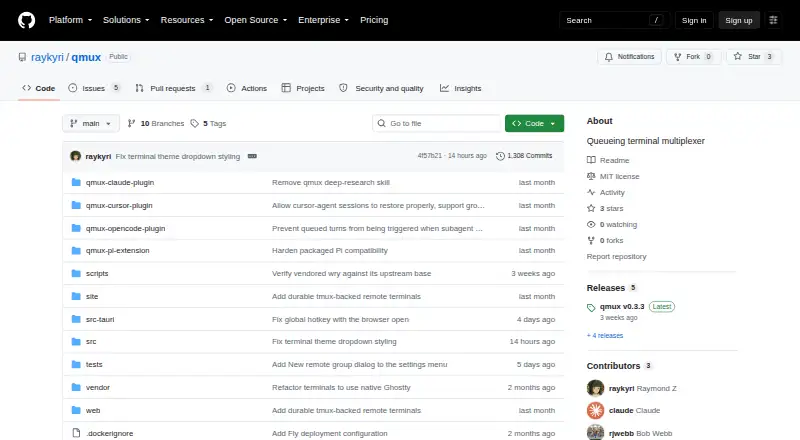
What qmux is
qmux is a free, MIT-licensed macOS desktop terminal multiplexer for launching and managing coding agents. Its native interface provides panes for agent sessions, status tracking, and queued follow-up work, with each pane hosting a Metal-rendered Ghostty terminal. Adapters support Claude Code, Codex, OpenCode, Grok, Muse, Pi, Cursor Agent, and Devin CLI. The follow-up composer can send, queue, steer, edit, or reorder turns and can approve or deny permission prompts where supported. qmux stores pane, group, agent, transcript, and queued-turn metadata locally for best-effort recovery after a restart, and supported sessions can be forked from the app or CLI. A Markdown prompt library offers global and per-project scopes, placeholders, and a Cmd-K command palette. SSH groups can run supported agents on another machine. Experimental features include Git worktree creation and a tab-bound browser panel. Users install and authenticate agent CLIs themselves. macOS 13 Ventura or later is required; the universal DMG supports Apple Silicon and Intel. Linux desktop support is planned.
Good
- Supports eight named agent adapters
- Queues, edits, and reorders follow-up turns
- Recovers local session metadata after restart
- Includes global and project prompt scopes
- Supports SSH terminal groups
Watch out
- macOS 13 Ventura or later required
- Linux desktop support is only planned
- Agent CLIs require separate installation
- Session synchronization and collaboration are unavailable
Who it suits
qmux suits macOS developers who run supported coding-agent command-line tools and want pane, queue, prompt, and session controls.
Verdict
qmux gathers multiple coding-agent sessions and follow-up controls in a macOS interface. It is a fit when local recovery, prompt organization, and SSH groups matter, but it remains macOS-only and depends on separately installed agents.
The facts
Each one read from qmux's own pages, with the date it was checked.
What it does
- Agent integrations
- Built-in adapters include Claude Code, Codex, OpenCode, Grok, Muse, Pi, Cursor Agent, and Devin CLI.checked 8 Oct 2001
- Experimental features
- The README describes experimental Git worktree creation for launched agents and an experimental tab-bound browser panel.checked 8 Oct 2001
- Follow-up queue
- Its follow-up composer can send, queue, steer, edit or reorder queued turns, and approve or deny permission prompts where supported.checked 8 Oct 2001
- Follow-ups
- The follow-up composer can send, queue, steer, edit, and reorder queued turns, and approve or deny permission prompts where supported.checked 7 Oct 2001
- License
- The repository lists the project under the MIT license.checked 8 Oct 2001
- Prompts
- Its prompt library supports Markdown prompts with global and per-project scopes, placeholders, and a Cmd-K command palette.checked 7 Oct 2001
- Prompt tools
- The prompt library supports Markdown prompts with global and per-project scopes, placeholders, and a Cmd-K command palette.checked 8 Oct 2001
- Provider setup
- Users must install and authenticate their own agent CLI; qmux says it does not install agents or copy their credentials.checked 8 Oct 2001
- Publishing security
- For hosted Gist comments, viewer access tokens are stored in encrypted HTTP-only session cookies and used only to create GitHub Gist comments.checked 8 Oct 2001
- Purpose
- qmux is a desktop terminal multiplexer for coding agents, with a native UI for launching agents, queueing follow-ups, tracking agent status, and driving terminal-based agents.checked 8 Oct 2001
- Recovery
- qmux persists pane, group, agent, transcript, and queued-turn metadata and offers best-effort recovery after restart.checked 7 Oct 2001
- Requirements
- The app requires macOS 13 Ventura or later and its DMG is a universal binary for Apple Silicon and Intel Macs.checked 7 Oct 2001
- Requirements and limits
- The app requires macOS 13 or later; the README says Linux desktop support is planned, while remote Linux hosts are supported for specified qmux CLI functions.checked 8 Oct 2001
- Research mode
- The v0.2.0 release notes describe Research mode as a way to create a personal knowledge base.checked 8 Oct 2001
- Security
- The maker says viewer access tokens for hosted Gist comments are stored in encrypted, HTTP-only session cookies and used only to create GitHub Gist comments.checked 7 Oct 2001
- Security details
- For remote groups, the README says the remote control socket is an owner-only Unix socket forwarded through SSH, with no network TCP listener or bearer token exposed.checked 8 Oct 2001
- Session management
- qmux supports session and transcript recovery, and can fork supported agent sessions from inside the app or through its CLI.checked 8 Oct 2001
- Terminal
- On macOS, each pane hosts a Metal-rendered Ghostty terminal surface.checked 7 Oct 2001
- Terminal rendering
- On macOS, each pane hosts a Metal-rendered Ghostty terminal surface.checked 8 Oct 2001
- Worktrees
- Git worktree creation for launched agents is experimental and includes dirty-worktree checks and a delete-or-keep prompt when closing worktree-backed panes.checked 7 Oct 2001
Where it runs
- Browser panel
- The experimental browser panel is tab-bound and resizable; token-gated local files are shown in a sandboxed preview.checked 7 Oct 2001
- Platform limitation
- The README describes qmux as macOS-only and says Linux support is planned for the future.checked 7 Oct 2001
- Remote machines
- Terminal groups can bind to another machine over SSH, where supported agents and shells run alongside the code they edit.checked 8 Oct 2001