PyUnfold
The facts below are what the maker publishes about PyUnfold, checked and dated. Our editors have not written about it yet.
Plans and prices
From PyUnfold's own pricing page, checked 11 Oct 2026.
| Plan | Price | What it gives you |
|---|---|---|
| PyUnfold | Free | Open-source Python package · MIT license |
The facts
Each one read from PyUnfold's own pages, with the date it was checked.
What it does
- Bayesian analysis
- Yeschecked 23 Sep 2026
- Convergence
- Users can adjust the test statistic criterion used to compare successive unfolded distributions and determine convergence.checked 11 Oct 2026
- Custom priors
- Users can supply custom initial prior distributions.checked 11 Oct 2026
- Deployment
- desktopchecked 23 Sep 2026
- Examples
- The documentation includes notebooks for a basic API tutorial, custom priors, spline regularization, and multivariate unfolding, which can be launched with Binder.checked 11 Oct 2026
- Installation requirement
- The installation page lists Python >= 2.7 or >= 3.4 as a dependency requirement.checked 11 Oct 2026
- Integrations
- The documented scientific computing dependencies are NumPy, SciPy, pandas, and six; the package can be installed with pip or conda.checked 11 Oct 2026
- Intended users
- The package is designed for members of scientific disciplines and for first-time users as well as experimental analyses.checked 11 Oct 2026
- License
- The public GitHub repository identifies PyUnfold as MIT licensed.checked 11 Oct 2026
- Method
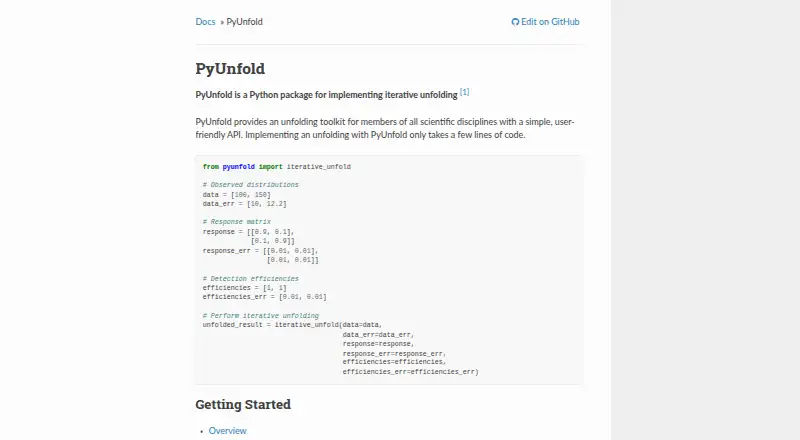
- Its iterative unfolding method uses Bayes’ theorem and provides uncertainty estimates that account for statistical and systematic errors.checked 11 Oct 2026
- Multidimensional analysis
- PyUnfold supports multidimensional unfolding.checked 11 Oct 2026
- Purpose
- PyUnfold is a Python package for iterative unfolding, a deconvolution method used to estimate true distributions from measured data.checked 11 Oct 2026
- Regression models
- Nochecked 23 Sep 2026
- Regularization
- Optional regularization uses tunable univariate splines to smooth unfolded distributions.checked 11 Oct 2026
- Release
- PyPI lists version 0.5.0, released November 19, 2018, as the latest version.checked 11 Oct 2026
- Research use
- The project says PyUnfold has been used for cosmic-ray energy spectrum measurement at HAWC and cosmic-ray composition analysis using IceCube.checked 11 Oct 2026
- Scripting support
- Yeschecked 23 Sep 2026
- Statistical tests
- Yeschecked 23 Sep 2026
- Support
- The project directs questions, feature proposals, and bug reports to its GitHub issue tracker.checked 11 Oct 2026
Money
- Free plan
- Yeschecked 23 Sep 2026