PySDM
PySDM is a free, open-source package for simulating particle populations that grow, collide, or break apart, with development focused on atmospheric cloud ph…
What PySDM is
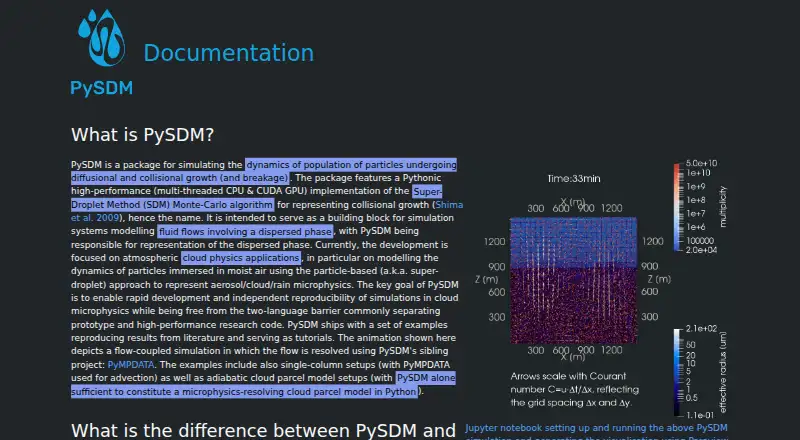
PySDM is a free, open-source package for simulating particle populations that grow, collide, or break apart, with development focused on atmospheric cloud physics and aerosol, cloud, and rain microphysics. It implements the Super-Droplet Method Monte Carlo algorithm to represent collisional growth. Documented compute options include a multithreaded CPU backend, a CUDA GPU backend, and a JAX backend that is early in development. Examples demonstrate condensation, coagulation and breakup, drop freezing, isotopic fractionation, aqueous chemistry, and seeding in box, parcel, single-column, and two-dimensional prescribed-flow setups. PySDM is available from PyPI for installation with pip, and documentation also covers installation from a local Git checkout. The GPU backend needs NVIDIA hardware and a CUDA driver. Example notebooks can be launched on Google Colab or mybinder.org, but are not included in the examples package wheels. PyMPDATA is used for advection in the single-column and two-dimensional examples. PySDM and PySDM-examples are released under the GNU GPL v3 license.
Good
- Free/libre open-source software under GNU GPL v3.
- Includes a multithreaded CPU backend.
- Examples cover several microphysical processes and setups.
- Installable from PyPI with pip.
Watch out
- CUDA backend requires NVIDIA hardware and a CUDA driver.
- JAX backend is early in development.
- Example notebooks are not included in package wheels.
Who it suits
PySDM suits developers and researchers building simulation systems involving dispersed phases, especially in atmospheric cloud physics. Users can choose a CPU backend or, with the required hardware and driver, the CUDA GPU backend.
Verdict
PySDM provides simulation methods, compute options, and examples for particle and atmospheric microphysics work. Check the backend requirements and notebook packaging details before choosing an installation route.
Plans and prices
From PySDM's own pricing page, checked 11 Oct 2026.
| Plan | Price | What it gives you |
|---|---|---|
| PySDM | Free | GNU GPL v3 open-source software package |
The facts
Each one read from PySDM's own pages, with the date it was checked.
What it does
- Authoring tools
- Yeschecked 23 Sep 2026
- Compute backends
- The documentation describes a multithreaded CPU backend, a CUDA GPU backend, and a JAX backend that is early in development.checked 11 Oct 2026
- Core method
- It implements the Super-Droplet Method Monte Carlo algorithm for representing collisional growth.checked 11 Oct 2026
- Data export
- Yeschecked 23 Sep 2026
- Delivery mode
- hybridchecked 23 Sep 2026
- GPU requirement
- The GPU backend requires NVIDIA hardware and a CUDA driver.checked 11 Oct 2026
- Installation
- PySDM is available from PyPI and can be installed with pip; the documentation also gives instructions for installing from a local Git checkout.checked 11 Oct 2026
- Intended users
- The package is intended as a building block for simulation systems involving dispersed phases, with development focused on atmospheric cloud physics applications.checked 11 Oct 2026
- Lesson library
- Yeschecked 23 Sep 2026
- License
- PySDM and PySDM-examples are free/libre open-source software released under the GNU GPL v3 license.checked 11 Oct 2026
- Model setups
- Examples cover box, parcel, single-column, and two-dimensional prescribed-flow environments.checked 11 Oct 2026
- Notebook access
- Example notebooks have badges for launching them on Google Colab or mybinder.org, and the notebooks themselves are not included in the examples package wheels.checked 11 Oct 2026
- Processes
- The example gallery covers condensation, collisional coagulation and breakup, drop freezing, isotopic fractionation, aqueous chemistry, and seeding.checked 11 Oct 2026
- Purpose
- PySDM simulates particle populations undergoing diffusional and collisional growth and breakage, with a focus on atmospheric cloud physics and aerosol, cloud, and rain microphysics.checked 11 Oct 2026
- Related software
- PyMPDATA is used for advection in the single-column and two-dimensional prescribed-flow examples.checked 11 Oct 2026
- Support
- The project recommends GitHub Discussions for help understanding, using, and extending PySDM, and its GitHub issue tracker for reporting incorrect or undocumented behavior.checked 11 Oct 2026
Money
- Free plan
- Yeschecked 23 Sep 2026
Alternatives to PySDM
- 1

SimFlow
Free planWebLinuxmacOSWindows8.2From €8,000 a year - 2

COMSOL Multiphysics
WebAPILinuxmacOS7.7 - 3
FeenoX
Free planWebAPILinuxSelf-hosted7.5Free plan - 4
myPhysicsLab
Free planWebLinuxmacOSSelf-hosted7.5Free plan - 5

OpenFOAM
Free planLinuxmacOSSelf-hostedWindows7.3Free plan - 6
MPTRAC
Free planWebLinuxSelf-hosted7.2Free plan