PyBurn Studio
PyBurn Studio is a free, open-source desktop application for burning and ripping optical discs on Linux, macOS, and Windows.
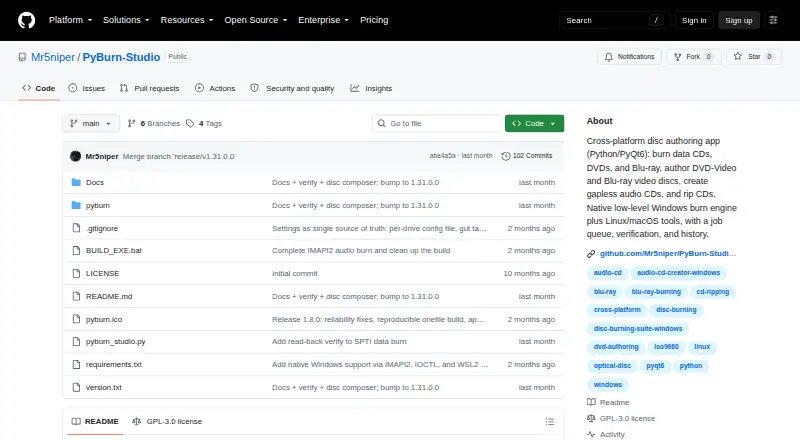
What PyBurn Studio is
PyBurn Studio is a free, open-source desktop application for burning and ripping optical discs on Linux, macOS, and Windows. It can create data CDs, DVDs, and Blu-ray discs from files and folders, arrange disc contents, and build ISO images. Audio CD projects accept MP3, WAV, FLAC, OGG, M4A, and AAC files; Windows supports gapless Disc-At-Once burning. The app also authors video DVDs using ffmpeg and dvdauthor, and Blu-ray BDMV discs using tsMuxeR. For CD ripping, it saves audio as MP3, FLAC, or WAV and can retrieve metadata through MusicBrainz. Jobs run one at a time in a queue with progress, logs, history, and retry options. Data-disc verification can compare a burned disc with its written image when enabled for the drive. Requirements include PyQt6; requests is optional for MusicBrainz lookups, and Blu-ray authoring requires optional tsMuxeR. Operating-system setup differs: Windows uses WSL2 for DVD and Blu-ray authoring, while Linux and macOS disc jobs rely on command-line tools.
Good
- Burns data CDs, DVDs, and Blu-ray discs
- Creates audio CDs from six listed formats
- Rips CDs to MP3, FLAC, or WAV
- Provides queued jobs, logs, history, and retries
Watch out
- Requires PyQt6
- Blu-ray authoring requires optional tsMuxeR
- Windows DVD and Blu-ray authoring uses WSL2
- Linux and macOS jobs rely on command-line tools
Who it suits
PyBurn Studio suits people who need to create or read data, audio, or video discs on Linux, macOS, or Windows. It may also fit users comfortable installing the tools required for their operating system and job type.
Verdict
PyBurn Studio covers data, audio, and video disc tasks across three desktop platforms, with ripping and optional verification as well. Check the operating-system-specific tool requirements, especially for Blu-ray and video authoring, before setting it up.
Plans and prices
From PyBurn Studio's own pricing page, checked 9 Oct 2001.
| Plan | Price | What it gives you |
|---|---|---|
| PyBurn Studio | Free | No price stated · GPL-3.0 licensed |
The facts
Each one read from PyBurn Studio's own pages, with the date it was checked.
What it does
- Audio CDs
- It authors audio CDs from MP3, WAV, FLAC, OGG, M4A, and AAC files, including gapless Disc-At-Once burning on Windows.checked 4 Oct 2001
- Audio formats
- Audio CD authoring accepts MP3, WAV, FLAC, OGG, M4A, and AAC files.checked 9 Oct 2001
- Burn verification
- Data burns can be verified by reading the disc back and comparing it with the written image.checked 9 Oct 2001
- CD ripping
- Audio CDs can be ripped to MP3, FLAC, or WAV, with optional MusicBrainz metadata lookup.checked 9 Oct 2001
- Data disc layout
- The Data tab lets users add files and folders, create folders, rename entries, and arrange the disc contents by dragging items.checked 9 Oct 2001
- Data discs
- It burns data CDs, DVDs, and Blu-ray discs from files and folders, with tools to arrange the disc contents and build an ISO image.checked 4 Oct 2001
- Disc formats
- It burns data CDs, DVDs, and Blu-ray discs, authors audio CDs and video discs, and rips audio CDs.checked 9 Oct 2001
- Job management
- The app queues jobs one at a time and provides progress, a global job log, persistent history, and the ability to retry jobs.checked 9 Oct 2001
- License
- The project is released under the GNU General Public License, version 3.checked 9 Oct 2001
- Optional integrations
- The app can use ffmpeg for audio and video tasks and requests for optional MusicBrainz lookups; Blu-ray authoring requires tsMuxeR.checked 9 Oct 2001
- Product
- PyBurn Studio is a desktop disc-authoring application built with Python and PyQt6 for burning and ripping discs on Linux and Windows.checked 9 Oct 2001
- Release
- The releases page lists PyBurn Studio v1.15.0.0 as the latest release and describes a native Windows SPTI/MMC burning engine.checked 9 Oct 2001
- Requirements
- PyQt6 is required; requests is optional for MusicBrainz lookups, and Blu-ray authoring requires the optional tsMuxeR tool.checked 4 Oct 2001
- Security and privacy
- The opened project page does not state security certifications or compliance claims.checked 9 Oct 2001
- Simulation mode
- When a required tool is missing, simulation mode lets users exercise the interface without running the disc job.checked 9 Oct 2001
- Support
- The repository page exposes an Issues section for reporting project issues.checked 9 Oct 2001
- Video discs
- It authors video DVDs using ffmpeg and dvdauthor, and Blu-ray BDMV discs using tsMuxeR.checked 4 Oct 2001
Where it runs
- Linux and macOS requirements
- Linux and macOS use command-line disc tools, and macOS instructions specify installing tools through Homebrew.checked 9 Oct 2001
- Linux and macOS tools
- On Linux and macOS, disc jobs use command-line tools, with dependencies varying by job type; macOS instructions specify installing tools through Homebrew.checked 4 Oct 2001
- Windows engine
- Windows data and audio burning and CD ripping use a built-in engine; video DVD and Blu-ray authoring use WSL2 for the authoring step.checked 9 Oct 2001
The company
- Maker
- The GitHub profile describes Mr5niper as a junior test engineer with experience in validation and system testing.checked 4 Oct 2001
The full review of PyBurn Studio
Overview
PyBurn Studio is a free, open-source desktop application for burning and ripping optical discs. It suits people who need one tool for data, audio, and video disc work across Linux, macOS, and Windows. Its breadth is useful, but setup depends on the disc task and operating system, with external tools required for some authoring jobs.
Key features
For data discs, PyBurn Studio can burn files and folders to CDs, DVDs, and Blu-ray discs, arrange their layout, and build an ISO image. Dragging items into place and creating or renaming folders gives users control over the disc structure before burning.
Audio CD authoring accepts MP3, WAV, FLAC, OGG, M4A, and AAC files. Windows users also get gapless Disc-At-Once burning, a specific advantage for albums that should play without gaps between tracks. The app can rip audio CDs to MP3, FLAC, or WAV, with optional MusicBrainz metadata lookups.
Video authoring covers DVDs through ffmpeg and dvdauthor, and Blu-ray BDMV discs through tsMuxeR. That range makes PyBurn Studio more than a basic data burner, but Blu-ray creation depends on installing the optional tsMuxeR tool. ffmpeg is also used for audio and video tasks.
Jobs run one at a time in a queue, with live progress, logs, persistent history, and retry options. Per-drive burn verification can read a data disc back and compare it with the written image. These tools help users track jobs and check data burns, though verification must be enabled per drive in Settings.
If a required tool is missing, simulation mode lets users explore the interface without running the disc job. It can help with setup, but it does not replace the tools needed to complete a burn.
Pricing
PyBurn Studio costs nothing. The free plan is the application itself, released under the GNU General Public License version 3; there is no paid tier or free trial. It is a straightforward fit for anyone comfortable using open-source desktop software rather than a subscription product.
The free price does not remove the setup requirements. PyQt6 is required, requests is optional for MusicBrainz lookups, and Blu-ray authoring needs tsMuxeR. Tool dependencies vary by job on Linux and macOS, while Windows uses WSL2 for DVD and Blu-ray authoring.
Platforms
PyBurn Studio runs on Linux, macOS, and Windows. Windows handles data and audio burning and CD ripping through built-in drive interfaces; DVD and Blu-ray authoring use WSL2. Linux and macOS rely on command-line disc tools, and macOS installation instructions use Homebrew. The operating-system differences matter: users should check the requirements for their intended job before choosing the platform or planning a video-disc workflow.
Who it's for
PyBurn Studio is a good match for users who still work with optical media and want data burning, audio CDs, CD ripping, and video authoring in one free desktop app. It is especially relevant to Windows users who want gapless audio CD burning, or to users who value a configurable data-disc layout and per-drive verification.
It is less suitable for someone seeking a tool-free setup or a simple video-only workflow. Linux and macOS users need command-line dependencies, Windows video authoring requires WSL2, and Blu-ray authoring requires tsMuxeR.
Pros and cons
- Pro: One free application covers data CDs, DVDs, and Blu-ray discs, audio CD authoring, video discs, and CD ripping, reducing the need to switch tools for common disc tasks.
- Pro: Data layout controls, job history, retry options, and optional read-back verification give users practical control over disc preparation and data burns.
- Pro: Windows gapless Disc-At-Once burning is useful for audio albums where pauses between tracks are undesirable.
- Con: Dependencies vary by platform and job; WSL2 is needed for Windows DVD and Blu-ray authoring, and command-line tools are needed on Linux and macOS.
- Con: Blu-ray authoring requires the optional tsMuxeR tool, so the format's inclusion does not mean it works without extra setup.
- Con: Burn verification applies to data discs and must be enabled for each drive in Settings.
Alternatives
For a broader look at this category, see DVD Authoring Software.
- DVDStyler is a free, open-source option for Linux, macOS, and Windows if DVD authoring is the main requirement.
- Open Burning Suite is another free, open-source disc-burning application for Linux, macOS, and Windows.
- Q DVD-Author is a free GPL-2.0 option for Linux users focused on DVD authoring.
- WinX DVD Author is a free Windows-only option that states it has no limits or watermarks and supports Windows 10/11.
- DVDBuilder SDK is a freemium Windows option credited to Primo Software.
- AVS Video Editor is a freemium Windows alternative, with a one-year subscription priced at $49 a year.
- DeVeDe NG is a free Linux alternative.
- Tipard DVD Creator is a paid Mac and Windows option with a free trial.
Verdict
Choose PyBurn Studio if you need a free, cross-platform toolkit for data and audio discs, ripping, and video-disc authoring, and are willing to install the tools your workflow requires. Its strongest reason to choose it is the breadth of disc tasks in one app; its strongest reason to look elsewhere is the platform-specific setup, particularly for Blu-ray and video authoring.
Getting started
- Open the PyBurn Studio project page on GitHub.
- PyQt6 is required by the application.
- On macOS, follow the project instructions to install command-line tools through Homebrew.
- Install optional tools needed for your selected task, such as tsMuxeR for Blu-ray authoring or requests for MusicBrainz lookups.
- Use the application to arrange a data disc, create an audio or video disc project, or rip an audio CD.
Questions
How much does PyBurn Studio cost?
The project is open source under the GNU GPL version 3; no price is stated.
Which operating systems does it support?
PyBurn Studio supports Linux, macOS, and Windows.
What disc tasks can it handle?
It burns data CDs, DVDs, and Blu-ray discs; authors audio CDs and video discs; and rips audio CDs.
What tools or requirements does it need?
PyQt6 is required. Blu-ray authoring requires the optional tsMuxeR tool, and requests is optional for MusicBrainz lookups. Linux and macOS use command-line disc tools; on Windows, DVD and Blu-ray authoring use WSL2.
Does it offer a free trial?
No. The listed pricing model is free, with a free plan and no free trial.
Alternatives to PyBurn Studio
- 1
Open Burning Suite
Free planOpen sourceLinuxmacOSSelf-hostedWindows7.2Free plan - 2
DVDStyler
Free planOpen sourceLinuxmacOSWindows7.1Free plan - 3
Tipard DVD Creator
macOSWindows6.3From $24 a month - 4
AVS Video Editor
Windows6.1From $4.08 a month - 5
Wondershare DVD Creator
macOSWindows6.1From $3.33 a month - 6
Xilisoft DVD Creator
macOSWindows6.1$27.97, paid once