PxeLab
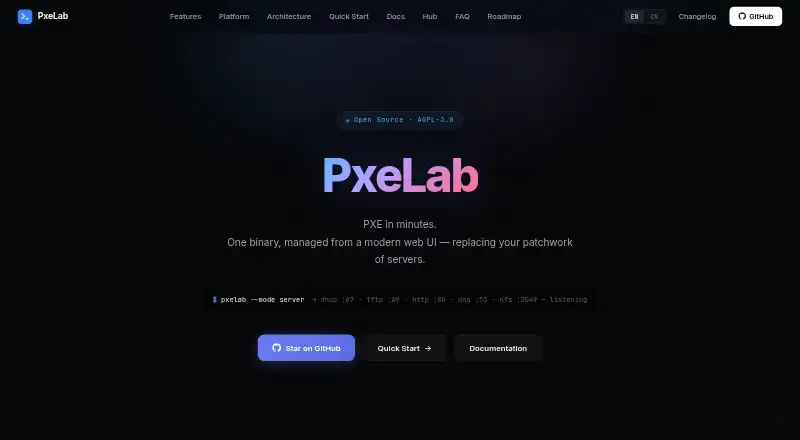
PxeLab is an open-source PXE network boot platform that bundles DHCP, TFTP, HTTP, DNS, and NFS in a single binary.
What PxeLab is
PxeLab is an open-source PXE network boot platform that bundles DHCP, TFTP, HTTP, DNS, and NFS in a single binary. Administrators can manage it through a web UI, REST API, or command line, and run it on Windows, Linux, or macOS in server or desktop modes. For network operating-system deployment, it includes ISO uploads, an image library, install task tracking, and a catalog of more than 64 Linux distributions with answer-file templates for unattended installation. Boot profiles can use direct kernel, chain, WDS, sanboot, or local disk options, with diffs, rollback, and host or group bindings. Host tools cover inventory, scheduled Wake-on-LAN, BMC/IPMI power control, and CSV import. Operational features include live logs, configuration audit logs, Prometheus metrics, and MAC-based allow and deny lists. Its NFSv3 server supports IP/CIDR allowlists and read-only exports. Secure Boot is supported for x86-64 and ARM64. PxeLab is licensed under AGPL-3.0. The Getting Started guide says deb and rpm packages, Homebrew, and Docker images are on the roadmap and not yet available.
Good
- Combines five network boot services in one binary
- Runs on Windows, Linux, and macOS
- Includes templates for unattended installs
- Offers REST API and command-line management
Watch out
- deb and rpm packages are not yet available
- Homebrew support is on the roadmap
- Docker images are not yet available
Who it suits
PxeLab lists IT operations and data center engineers, system administrators, development and test teams, and education and training users as audiences. It is suited to users who need network boot deployment with management through a web UI, API, or CLI.
Verdict
PxeLab combines network boot services with host management, deployment templates, and operational visibility. Check the current availability limits if your deployment depends on packages, Homebrew, or Docker images.
The facts
Each one read from PxeLab's own pages, with the date it was checked.
What it does
- Access controls
- The product supports MAC whitelist and blacklist access control, and its built-in NFSv3 server supports IP/CIDR whitelists and read-only exports.checked 8 Oct 2026
- API and control
- The site says every management operation is covered by a REST API, and the product can also be managed through its web UI or CLI.checked 8 Oct 2026
- API security
- Local API requests need no authentication by default; remote access uses a configured Bearer token.checked 8 Oct 2026
- Architecture support
- The site says PxeLab can boot 11 client architectures and automatically select the boot file.checked 8 Oct 2026
- Automated installs
- The built-in catalog covers 64+ distributions and includes autoinstall, preseed, kickstart, and autounattend answer-file templates.checked 8 Oct 2026
- Availability limit
- The Getting Started guide says deb and rpm packages, Homebrew, and Docker images are on the roadmap and are not yet available.checked 8 Oct 2026
- Boot profiles
- Boot profiles can use direct kernel, chain, WDS, sanboot, or local disk options, with diffs, rollback, and host or group bindings.checked 8 Oct 2026
- Boot services
- Built-in services include DHCP server, proxy, and off modes, TFTP, DNS forwarding, and an NFSv3 server.checked 8 Oct 2026
- Boot support
- PxeLab supports 10 client CPU architectures and Secure Boot for x86-64 and ARM64.checked 8 Oct 2026
- Deployment
- PxeLab runs on Windows, Linux, and macOS, with server and desktop app modes.checked 8 Oct 2026
- Host management
- Host inventory supports MAC/IP grouping, scheduled Wake-on-LAN, BMC/IPMI power control, and CSV bulk import.checked 8 Oct 2026
- Host operations
- Host tools include inventory, scheduled Wake-on-LAN, BMC/IPMI power control, and CSV bulk import.checked 8 Oct 2026
- Integrations
- PxeLab offers a REST API for automation and CI workflows, and PxeLab Hub provides community-contributed boot templates and configurations.checked 8 Oct 2026
- Intended users
- The site identifies IT operations engineers, data center engineers, system administrators, Dev and QA teams, and education and training as intended users.checked 8 Oct 2026
- License
- PxeLab is open source under the AGPL-3.0 license.checked 8 Oct 2026
- Management
- The services can be managed through a web UI, REST API, or command line.checked 8 Oct 2026
- Monitoring
- PxeLab provides real-time log streams, configuration audit logs, and a Prometheus metrics endpoint.checked 8 Oct 2026
- Product
- PxeLab is an all-in-one PXE network boot platform that bundles DHCP, TFTP, HTTP, DNS, and NFS in a single binary.checked 8 Oct 2026
- Provisioning
- The product includes a catalog of 64+ Linux distributions, answer-file templates, and install task tracking.checked 8 Oct 2026
- Purpose
- PxeLab is an all-in-one PXE network boot server with DHCP, TFTP, HTTP, DNS, and NFS managed through a web UI.checked 8 Oct 2026
- Secure Boot
- Secure Boot is supported for UEFI x64 and UEFI ARM64 architectures.checked 8 Oct 2026
- Security and operations
- Listed controls and observability features include NFS IP/CIDR whitelists, MAC whitelist/blacklist access control, audit logs, SSE log streams, and Prometheus metrics.checked 8 Oct 2026
Where it runs
- OS deployment
- It supports ISO uploads, an OS image library, answer-file templates, and install task tracking.checked 8 Oct 2026
Alternatives to PxeLab
- 1

Canonical MAAS
Free planOpen sourceWebAPILinuxSelf-hosted8.1From $30 a year - 2

FOG Project
Free planOpen sourceWebAPILinuxmacOS7.7Free plan - 3

Foreman
Free planWebAPILinuxSelf-hosted6.9Free plan - 4
Supermicro SuperDoctor 5
Free planLinuxWindows6.8Free plan - 5

Clonezilla
Free planLinuxmacOSSelf-hostedWindows6.7Free plan - 6
iVentoy
Free planLinuxSelf-hostedWindows6.7$49 one-time