Project Moonshot
Project Moonshot is an open-source toolkit for assessing the safety and reliability of large language models and AI applications.
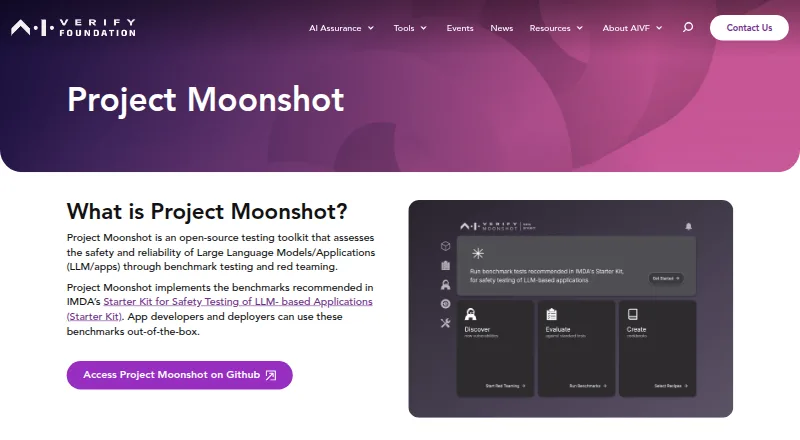
What Project Moonshot is
Project Moonshot is an open-source toolkit for assessing the safety and reliability of large language models and AI applications. It runs benchmark tests against open-source datasets and metrics, and can generate adversarial prompts with algorithmic strategies or generative LLMs to probe for vulnerabilities and misuse. Users can create custom evaluations from their own datasets, with optional prompt templates, metrics, and grading scales. Results are available as interactive HTML reports and downloadable raw JSON for programmatic analysis. Moonshot can be used through a web interface, command line, library APIs, or web APIs. It connects to providers including OpenAI, Anthropic, Together, and Hugging Face, and users can build connectors for other models or applications on custom servers. The toolkit implements benchmarks recommended in IMDA’s Starter Kit for safety testing LLM-based applications. It is free and released as beta software under Apache License 2.0. Installation uses pip; Python 3.11 is required, and the web interface also requires Node.js 20.11.1 LTS or later.
Good
- Benchmarking uses open-source datasets and metrics.
- Generates adversarial prompts to probe vulnerabilities.
- Supports custom datasets and evaluation criteria.
- Provides HTML reports and downloadable JSON results.
- Free plan; available for self-hosted deployment.
Watch out
- Beta software.
- Requires Python 3.11.
- Web UI requires Node.js 20.11.1 LTS or later.
- x86 Macs may have installation difficulties with dependencies.
Who it suits
It suits AI developers and compliance teams evaluating LLMs and applications built with them. It can also fit teams that need custom tests or self-hosted deployment.
Verdict
Project Moonshot brings benchmarking, red teaming, and custom evaluations into one toolkit, with several interfaces and report formats. Account for its beta status and installation requirements before choosing it.
Plans and prices
From Project Moonshot's own pricing page, checked 30 Sep 2026.
| Plan | Price | What it gives you |
|---|---|---|
| Project Moonshot | Free | Open-source toolkit; requires Python 3.11; web UI requires Node.js 20.11.1 LTS or above |
The facts
Each one read from Project Moonshot's own pages, with the date it was checked.
What it does
- Benchmarking
- Its benchmarks cover capability, quality, and trust and safety, including measures such as accuracy, bias, toxicity, and hallucination.checked 30 Sep 2026
- Compatibility note
- The installation guide recommends Chrome for the best web UI experience and says x86 Macs may encounter installation difficulties with moonshot-data dependencies.checked 30 Sep 2026
- Custom connectors
- Users can create model connectors for other models or their own LLM applications hosted on custom servers.checked 30 Sep 2026
- Custom evaluations
- Users can create recipes using their own datasets, optional prompt templates, evaluation metrics, and grading scales.checked 30 Sep 2026
- Custom tests
- Users can build benchmark tests using custom datasets, optional prompt templates, evaluation metrics, and grading scales.checked 29 Sep 2026
- IMDA alignment
- The toolkit implements benchmarks recommended in IMDA’s Starter Kit for safety testing LLM-based applications.checked 29 Sep 2026
- Installation
- The maker's instructions install Moonshot with pip and run the web UI locally at localhost:3000.checked 30 Sep 2026
- Integrations
- Users can configure connections to their LLMs and create custom connector endpoints through the Web UI or CLI guides.checked 29 Sep 2026
- Intended users
- The maker describes Moonshot as a tool for AI developers, compliance teams, and AI system owners evaluating LLMs and LLM applications.checked 30 Sep 2026
- Interfaces
- Moonshot can be used through a web UI, an interactive command-line interface, library APIs, and web APIs.checked 30 Sep 2026
- License and maturity
- The repository identifies Moonshot as beta software released under the Apache Software License 2.0.checked 29 Sep 2026
- License and status
- The GitHub repository identifies the project as beta and licenses it under Apache License 2.0.checked 30 Sep 2026
- Provider connections
- The documentation names OpenAI, Anthropic, Together, and Hugging Face as model providers Moonshot can connect to with an API key.checked 30 Sep 2026
- Purpose
- Project Moonshot is an open-source toolkit for testing the safety and reliability of LLMs and LLM applications through benchmarking and red teaming.checked 30 Sep 2026
- Reporting
- It provides interactive HTML reports and downloadable raw JSON test results.checked 29 Sep 2026
- Reports
- Moonshot provides interactive HTML reports and downloadable raw JSON results for programmatic analysis.checked 30 Sep 2026
- Requirements
- Moonshot requires Python 3.11, and its web UI requires Node.js 20.11.1 LTS or above and npm 10.8.0 or above.checked 30 Sep 2026
- Support
- The Moonshot FAQ directs users who need more help to raise an issue on GitHub.checked 30 Sep 2026
The company
- Founded
- 2024checked 28 Sep 2026
- Maker
- AI Verify Foundation is a not-for-profit wholly owned subsidiary of Singapore’s Infocommunications Media Development Authority.checked 29 Sep 2026
- Red teaming
- The toolkit supports adversarial testing with prompt templates, context strategies, and automated attack modules.checked 30 Sep 2026
The full review of Project Moonshot
Overview
Project Moonshot is an open-source toolkit for evaluating large language models and applications with benchmarks, red-team tests, and custom evaluations. It is best suited to AI developers and compliance teams who can run software locally and want control over their test recipes. Its breadth of interfaces and reporting is appealing, though beta status and installation prerequisites make it less turnkey than a hosted service.
Developed by AI Verify Foundation, a not-for-profit subsidiary wholly owned by Singapore’s Infocommunications Media Development Authority, Moonshot implements benchmarks recommended in IMDA’s Starter Kit for safety testing LLM-based applications. The Apache License 2.0 permits use as open-source software, but beta maturity is a reason for teams to validate it against their own operational needs before relying on it.
Key features
Benchmarking and red teaming
Moonshot runs benchmark tests against open-source datasets and metrics for performance and trust and safety risks. It can also generate adversarial prompts through algorithmic strategies or generative LLMs. Prompt injection, jailbreaks, data leakage, and unsafe outputs are among the supported test areas, making the toolkit relevant to teams that need to probe both model quality and common safety concerns in one workflow.
Custom evaluations and connectors
Users can create evaluation recipes from their own datasets, optional prompt templates, metrics, and grading scales. That flexibility is useful when generic benchmarks do not reflect an application’s risks, although teams must supply and maintain the assets that make those tests meaningful. Connections to OpenAI, Anthropic, Together, and Hugging Face models use API keys; users can also build connectors for other models or their own applications hosted on custom servers.
Interfaces and reports
Moonshot offers a Web UI, interactive command-line interface, library APIs, and Web APIs. Results appear in interactive HTML reports, with raw JSON downloads for programmatic analysis. This gives both practitioners and automated workflows a way to consume results rather than limiting evaluation to a single interface.
Pricing
Project Moonshot costs free. The open-source toolkit has no paid tier or trial to weigh against its free option. That makes it accessible for teams willing to manage their own environment; the tradeoff is that setup and test assets are part of the work, rather than a hosted service handling them.
Moonshot requires Python 3.11, and its Web UI requires Node.js 20.11.1 LTS or later. Installation uses pip and runs the UI locally at localhost:3000. The installation guide recommends Chrome for the best Web UI experience and warns that x86 Macs may encounter difficulties with moonshot-data dependencies. The FAQ directs users needing help to raise a GitHub issue.
Platforms
Moonshot supports API, Linux, macOS, self-hosted, web, and Windows use. Its self-hosted deployment and multiple interfaces suit teams that want to keep evaluation close to their own systems, but the language-runtime requirements and test assets make it a less convenient fit for readers seeking an immediately usable hosted tool.
Who it's for
AI developers and compliance teams evaluating LLMs or LLM-based applications are the clearest fit, particularly when they need custom datasets, connectors, or reproducible results in JSON. It is less suitable for teams that need mature, managed software or cannot take on local setup and maintenance.
Pros and cons
- Pros: Combines benchmarks and adversarial testing, including prompt injection, jailbreak, data leakage, and unsafe-output checks.
- Pros: Custom recipes, model connectors, and API access allow teams to shape evaluations around their own applications.
- Pros: HTML reports and raw JSON serve both human review and programmatic analysis.
- Cons: Beta status makes maturity a consideration for teams depending on stable evaluation workflows.
- Cons: Python, Node.js for the Web UI, and test-asset requirements add setup work; x86 Mac users may hit dependency difficulties.
Alternatives
Browse AI Security Testing Tools to compare the category. Choose OpenSecureAI Scanner if you want a freemium option with a paid Pro plan at $49 a month, including 50,000 API requests per month, 120 requests per minute per key, hosted AI remediation and LLM Gateway completions, and priority email support. Its API, Linux, macOS, web, and Windows platforms offer a different deployment mix.
PromptGuard is another freemium alternative, with a free plan capped at 20,000 scans a month, one API key, one project, and 24-hour log retention; choose it if those defined limits suit your needs. Promptfoo offers a Community plan at no cost with 10k red-team probes per month, LLM evaluation features, model providers and integrations, and local or self-hosted runs, so it is worth considering if that allowance and workflow fit better.
PyRIT is a free open-source framework that requires a Python environment and configured AI endpoints. Basilisk is free open-source software available through CLI, desktop, Docker, or source distribution, for authorized use only. F5 BIG-IP APM is a paid alternative with a free trial and a perpetual license offered on BIG-IP Virtual Editions, hardware, or hybrid environments. AgentScan has a free plan with five scans per month, 185 attack vectors, five categories, auto-detection of agent format, and JSON results. AIRTaaS is a free web-based alternative.
Verdict
Choose Project Moonshot if you are an AI developer or compliance team that wants a free, self-hosted toolkit for combining standard benchmarks with custom safety evaluations and can handle its setup requirements. Its range of interfaces and exportable results are strong reasons to consider it; its beta status and installation burden are reasons to look elsewhere if you need a mature, managed evaluation service.
Getting started
- Visit the Project Moonshot website.
- Install Moonshot with pip.
- Use Python 3.11; install Node.js 20.11.1 LTS or later if using the Web UI.
- Run the Web UI locally at localhost:3000, or use the CLI, library APIs, or Web APIs.
- Configure a provider connection with an API key or create a custom connector.
Limits worth knowing
Moonshot is beta software. Installation requires Python 3.11; the Web UI additionally requires Node.js 20.11.1 LTS or later, and test assets are required to run tests.
Questions
Is Project Moonshot free?
Yes. Project Moonshot is listed as a free, open-source toolkit.
What license does Moonshot use?
The repository identifies the project as beta software released under Apache License 2.0.
Which model providers can it connect to?
The documentation names OpenAI, Anthropic, Together, and Hugging Face as providers Moonshot can connect to with an API key. Users can also create connectors for other models or applications on custom servers.
What does installation require?
Python 3.11 is required. The Web UI additionally requires Node.js 20.11.1 LTS or later, and test assets are needed to run tests.
Who makes Project Moonshot?
AI Verify Foundation makes the project. It is a not-for-profit wholly owned subsidiary of Singapore’s Infocommunications Media Development Authority.
Alternatives to Project Moonshot
- 1
OpenSecureAI Scanner
Free planOpen sourceWebAPILinuxmacOS8.1From $49 a month - 2

PromptGuard
Free planWebAPIExtensionLinux7.9From $19 a month - 3

Promptfoo
Free planOpen sourceWebAPILinuxmacOS7.8Free plan - 4
Giskard
Free planOpen sourceWebAPILinuxSelf-hosted7.6Free plan - 5
AIRTA Red Team
Free planOpen sourceWebAPILinuxmacOS7.5Free plan - 6
CyberSecEval
Free planOpen sourceWebAPILinuxmacOS7.5Free plan