
Practis
Practis is a music practice diary that brings scores, planning, and practice records into one place.
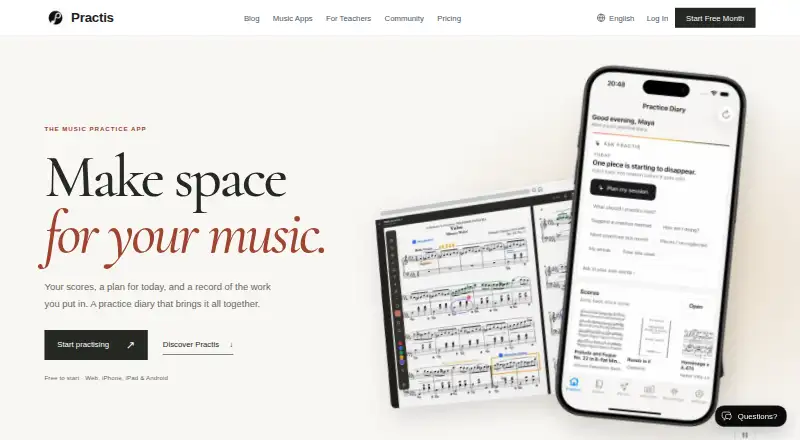
What Practis is
Practis is a music practice diary that brings scores, planning, and practice records into one place. Its Cue feature listens while you practise from a score and reports the passages you revisit and the time spent on them. You can upload PDF scores, add annotations and bookmarks, and use a metronome alongside the score. Repertoire tools help organise pieces, prepare recital or exam programs, and keep notes, progress, and practice history with each piece. For planning, Practis offers a timer, Pomodoro intervals, a practice coach, and a weekly plan. Tracking and goal setting cover any instrument, including voice. A free plan supports up to 5 active pieces, with a diary, history, streaks, daily and weekly goals, and limited Ask Practis. Pro monthly is $4.99 a month after the free first month; Pro yearly is $39.99 a year. Teacher plans add dashboards and teaching tools, with active student limits of 5, 10, or 30 depending on the tier. Practis is available on Android, iOS, and web.
Good
- Cue reports revisited passages and practice time.
- PDF scores support annotations, bookmarks, and metronome use.
- Repertoire records notes, progress, and practice history.
- Practice tools include timers and weekly plans.
- Supports tracking for any instrument, including voice.
Watch out
- Free plan is limited to 5 active pieces.
- Teacher plans cap active students at 5, 10, or 30.
- Pro monthly costs $4.99 a month after the free first month.
Who it suits
Practis suits musicians who want a place to plan practice, track progress, and organise scores and repertoire. Its teacher plans also suit instructors who need student and lesson management tools.
Verdict
Practis combines score tools, repertoire management, practice planning, and progress records for musicians. The free plan is limited to five active pieces, while paid and teacher plans offer expanded features.
Plans and prices
From Practis's own pricing page, checked 2 Oct 2026.
| Plan | Price | What it gives you |
|---|---|---|
| Free | Free | Up to 5 active pieces · practice diary, history, and streak · daily and weekly goals · limited Ask Practis |
| Pro (monthly) | $4.99 a month | Same features as yearly Pro · monthly plan includes 30 days of full Pro access · Monthly, after the free first month |
| Teacher Starter | $9.99 a month | Up to 5 students · invited students get Practis Pro free · teaching dashboard, prep view, recap loop, music-native assignments · Monthly |
| Teacher Studio | $14.99 a month | Up to 10 students · lesson scheduling, calendar, recurring lessons · practice history archive, recordings, feedback · Monthly |
| Pro (yearly) | $39.99 a year | Unlimited pieces and sessions · full Ask Practis with planning and scheduling · recordings, recaps, deadlines, smart suggestions · analytics, tempo trends, printable reports · score sync and performance heatmaps · Once a year |
| Teacher Pro | $39.99 a month | Up to 30 students · priority support and onboarding help · tools for large assignment and lesson volumes · Monthly |
| Academy | Priced on request | Unlimited students · multiple teachers · custom onboarding and data migration · institution-tailored billing |
The facts
Each one read from Practis's own pages, with the date it was checked.
What it does
- Cue
- Cue listens while a user practises from a score and reports which passages they returned to and how long they spent on them.checked 2 Oct 2026
- Instruments
- Practis supports practice tracking and goal setting for any instrument, including voice.checked 2 Oct 2026
- Integrations
- The pricing page states that Stripe handles paid plan billing and the Play Store handles billing on Android.checked 2 Oct 2026
- Payment and support
- Paid plans are billed through Stripe, Android subscriptions use Google Play billing, and Teacher Pro includes priority support and onboarding help.checked 2 Oct 2026
- Privacy contact and location
- The privacy policy identifies Pract.is at Mölker Gasse 4, Vienna, Austria, and lists [email protected] as its contact.checked 2 Oct 2026
- Purpose
- Practis brings scores, a practice plan, and a record of practice together in a music practice diary.checked 2 Oct 2026
- Repertoire
- Users can organise repertoire, prepare recital and exam programs, and keep notes, progress, and practice history with each piece.checked 2 Oct 2026
- Score tools
- Users can upload PDF scores, add annotations and bookmarks, and use a metronome alongside the score.checked 2 Oct 2026
- Security and privacy
- Pract.is says it uses technical and organizational measures to protect personal data and supports account deletion through app settings.checked 2 Oct 2026
- Teacher offering
- Teacher plans include a teaching dashboard, prep view, recaps, and music-focused assignments; higher tiers include lesson scheduling and practice history tools.checked 2 Oct 2026
Money
- Practice planning
- The app offers a timer, Pomodoro intervals, a practice coach, and a weekly plan.checked 2 Oct 2026
- Teacher plan limit
- Teacher plans cap active students at 5, 10, or 30 for the three priced tiers; the site says it does not automatically charge overages.checked 2 Oct 2026
The full review of Practis
Practis is a music practice diary that connects score work, repertoire, planning, and progress records. It is best suited to musicians who want one place to organise pieces and shape their practice, or teachers who need music-focused student tools. Its free plan is a useful starting point, but the five-piece cap makes Pro the practical choice for a larger repertoire.
Overview
Practis brings a score, a plan for working on it, and a record of practice into one workflow. Its Cue feature listens during score-based practice and reports which passages a player revisited and how long they spent on them, giving players a more specific record than a simple session log. It supports any instrument, including voice.
That combination makes Practis more compelling for musicians who want to connect practice habits to particular pieces than for someone seeking only a timer. Repertoire can include notes, progress, and practice history, and can be arranged into recital or exam programs. The main trade-off is that the free plan limits users to five active pieces.
Key features
- Score work: Upload PDF scores, annotate and bookmark them, and use a metronome alongside the score. These tools keep reference material close to practice, though the free plan's piece limit may constrain players with a broad working repertoire.
- Planning: A timer, Pomodoro intervals, a practice coach, and a weekly plan support both structured sessions and longer-term routines. Daily and weekly goals are included on Free.
- Practice records: The diary, history, and streak help track consistency; Cue adds passage-level detail by identifying returns to sections and time spent. This is useful for players who want to review how they allocate practice, not just whether they practised.
- Pro review tools: Pro includes recordings, recaps, deadlines, smart suggestions, analytics, tempo trends, printable reports, score sync, and performance heatmaps. That is a substantial step up for musicians who want richer progress review, rather than merely removing the piece cap.
- Teacher workspace: Teacher plans add a dashboard, prep view, recaps, and music-focused assignments. Studio adds scheduling, calendars, recurring lessons, archived practice history, recordings, and feedback; Pro is aimed at larger teaching volumes and adds priority support and onboarding.
Pricing
Practis is freemium, with a 30-day trial and paid plans from $4.99 a month. The Free plan costs 0.00 USD and includes up to five active pieces, a practice diary, history and streak, daily and weekly goals, and limited Ask Practis. It suits a focused repertoire or a trial of the workflow, but not players who need unlimited pieces or the full planning and review toolkit.
- Pro (monthly): $4.99 a month, billed monthly after the free first month. It provides the same features as yearly Pro and includes 30 days of full Pro access. This lowers the initial commitment, but costs more over a year than the annual option.
- Pro (yearly): $39.99 a year, billed once a year. It includes unlimited pieces and sessions, full Ask Practis with planning and scheduling, recordings, recaps, deadlines, smart suggestions, analytics, tempo trends, printable reports, score sync, and performance heatmaps. For an individual who expects to use Pro beyond the first month, this is the lower-cost paid route.
- Teacher Starter: $9.99 a month for up to five students. Invited students get Practis Pro free; the plan includes the dashboard, prep view, recap loop, and music-native assignments. It fits a small teaching roster that does not need lesson scheduling or the Studio history tools.
- Teacher Studio: $14.99 a month for up to 10 students, adding lesson scheduling, a calendar, recurring lessons, practice-history archives, recordings, and feedback. It is the better fit where lesson coordination and review are part of the teaching workflow.
- Teacher Pro: $39.99 a month for up to 30 students, with priority support, onboarding help, and tools for large assignment and lesson volumes. Practis says it does not automatically charge overages, so the cap matters more than surprise per-student charges.
- Academy: Custom pricing for unlimited students, multiple teachers, custom onboarding and data migration, and institution-tailored billing.
Paid plans are billed through Stripe, while Android subscriptions use Google Play billing. Teacher plans are priced around student capacity, so teachers should choose a tier that covers their active roster.
Platforms
Practis is available on web, iOS, and Android, giving musicians options across mobile and browser use. Android subscriptions are handled through Google Play billing.
Who it's for
Practis suits individual musicians who want score-aware practice records, repertoire organisation, and planning in one place. It is also a strong fit for teachers who want assignments and progress recaps tied to music, with higher tiers for scheduling and larger student groups. A player with only a few active pieces can start free; someone managing more than five should weigh Pro, while teachers should compare the student caps and workflow tools across the three priced tiers.
It is less suited to someone who needs only a basic practice timer, or to an individual unwilling to move beyond five active pieces but needing a larger repertoire.
Pros and cons
- Pro: Cue connects practice records to passages revisited and time spent, making the diary more informative than a session count alone.
- Pro: Scores, repertoire notes, programs, planning, and progress history sit within one music-focused workflow.
- Pro: Teacher plans scale from five to 30 students, and Practis says they do not automatically bill overages.
- Con: Free is capped at five active pieces, which can be restrictive for a player rotating through a larger repertoire.
- Con: The most complete progress-review and planning features are part of Pro, so Free is not a full-featured long-term option for users who need unlimited pieces or richer review.
- Con: Teachers who need scheduling, recurring lessons, or archived practice history must step up from Starter to Studio.
Alternatives
For a broader comparison, browse Music Practice Software.
- Modacity is worth comparing if its free plan's allowance of 10 practice items, two lists, and one folder better matches how you organise practice.
- Practice Space is another freemium option for web, iOS, and Android, with a Practice Space Plus plan that includes unlimited free student access.
- Exerzisor may suit someone who prefers a self-installed, free option and can handle deploying updates manually.
- MatchMySound is a web alternative with free teacher access for enrolled, active students; teachers may cover student fees.
- My Practice Canvas offers a free plan with one PDF up to 10 pages, YouTube loops, annotations, and a Practice Coach, making it a focused alternative for that workflow.
- Vivid Practice is a freemium option across web, iOS, and Android, with a free tier for one student and paid studio tiers.
- Better Practice is worth considering for musicians who want an individual plan and can use Android, iOS, macOS, web, or Windows.
- ChoirMate is another freemium option for web, iOS, and Android.
Verdict
Choose Practis if you want score-aware practice tracking joined to repertoire, planning, and progress review, or if you teach and need music-focused assignments and recaps. Its strongest reason to choose is that it ties practice records to the pieces and passages being worked on. Look elsewhere if five active pieces is enough for free but you need a lasting option without that cap, or if you need only a simpler practice timer.
Getting started
- Open the Practis website
- Choose the Free plan or a paid plan
- Use the web app or install Practis on Android or iOS
- Upload PDF scores and add annotations or bookmarks
- Organize repertoire and set practice goals
- Start sessions with the timer, metronome, or practice plan
Limits worth knowing
The Free plan allows up to five active pieces and provides limited Ask Practis. Teacher Starter, Teacher Studio, and Teacher Pro cap active students at 5, 10, and 30 respectively.
Questions
What does the Free plan include?
It is listed as free and includes up to five active pieces, a practice diary, history, streak, daily and weekly goals, and limited Ask Practis.
How much is Pro?
Pro monthly costs $4.99 a month after the free first month. Pro yearly costs $39.99 a year.
Which platforms does Practis support?
Practis is available on the web, Android, and iOS.
What do teacher plans provide?
Teacher plans include a teaching dashboard, preparation view, recaps, and music-focused assignments. Higher tiers add lesson scheduling, practice-history tools, recordings, feedback, priority support, or onboarding help.
How many students can teacher plans handle?
Teacher Starter supports up to 5 students, Teacher Studio up to 10, and Teacher Pro up to 30.
How are subscriptions billed?
Paid plans are billed through Stripe, while Android subscriptions use Google Play billing.
Alternatives to Practis
- 1

ChoirMate
Free planAndroidiOSWeb7.9From $4.99 a month - 2
Vivid Practice
Free planAndroidiOSWeb7.9From $90 a year - 3

MatchMySound
Free planAndroidWebAPIExtension7.6From $4.99 a month - 4
Instrumentive
AndroidiOSWebmacOS7.3From $17.49 a year - 5
Octero
Free planAndroidiOSWeb7.3From $5.99 a month - 6
Maestro Planner
Free planAndroidiOSWeb7.1From $10 a month