PouchDB
PouchDB is a free, open-source JavaScript database for applications that store data locally and sync with CouchDB or compatible servers.
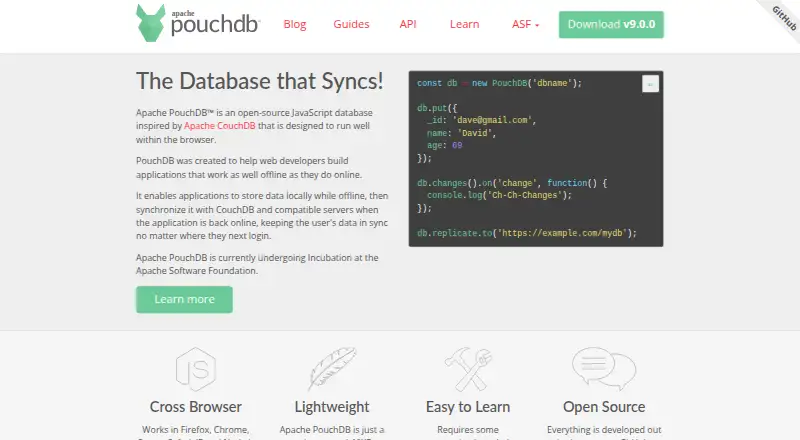
What PouchDB is
PouchDB is a free, open-source JavaScript database for applications that store data locally and sync with CouchDB or compatible servers. Applications can keep data available offline and synchronize local and remote databases after reconnecting. Its replication API can follow future changes and, when configured, retry after connection failures. PouchDB runs in browsers and Node.js, and can also be used in Cordova, PhoneGap, NW.js, Electron, and Chrome apps. It uses IndexedDB by default in browsers and LevelDB by default in Node.js. Documents can contain attachments such as images and audio, stored as base64 data or Blobs. The database includes a map/reduce API; Mango queries require the separate pouchdb-find plugin, which is not shipped by default. Its asynchronous API supports callbacks, promises, and async functions, and the project describes it as framework-agnostic, naming Angular, React, Ember, and Backbone as examples. Listed tested server support includes CouchDB 1.x, 2.x, and 3.x, Cloudant, and PouchDB Server. Replication requires a backend that speaks the CouchDB replication protocol. The project homepage says Apache PouchDB is undergoing incubation at the Apache Software Foundation.
Good
- Supports offline local storage and database synchronization
- Runs in browsers and Node.js
- Documents can include image and audio attachments
- Asynchronous API supports callbacks, promises, and async functions
Watch out
- Replication requires the CouchDB replication protocol
- Mango queries need a separate plugin
- Mango query plugin is not shipped by default
Who it suits
PouchDB suits JavaScript developers building applications that need local data storage and synchronization with compatible servers. It can be used across browser, Node.js, and listed app environments.
Verdict
PouchDB is suited to applications that need local-first data and synchronization with compatible servers. Developers should account for its replication protocol requirement and the separate plugin needed for Mango queries.
Plans and prices
From PouchDB's own pricing page, checked 8 Oct 2026.
| Plan | Price | What it gives you |
|---|---|---|
| Free and open source | Free | — |
The facts
Each one read from PouchDB's own pages, with the date it was checked.
What it does
- API
- PouchDB provides an asynchronous API that supports callbacks, promises, and async functions.checked 8 Oct 2026
- Attachments
- Documents can contain attachments such as images and audio files, stored as base64 data or Blobs.checked 8 Oct 2026
- Compatibility limit
- PouchDB cannot replicate with a backend that does not speak the CouchDB replication protocol.checked 8 Oct 2026
- Compatible servers
- The adapters page lists tested support for CouchDB 1.x, 2.x, and 3.x, Cloudant, and PouchDB Server.checked 8 Oct 2026
- Environments
- PouchDB runs in browsers and Node.js, and can be used in Cordova, PhoneGap, NW.js, Electron, and Chrome apps.checked 8 Oct 2026
- Integrations
- The project describes itself as framework-agnostic and names Angular, React, Ember, and Backbone as examples.checked 8 Oct 2026
- Offline use
- Applications can store data locally while offline and synchronize it when they reconnect.checked 8 Oct 2026
- Project status
- The homepage says Apache PouchDB is undergoing incubation at the Apache Software Foundation.checked 8 Oct 2026
- Purpose
- PouchDB is an open-source JavaScript database designed to store data locally and sync it with CouchDB and compatible servers.checked 8 Oct 2026
- Queries
- PouchDB includes a map/reduce API, while its Mango query API is available through a separate pouchdb-find plugin and is not shipped by default.checked 8 Oct 2026
- Replication
- Its replication API can sync local and remote databases, track future changes, and retry after connection failures when configured to do so.checked 8 Oct 2026
- Security and compliance
- The opened official pages describe HTTPS database URLs as supported but do not state a security certification or compliance standard.checked 8 Oct 2026
- Storage
- PouchDB uses IndexedDB in browsers by default and LevelDB in Node.js by default.checked 8 Oct 2026
- Storage limit
- The adapters page says Cordova SQLite can allow unlimited storage compared with IndexedDB and WebSQL storage limits.checked 8 Oct 2026
- Support
- The project homepage points users to GitHub Discussions, Slack, and Stack Overflow for discussion.checked 8 Oct 2026
The full review of PouchDB
Overview
PouchDB is an open-source JavaScript database for applications that need local data and synchronization across supported environments. It suits developers building offline-capable software around CouchDB-compatible servers. Its clearest advantage is local-first work without a subscription; its defining constraint is that synchronization requires the CouchDB replication protocol.
Key features
Applications can keep data on the device while offline and synchronize after reconnecting. PouchDB’s replication API can track later changes and retry after connection failures when configured, making it a practical fit for intermittent connectivity. It is not a protocol-neutral sync layer: a backend that does not speak CouchDB replication cannot participate.
In browsers, PouchDB uses IndexedDB by default; Node.js uses LevelDB. It also runs in Cordova, PhoneGap, NW.js, Electron, and Chrome apps. Cordova’s SQLite adapter can allow more storage than IndexedDB and WebSQL limits, which may matter to apps that retain substantial local data.
The built-in map/reduce API handles queries, while Mango queries require the separate pouchdb-find plugin. Teams that want Mango should plan for that dependency. Documents can include attachments such as images and audio, stored as base64 data or Blobs.
The asynchronous API supports callbacks, promises, and async functions. PouchDB describes itself as framework-agnostic and names Angular, React, Ember, and Backbone as examples, so teams can use it across those application frameworks rather than adopting a framework-specific database layer. Tested server support includes CouchDB 1.x, 2.x, and 3.x, Cloudant, and PouchDB Server.
Pricing
PouchDB is free and open source: the Free and open source plan costs nothing. There is no paid tier to weigh against a capped entry plan; this makes it a straightforward option for developers who want local storage and compatible-server replication without a software subscription.
The trade-off is architectural rather than tier-based: the free database does not remove the CouchDB protocol requirement, and Mango queries need an additional plugin. PouchDB is self-hosted, so teams should choose it for the database capabilities and deployment model, not for a managed service bundled into the plan.
Platforms
PouchDB supports Android, iOS, Linux, macOS, web, and Windows, as well as self-hosted deployment. Its browser and Node.js support, together with Cordova, PhoneGap, NW.js, Electron, and Chrome app environments, gives developers options across web and desktop-style applications. The default storage engine varies by runtime: IndexedDB in browsers and LevelDB in Node.js.
Who it's for
PouchDB is a strong fit for developers who need applications to remain usable offline, then synchronize local and remote data when connectivity returns. It is especially appropriate when the server is CouchDB, Cloudant, or PouchDB Server, and when map/reduce queries meet the application’s needs.
Look elsewhere if the backend cannot use CouchDB replication, or if Mango queries must be available without adding a plugin. The project points users to GitHub Discussions, Slack, and Stack Overflow for discussion. Its homepage says Apache PouchDB is undergoing incubation at the Apache Software Foundation. HTTPS database URLs are supported; the project’s official pages do not state a security certification or compliance standard.
Pros and cons
- Offline storage with synchronization: applications can continue working locally and sync after reconnecting, with configurable retries after connection failures.
- Free and open source: the plan costs nothing, with no subscription tier to budget for.
- Multiple storage and runtime options: browser IndexedDB, Node.js LevelDB, and the Cordova SQLite option accommodate different environments and storage needs.
- Protocol-bound replication: servers must speak CouchDB replication, ruling out incompatible backends.
- Mango is a separate dependency: the query API is not included by default, so teams seeking Mango must add pouchdb-find.
Alternatives
Apache CouchDB is worth considering when the goal is a free, self-hosted CouchDB database on servers or VMs, either as a single node or in a cluster, rather than a JavaScript database embedded in an application.
JayDB may fit readers seeking a database with a freemium plan and a published free allowance of 1 GB stored, 100,000 reads per month, and 10,000 writes per month.
RavenDB is another document database option, with Developer and Community plans described in terms of cores, RAM, and nodes.
eXist-db offers a free, open-source option for academic, non-commercial, and commercial applications.
MarkLogic is an alternative with a Developer plan for up to 1 TB of data and noncommercial use, plus an Enterprise plan.
Azure DocumentDB may suit readers comparing cluster-based plans, including a Free Tier with 32 GB of storage and one free database server per subscription.
BaseX is a free, open-source option for teams able to use Java 17 or higher.
DocumentDB is a free, MIT-licensed open-source database that can be run locally with Docker or installed using Linux packages.
Browse more options in Document Databases or Embedded Databases.
Verdict
Choose PouchDB for an offline-capable JavaScript application when local data and synchronization with a CouchDB-compatible server are central requirements. It delivers that model for free across several runtimes. Choose another approach if your backend cannot speak CouchDB replication or you need Mango queries without a separate plugin.
Getting started
- Visit https://pouchdb.com/.
- Choose a supported environment such as a browser or Node.js.
- Use the default browser storage adapter, IndexedDB, or the Node.js default, LevelDB.
- Connect replication to a server that speaks the CouchDB replication protocol.
- Use the map/reduce API, or add the separate pouchdb-find plugin for Mango queries.
Questions
How much does PouchDB cost?
PouchDB is free and open source. The listed Free and open source plan is free.
Which platforms and environments does it support?
It runs in browsers and Node.js and can be used in Cordova, PhoneGap, NW.js, Electron, and Chrome apps. Listed platforms include Android, iOS, Linux, macOS, self-hosted, web, and Windows.
Can PouchDB work offline?
Yes. Applications can store data locally while offline and synchronize after reconnecting.
Which servers can it synchronize with?
Listed tested support includes CouchDB 1.x, 2.x, and 3.x, Cloudant, and PouchDB Server. The backend must speak the CouchDB replication protocol.
Does PouchDB include Mango queries?
No. It includes a map/reduce API; Mango queries are available through the separate pouchdb-find plugin.
What storage does it use?
IndexedDB is the default in browsers, and LevelDB is the default in Node.js. Cordova SQLite can allow unlimited storage compared with IndexedDB and WebSQL limits.
Alternatives to PouchDB
- 1

JayDB
Free planOpen sourceAndroidiOSWebAPI8.4Free plan - 2

Firestore
Free planAndroidiOSWebAPI8.1$0.03 usage-based - 3

RethinkDB
Free planOpen sourceWebAPILinuxmacOS7.4Free plan - 4
restdb.io
Free planAndroidiOSWebAPI7.2From $19 a month - 5

Amazon DocumentDB
WebAPI7.1 - 6
UnQLite
Free planAPILinuxmacOSSelf-hosted7.0From $15,000 a year