
Apache CouchDB
Apache CouchDB is a document database that stores named documents and lets applications read and update them through a RESTful HTTP API.
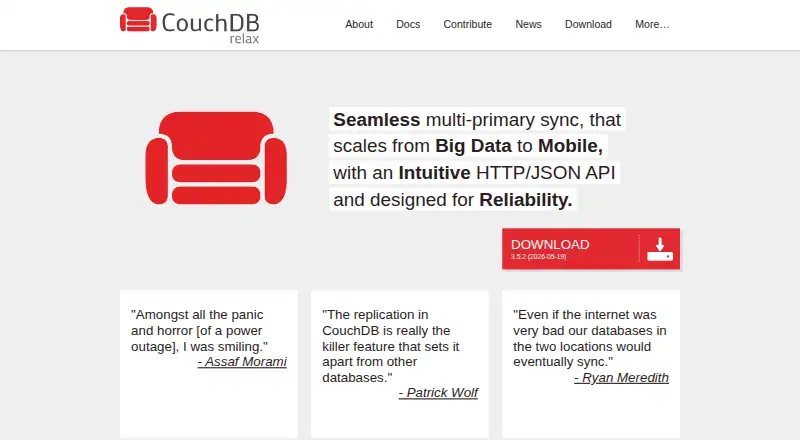
What Apache CouchDB is
Apache CouchDB is a document database that stores named documents and lets applications read and update them through a RESTful HTTP API. Documents can hold fields and attachments, and do not need to follow a fixed schema. CouchDB includes a query engine, with views defined using JavaScript map functions and optional reduce functions.
Its incremental replication can synchronize databases in both directions between peers, including after a connection has been interrupted. The project describes this capability as a way to support offline-first applications across servers, phones, and browsers; PouchDB can replicate data with CouchDB from mobile devices and web browsers. A cluster can present one logical database across multiple servers or virtual machines for additional capacity and high availability.
CouchDB is free, self-hosted software under the Apache License 2.0. It uses an append-only file design, with document updates described as ACID and all-or-nothing. Security features include administrator accounts, basic and cookie authentication, reader access controls, and JavaScript-based validation of document updates. Conflicting revisions can be resolved manually or automatically.
Good
- Documents allow fields and attachments without a fixed schema.
- Supports bidirectional, incremental replication between peers.
- Clusters can provide higher capacity and high availability.
- Includes authentication, access controls, and update validation.
Watch out
- Requires self-hosting on servers or virtual machines.
- Conflicting document revisions may need resolution.
Who it suits
CouchDB suits developers who need a flexible document database and replication between connected or intermittently connected peers. It is also suited to teams able to host and manage database servers or virtual machines.
Verdict
CouchDB combines a flexible document model with replication, clustering, and configurable access controls. Its self-hosted deployment makes server management part of the choice.
Plans and prices
From Apache CouchDB's own pricing page, checked 3 Oct 2026.
| Plan | Price | What it gives you |
|---|---|---|
| Apache CouchDB | Free | Open-source database software · self-hosted on servers or VMs · single-node or cluster |
The facts
Each one read from Apache CouchDB's own pages, with the date it was checked.
What it does
- Clustering
- A CouchDB cluster can run one logical database server across multiple servers or virtual machines, with higher capacity and high availability.checked 3 Oct 2026
- Conflict handling
- Replicas can retain conflicting document revisions, and CouchDB supports manual or automated conflict resolution.checked 3 Oct 2026
- Document model
- Documents can contain fields and attachments, and CouchDB does not require a fixed schema.checked 3 Oct 2026
- Integrations
- PouchDB is built for mobile devices and web browsers and can replicate data with CouchDB.checked 3 Oct 2026
- License
- The Apache CouchDB website identifies the software as licensed under the Apache License 2.0.checked 3 Oct 2026
- Querying
- CouchDB includes a query engine and supports views built with JavaScript map functions and optional reduce functions.checked 3 Oct 2026
- Reliability
- CouchDB uses an append-only file design, and its documentation describes document updates as ACID and all-or-nothing.checked 3 Oct 2026
- Replication
- CouchDB synchronizes databases incrementally and supports bidirectional replication between peers, including after periods of disconnection.checked 3 Oct 2026
- Security
- CouchDB provides administrator accounts, basic and cookie authentication, reader access controls, and JavaScript document-update validation that can enforce custom security rules.checked 3 Oct 2026
- Support
- The project offers a user mailing list described as a general discussion and support forum for CouchDB users.checked 3 Oct 2026
- What it does
- Apache CouchDB is a document database that stores named documents and provides a RESTful HTTP API for reading and updating them.checked 3 Oct 2026
The company
- Founded
- 2008checked 28 Sep 2026
- Project founded
- The Apache Software Foundation records the Apache CouchDB project as founded on 2008-11-19.checked 3 Oct 2026
Money
- Free plan
- Yeschecked 22 Sep 2026
Where it runs
- Offline applications
- The project describes replication between CouchDB server clusters, mobile phones, and web browsers as enabling offline-first applications.checked 3 Oct 2026
- Platforms
- The project lists downloads for Windows x64, macOS, Debian, Ubuntu, RHEL, and CentOS, as well as source releases.checked 3 Oct 2026
The full review of Apache CouchDB
Apache CouchDB is a self-hosted document database for teams that need flexible JSON records, binary attachments, and synchronization across devices or servers that may disconnect. It is most compelling for offline-capable applications and organizations prepared to operate their own infrastructure; teams wanting a managed database should look elsewhere.
Overview
CouchDB stores named documents and exposes a RESTful HTTP API for reading and updating them. Documents can use different fields and include binary attachments, so a fixed schema is not required as records evolve. That flexibility helps prototypes and applications with varied data, but it also leaves your team responsible for maintaining coherent document structures.
Replication works incrementally and in both directions between peers, including after an outage or period offline. Servers, mobile phones, and browsers can participate in an offline-first design, with PouchDB providing a browser- and mobile-oriented companion that replicates with CouchDB. Replication can preserve conflicting revisions, so applications need a deliberate manual or automated conflict-resolution policy.
Key features
Documents, queries and transactions
The query engine supports views written with JavaScript map functions and optional reduce functions. This is a practical model for applications whose access patterns can be expressed through prebuilt views and summaries. It is less suitable for teams that expect a different querying style or want the database to impose a rigid relational structure. Document updates are described as ACID and all-or-nothing, providing transactional reliability for individual document changes.
Replication and clustering
Bidirectional, incremental synchronization is CouchDB’s defining advantage. It reduces the need for constant connectivity and allows peers to catch up efficiently, but conflict retention means synchronization is not the same as automatic agreement. A cluster can present one logical database across multiple servers or virtual machines, increasing capacity and availability. Clustering improves the platform’s fit for larger deployments, while adding operational complexity that smaller teams may not need.
Security and durability
An append-only file design supports CouchDB’s durability model. Administrator accounts, basic and cookie authentication, reader access controls, and JavaScript document-update validation provide several ways to restrict access and enforce custom rules. These controls are useful when application-specific validation matters, although self-hosting still makes configuration and ongoing administration your responsibility.
Pricing
Apache CouchDB — free
The free, open-source plan includes the database software for self-hosting on servers or virtual machines, either as a single node or a cluster. There is no paid tier, trial period, seat charge, storage quota, or hosted-service allowance in this plan. The price advantage is substantial for organizations able to supply infrastructure and database administration; it does not remove those operating costs or the work of designing replication and conflict handling.
Platforms
CouchDB supports API access and runs on Linux, macOS, and Windows, with deployment on self-hosted infrastructure and use through the web. Its replication model also extends to mobile and browser applications through PouchDB, making it suitable for distributed clients as well as conventional server deployments.
Who it's for
CouchDB is a strong choice for developers building offline-first software, field applications, or distributed systems where peers must synchronize after disconnection. It also suits teams that value schema flexibility, JSON documents, and open-source licensing and can operate servers or virtual machines.
Look elsewhere if you want a fully managed database, a provider to absorb operational maintenance, or a data model that avoids application-level conflict decisions. CouchDB’s flexibility and replication are advantages only when your architecture and team can use them deliberately.
Pros and cons
- Pro: Flexible JSON documents and binary attachments accommodate records that vary or change without migrations imposed by a fixed schema.
- Pro: Incremental, bidirectional replication supports offline operation across servers, browsers, and mobile clients.
- Pro: Clustering can combine multiple servers or virtual machines into one logical database with higher capacity and availability.
- Pro: Open-source Apache License 2.0 software has no license fee or plan quotas.
- Con: Self-hosting makes infrastructure, upgrades, security configuration, and availability your responsibility.
- Con: Conflicting revisions can remain in replicas, requiring application-defined manual or automated resolution.
- Con: JavaScript view-based querying favors known access patterns and may not suit every analytical or data-modeling requirement.
Alternatives
PouchDB is the natural alternative when your priority is a browser- or mobile-focused local database that replicates with CouchDB.
JayDB is worth considering when you want a freemium option with a free plan and published monthly read, write, and storage allowances.
RavenDB offers developer and community plans if those editions’ stated node, core, and memory limits fit your deployment.
eXist-db is another free, open-source database for academic, non-commercial, or commercial use.
MarkLogic is an alternative when a freemium product with a free trial and developer or enterprise editions matches your needs.
Azure DocumentDB suits teams seeking a cloud-oriented option with a free cluster tier and a stated 32 GB allowance.
BaseX is a free open-source choice for deployments that can meet its Java 17-or-higher requirement.
DocumentDB is a free MIT-licensed database that can run locally through Docker or Linux packages.
For broader comparisons, see Document Databases and Database Software.
Verdict
Choose Apache CouchDB for an offline-capable, self-hosted application whose flexible documents and two-way replication justify operational ownership. Its strongest reason to choose it is reliable synchronization across intermittently connected peers; its main reason to look elsewhere is the need to run the infrastructure and resolve replicated conflicts yourself.
Alternatives to Apache CouchDB
- 1

JayDB
Free planOpen sourceAndroidiOSWebAPI8.4Free plan - 2

Firestore
Free planAndroidiOSWebAPI8.1$0.03 usage-based - 3

RethinkDB
Free planOpen sourceWebAPILinuxmacOS7.4Free plan - 4
restdb.io
Free planAndroidiOSWebAPI7.2From $19 a month - 5

Amazon DocumentDB
WebAPI7.1 - 6
UnQLite
Free planAPILinuxmacOSSelf-hosted7.0From $15,000 a year