RavenDB
RavenDB is a schema-less NoSQL document database for storing JSON documents and binary attachments.
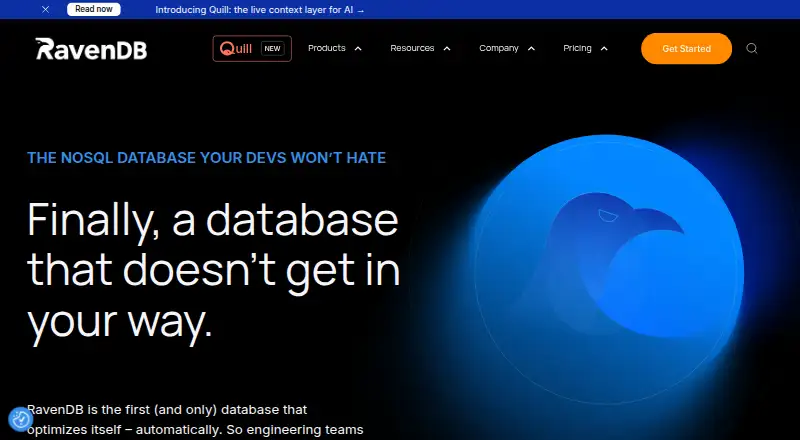
What RavenDB is
RavenDB is a schema-less NoSQL document database for storing JSON documents and binary attachments. It automatically creates and optimizes indexes, and offers cloud, on-premises, and Edge deployments. Its listed data capabilities include full-text, spatial, and vector search, along with time series, counters, and document revisions. RavenDB also supports AI integrations for summarization, classification, enrichment, and tagging in database workflows. For availability, it lists clustering, sharding, failover, and cluster-wide transactions. Developer clients include C++, PHP, C#, Java, Node.js, Python, Ruby, and Go, with integrations such as SQL Server, Kafka, Snowflake, Power BI, AWS, Azure, Docker, and Kubernetes. Security offerings listed include X.509 certificates, TLS 1.3, storage encryption, and encrypted backups. RavenDB was founded in 2010 and is headquartered in Hadera, Israel. A free Community license is available, subject to limits on cores, cluster size, and memory, and requires the latest major version with periodic renewal. Prices are not listed for its plans.
Good
- Automatically creates and optimizes indexes.
- Offers cloud, on-premises, and Edge deployments.
- Includes full-text, spatial, and vector search.
- Lists clustering, sharding, failover, and cluster-wide transactions.
- Free Community license is available.
Watch out
- Community license has core, cluster, and memory limits.
- Community license requires the latest major version.
- Community license requires periodic renewal.
- Plan prices are not listed.
Who it suits
RavenDB suits developers and organizations looking for a document database with multiple deployment options, search features, and client support across several programming languages. Its Community license may suit those within its core, cluster, and memory limits.
Verdict
RavenDB combines document storage with search, AI integrations, and availability features across several deployment options. Check the Community license limits and renewal requirements before choosing it.
Plans and prices
From RavenDB's own pricing page, checked 30 Sep 2026.
| Plan | Price | What it gives you |
|---|---|---|
| Community | Free | Free · commercial use · unlimited databases and database sizes · 60 cores per customer entity · latest major version required · renew yearly |
| Developer | Free | Free · development, CI and QA only (not production, staging or UAT) · 9 cores · 36 GB RAM · 3 nodes · renew every 6 months |
| AI | Priced on request | Contact sales for a quote · on-prem license · includes AI capabilities |
| Cloud | Priced on request | Free, developer, or production tiers are offered; cloud pricing page requires JavaScript |
| Enterprise | Priced on request | Contact sales for a quote · on-prem license · license limits apply; page lists maximum cluster size of 6 |
| Professional | Priced on request | Contact sales for a quote · on-prem license · license limits apply; page lists maximum cluster size of 5 |
The facts
Each one read from RavenDB's own pages, with the date it was checked.
What it does
- AI
- RavenDB supports AI integrations for LLM-driven summarization, classification, enrichment, and tagging within database workflows.checked 30 Sep 2026
- Data features
- The feature page lists full-text, spatial, and vector search, time series, counters, attachments, and document revisions.checked 30 Sep 2026
- Deployment
- RavenDB is available as cloud, on-premises, and Edge deployments.checked 30 Sep 2026
- Developer clients
- The feature page lists client support for C++, PHP, C#, Java, Node.js, Python, Ruby, and Go.checked 30 Sep 2026
- High availability
- RavenDB lists clustering, sharding, failover, and cluster-wide transactions among its features.checked 30 Sep 2026
- Integrations
- Listed integrations include SQL Server, PostgreSQL, MySQL, Elasticsearch, Kafka, RabbitMQ, Snowflake, Power BI, AWS, Azure, GCP, Docker, and Kubernetes.checked 30 Sep 2026
- Product
- RavenDB describes itself as a schema-less NoSQL document database that automatically creates and optimizes indexes.checked 30 Sep 2026
- Security
- RavenDB lists X.509 certificates, TLS 1.3, storage encryption, encrypted backups, ISO/IEC 27001:2022, SOC Type II and Type III, and HIPAA on its security and trust pages.checked 30 Sep 2026
- Support
- RavenDB says support requests are handled through paid support plans, with professional and production options listing email and phone support and SLA details.checked 30 Sep 2026
- Vector search
- Yeschecked 22 Sep 2026
The company
- Company history
- RavenDB says RavenDB 1.0 shipped in 2010 and identifies RavenDB Ltd in its site footer.checked 30 Sep 2026
- Founded
- 2010checked 28 Sep 2026
- Headquarters
- Hadera, Israelchecked 28 Sep 2026
Where it runs
- Download platforms
- The download page offers packages for Windows, macOS, Linux, Ubuntu, Raspberry Pi, and Docker.checked 30 Sep 2026
Money
- Free license limits
- The Community license is limited to 60 cores per customer entity, including subsidiaries, requires the latest major version, and is valid for one year with periodic renewal.checked 30 Sep 2026
- Free plan
- Yeschecked 22 Sep 2026
The full review of RavenDB
Overview
RavenDB is a schema-less NoSQL database for JSON documents and binary attachments, with automatic index creation and optimization. It suits teams that need search, distributed availability, or several deployment choices alongside document storage. Its breadth is a strength, but the Community license’s cluster caps and renewal conditions deserve attention before adoption.
Cloud, on-premises, and Edge deployments give teams flexibility over where the database runs. The feature set includes transactions, full-text, spatial, and vector search, plus time series, counters, and document revisions. RavenDB also offers AI integrations for applying LLM-driven summarization, classification, enrichment, and tagging within database workflows.
Support requests go through paid support plans; professional and production options include email and phone support with SLA details. For teams that need that support, it is a meaningful part of the commercial decision rather than an incidental extra.
Key features
Search, indexing, and data
Automatic index creation and optimization reduce the need to manage indexes manually, while full-text, spatial, and vector search make RavenDB relevant to more than basic document retrieval. Time series, counters, attachments, and revisions add varied data-handling options. That range may be useful in a database-centered workflow, though buyers should weigh it against their actual requirements rather than choosing on feature count alone.
Availability, security, and integrations
Clustering, sharding, failover, and cluster-wide transactions support deployments that need distributed operation and availability. Security features include X.509 certificates, TLS 1.3, storage encryption, and encrypted backups; RavenDB also cites ISO/IEC 27001:2022, SOC Type II and Type III, and HIPAA. Listed integrations span SQL Server, PostgreSQL, MySQL, Elasticsearch, Kafka, RabbitMQ, Snowflake, Power BI, AWS, Azure, GCP, Docker, and Kubernetes. Client support covers C++, PHP, C#, Java, Node.js, Python, Ruby, and Go.
Pricing
The Developer plan allows 9 cores, 36 GB RAM, and 3 nodes, making it a bounded option for development workloads. The Community license permits up to 60 cores per customer entity, including subsidiaries, but clusters are limited to 3 nodes, 3 cores per cluster, and 6 GB RAM per cluster. It also requires the latest major version and lasts one year with periodic renewal, so it is not a set-and-forget license.
Professional and Enterprise are commercial, per-core license tiers; they may suit organizations evaluating paid licensing, but the per-core model makes workload size relevant to cost. The AI plan is a commercial AI license tier. Cloud includes 1 GB of monthly backup storage, so teams should account for that cap when considering the hosted option. Each of these plans has custom pricing.
Platforms
RavenDB supports API, Linux, macOS, self-hosted, web, and Windows environments. Download packages are offered for Windows, macOS, Linux, Ubuntu, Raspberry Pi, and Docker. The combination of managed cloud and self-hosted deployments gives teams a choice between hosted operations and control over their own environment.
Who it's for
RavenDB is a strong candidate for teams building around document data that also need search, transactions, and options for clustering or sharding. Its client support across several languages and integrations with database, messaging, analytics, and cloud services may help fit it into varied stacks. Teams seeking LLM-driven enrichment within database workflows may also find its AI integrations relevant.
It is less compelling for buyers who need simple, unrestricted free licensing: Community has per-cluster resource limits, requires the latest major version, and must be renewed periodically. Organizations that need support should also account for paid support plans.
Pros and cons
- Pros: Automatic index creation and optimization can reduce manual index management for schema-less document workloads.
- Pros: Full-text, spatial, and vector search, plus time series and revisions, cover varied data needs in one database.
- Pros: Cloud, on-premises, and Edge deployments provide flexibility over where it runs.
- Pros: Clustering, sharding, failover, and cluster-wide transactions address distributed-operation needs.
- Cons: Community clusters are capped at 3 cores and 6 GB RAM each, even though the customer-entity allowance reaches 60 cores.
- Cons: The Community license requires the latest major version and periodic renewal after one year.
- Cons: Paid support is required for support requests, and commercial licensing is per-core.
- Cons: Cloud's 1 GB monthly backup-storage allowance may be limiting for larger backup needs.
Alternatives
Choose Apache CouchDB if a free, self-hosted database is the priority; its listed plan costs nothing. MarkLogic is another freemium option, with a Developer plan allowing up to 1TB of data for noncommercial use and an Enterprise tier. Consider Firestore when Android or iOS support matters, with listed daily allowances of 50,000 document reads and 20,000 document writes in Standard edition. Oracle Autonomous AI Lakehouse has an Always Free option for an unlimited time, subject to capacity limits. SurrealDB offers a self-hosted Start plan at no cost, with usage-based charges and 1GB of storage free forever for the first instance. Pick Couchbase Lite if its listed Couchbase Mobile package, including Sync Gateway licensing, peer-to-peer syncing, SQL++ and full-text search, and vector search, better fits your needs. eXist-db and BaseX are also free database options.
Compare RavenDB with Document Databases, Spatial Databases, Multimodel Databases, and Database Software.
Verdict
Choose RavenDB if you need a document database that combines broad search, AI workflow integrations, transactions, and distributed availability across hosted and self-managed deployments. Its main trade-offs are the Community cluster caps and renewal requirements, custom-priced commercial tiers, and paid support; readers who need a simpler free, self-hosted option should consider Apache CouchDB instead.
Getting started
- Visit https://ravendb.net/.
- Choose a deployment: cloud, on-premises, or Edge.
- For a local download, select a package for Windows, macOS, Linux, Ubuntu, Raspberry Pi, or Docker.
- Choose a plan, noting the Community license conditions.
Limits worth knowing
The Community license is limited to 60 cores per customer entity, including subsidiaries. Its cluster maximum is three nodes, three cores per cluster, and 6 GB RAM per cluster; it requires the latest major version and is valid for one year with periodic renewal.
Questions
Is RavenDB free?
A free Community license is available. It has core, cluster, RAM, version, and renewal conditions.
Where can RavenDB be deployed?
RavenDB is available as a cloud, on-premises, or Edge deployment.
What search types does RavenDB offer?
Listed search capabilities include full-text, spatial, and vector search.
Which programming languages have client support?
Listed clients support C++, PHP, C#, Java, Node.js, Python, Ruby, and Go.
What support is available?
Support requests are handled through paid support plans. Professional and production options list email and phone support with SLA details.
What security and compliance items does RavenDB list?
Its security pages list X.509 certificates, TLS 1.3, storage encryption, encrypted backups, ISO/IEC 27001:2022, SOC Type II and III, and HIPAA.
Alternatives to RavenDB
- 1

JayDB
Free planOpen sourceAndroidiOSWebAPI8.4Free plan - 2

Firestore
Free planAndroidiOSWebAPI8.1$0.03 usage-based - 3

RethinkDB
Free planOpen sourceWebAPILinuxmacOS7.4Free plan - 4
restdb.io
Free planAndroidiOSWebAPI7.2From $19 a month - 5

Amazon DocumentDB
WebAPI7.1 - 6
UnQLite
Free planAPILinuxmacOSSelf-hosted7.0From $15,000 a year